
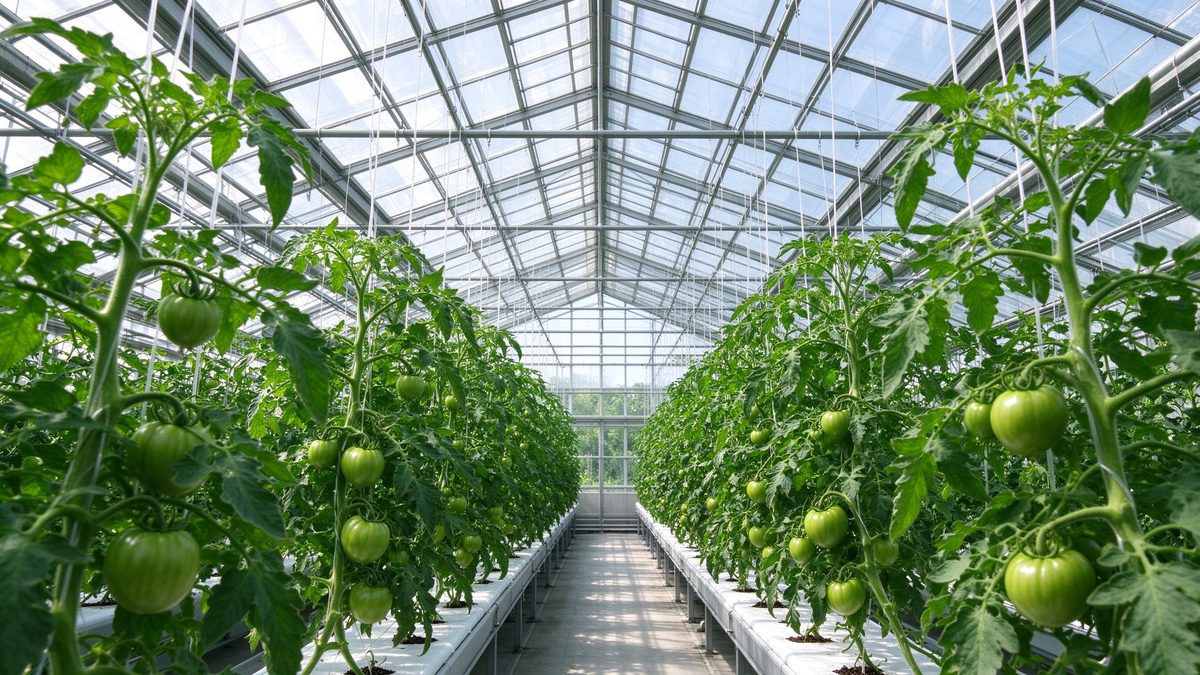
The Case for Proximity
Urban and peri-urban greenhouses place production close to the consumers who eat the produce. The immediate benefits are logistical: shorter transport, fresher product, lower spoilage, and the ability to harvest to order rather than to forecast.
The model also changes the relationship with buyers. Restaurants, retailers, and community groups near the greenhouse can visit, taste, and commit to volumes in advance. That visibility supports premium pricing for freshness and provenance, which are the two attributes urban consumers value most.

Site Constraints and Design Responses
Urban sites are small, expensive, and often awkward: rooftops, former industrial land, car parks, and narrow infill plots. Structures must be compact, modular, and light. Rooftop installations require structural assessment and careful load distribution.
Access drives design more than climate does. A greenhouse that cannot be reached by a delivery vehicle, or that requires produce to be carried down four flights, loses its logistical advantage. Layout planning should begin with the route produce takes to the customer.
Growing Systems Suited to Small Sites
Small footprints favour high-value, fast-cycle crops: leafy greens, herbs, microgreens, strawberries, and edible flowers. Hydroponic and substrate systems suit these crops and reduce weight compared with soil-based benches.
Vertical stacking multiplies output per square metre but increases energy demand for lighting. The economics depend on local electricity prices and crop value. Many successful urban operations combine a greenhouse for natural-light crops with a small controlled chamber for high-value propagation or microgreens.

Community and Regulatory Dimensions
Urban agriculture often requires engagement with planning authorities, particularly for rooftop structures, water connections, and waste discharge. Early consultation prevents delays that can exceed construction time.
Community involvement is both a market and a risk buffer. Schools, restaurants, and local groups that buy from an urban greenhouse become advocates when planning questions arise. Demonstration and education activities can add revenue alongside produce sales.
Educational programming, volunteer days, and supply agreements with local schools convert a production facility into a community asset. That status is commercially valuable: it supports premium pricing, secures planning permission, and provides a labour pool that rural operations struggle to attract.
Urban greenhouses operate in a social context that rural farms do not. Neighbours notice lighting, deliveries, and noise. Early engagement, transparent communication, and visible benefit to the local area reduce friction and build the goodwill that sustains the operation through planning reviews and expansion.
Community Engagement as Infrastructure
Successful urban operations concentrate on freshness premiums: herbs, edible flowers, specialty lettuce, and strawberries sold within hours of harvest to customers who value provenance. Where land and power are cheaper, the same crops are better grown at the urban fringe and delivered in.
Urban sites usually pay commercial or industrial electricity rates, and rooftop installations face higher structural and access costs. These penalties mean low-value, high-volume crops rarely work in cities. The crop mix must justify the location.
Energy and Economic Realities
Urban greenhouse projects succeed or fail on their commercial model long before their horticultural technique is tested. A well-grown crop without a committed local buyer is a costly hobby. Conversely, a modest facility with strong restaurant and retail relationships can operate profitably at small scale. Market development, not growing skill, is usually the limiting factor in cities.
Finally, urban production benefits from starting small and proving the model before scaling. A single compact greenhouse serving a handful of committed customers generates the operating data, market relationships, and community credibility that larger projects require. Expanding on that foundation is far safer than committing capital to a large facility before any of those three assets exist. Shouguang Zhongtian supplies modular systems that allow exactly this staged approach.
Conclusion
Urban greenhouses succeed when they are designed around logistics and market proximity rather than around maximum yield per square metre. Shouguang Zhongtian supplies compact modular greenhouse systems suited to constrained urban sites, with hydroponic and substrate options for high-value crops.


