
The Hidden Cost of Infestation
Root-knot nematodes invade roots and force the plant to build galls instead of functioning root tissue. Above ground, the symptom is a slow, uneven crop: plants that wilt at midday, grow smaller, and yield progressively less across the season.
In protected systems the problem compounds, because soil is never rested and nematode populations build with every cycle. By the time symptoms are obvious, densities are high enough that a single control measure rarely restores full yield.

Detection Before Symptoms
Nematode problems are diagnosed by looking at roots, not at leaves. At the end of a crop, lift a sample of plants from several blocks and inspect the root systems for galls; the pattern of distribution across blocks indicates how far the infestation has spread.
Soil sampling before planting guides decisions for the coming cycle. Counting juveniles in soil, or using a laboratory assay, costs little compared with the yield loss from an untreated infestation discovered six weeks too late.
Grafting and Resistant Rootstocks
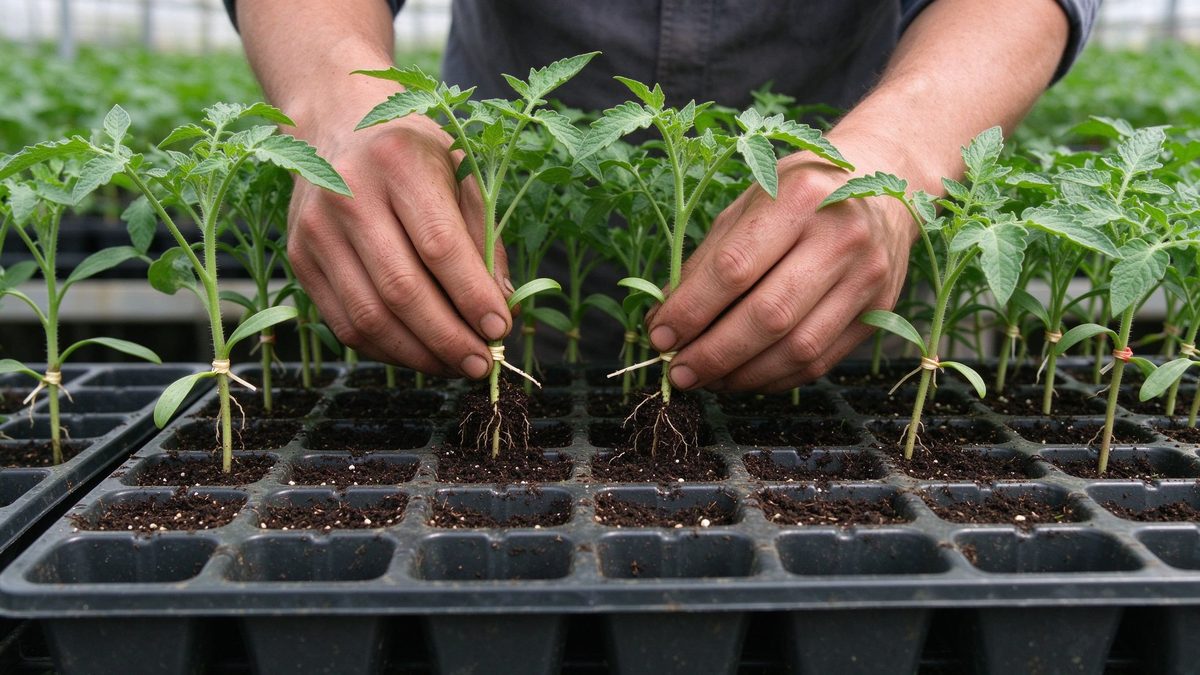
Resistant rootstocks are the most reliable cultural tool available. Tomato rootstocks carrying resistance to Meloidogyne species are widely available, and grafted plants maintain yield on land where susceptible varieties collapse.
Resistance is not immunity, and rootstocks differ in which species they suppress. Knowing the nematode species present, through laboratory identification, allows a rootstock to be chosen deliberately rather than by marketing claims. Population density also matters, because high pressure can overcome partial resistance.

Cultural and Biological Measures
Rotation within protected systems is difficult but not impossible. Including a non-host crop for even a short cycle interrupts reproduction, and soil solarization during a hot fallow period reduces populations substantially.
Organic matter and biological products support root health rather than eradicating nematodes. Compost improves soil structure and increases the diversity of antagonistic organisms, and commercial preparations of nematophagous fungi or bacteria provide suppressive pressure when applied consistently over several seasons.
Chemical Options and Their Limits
Where chemicals remain available, they are contact or fumigant products with narrow windows of efficacy and significant handling requirements. Their reliability is lower than growers expect, because nematodes survive in soil zones that treatment does not reach.
Treating chemistry as a rescue tool rather than a plan is the realistic approach. It buys a season while cultural measures are established, and it should not be relied on repeatedly, because repeated use selects for tolerance and increases cost without improving control.
Quarantine practice protects the whole operation. Nematodes move in soil on machinery, boots, crates and seedling trays, so cleaning equipment between blocks, restricting movement from known-infested areas, and sourcing clean transplants are the cheapest controls available. They cost attention rather than money, and they prevent the spread that makes every later measure more expensive.
Water and nutrient management interacts with infestation. Damaged root systems cannot absorb at the rate the irrigation schedule assumes, so infested zones show higher drain volumes and lower substrate conductivity than healthy areas with the same input. That discrepancy is a useful diagnostic signal before root inspection confirms it.
Yield loss from nematodes is usually expressed as a percentage averaged across a block, which hides the pattern. Damage concentrates in patches, and those patches expand each season along the direction of cultivation and irrigation flow, so a modest average loss can conceal a zone where plants are barely productive.
Variety resistance is the foundation of any programme. Resistant rootstocks and resistant varieties reduce multiplication inside the root, and combining them with clean planting material and rotation gives the plant a buffer that no single treatment can provide on its own.
Conclusion
Nematode control is a multi-season strategy, not a spray decision. Identify the species, graft onto resistant roots, and rebuild soil biology. Shouguang Zhongtian supports growers with grafted seedling programmes and greenhouse systems that make fallow treatments and substrate conversion practical.


