
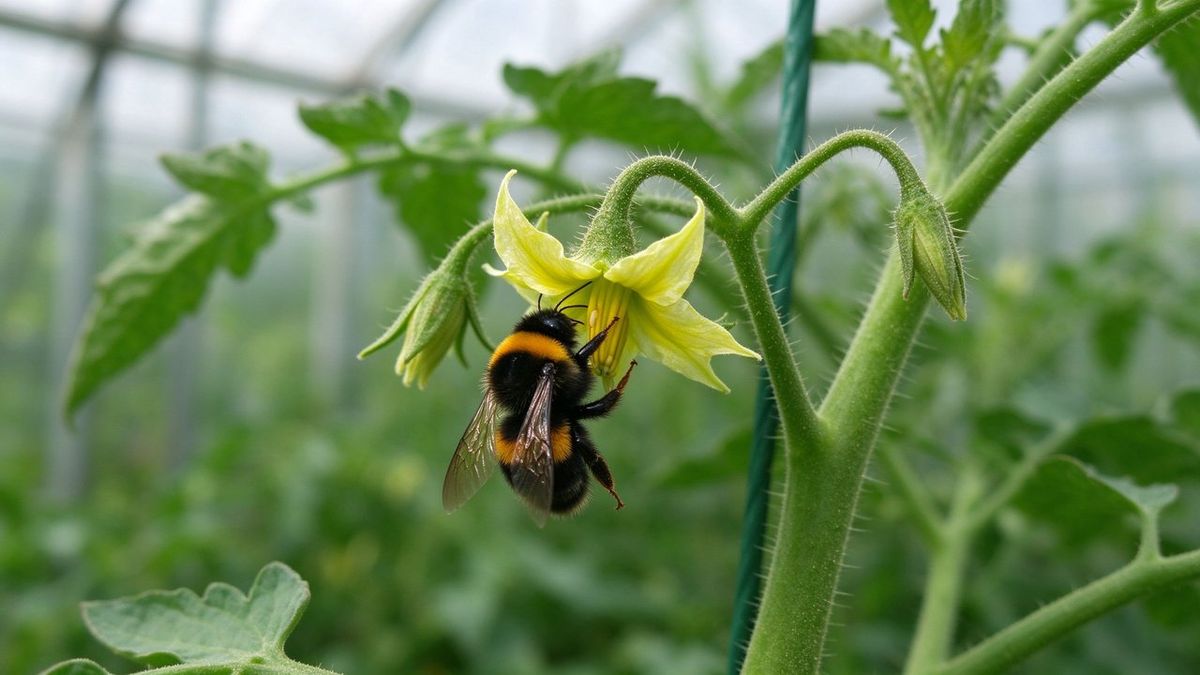
Tomato flowers require vibration to release pollen from the poricidal anther cone. In open fields wind does this; in a greenhouse, bumblebees, electric vibrators, or air blowers are needed. Bumblebee colonies, mainly Bombus terrestris, are the most effective tool, improving fruit set by 15 to 25 percent and raising average fruit weight by 10 percent compared with mechanical vibration. Yet colonies fail regularly when growers ignore pesticide intervals, CO2 setpoints, and hive placement. Optimising bumblebee pollination is a small-budget, high-return operation that pays back in the first truss.
Colony Introduction and Placement
Place one colony per 1500 to 2000 square metres, 2 to 3 weeks before the first truss opens. Hives sit at 1.5 m above the floor on a wooden pallet, facing east to catch morning sun. Mark the hive entrance with a yellow dot so returning bees orient quickly.
Inspect the sugar reservoir weekly. A healthy colony consumes 20 to 30 ml of artificial nectar per day at peak flowering. Replace the colony after 8 to 10 weeks; Bombus terrestris queens slow production by then and fruit set drops by 30 percent even if the box still has bees.
Pollination Quality Signals
Bumblebee visits leave a characteristic brown buzz mark on the anther cone, which darkens from white to brown within 24 hours. Check 50 open flowers per colony twice per week; more than 80 percent brown marks means pollination is adequate. Below 50 percent, introduce a second colony or run a mechanical vibrator as backup.
Fruit shape confirms pollination. Well-pollinated tomatoes are round and heavy; misshapen or lobed fruit signals poor pollination on that truss. Track the percentage of misshapen fruit weekly; above 5 percent warrants intervention.
Pesticide Compatibility
Check every product against the bumblebee safety table before spraying. Pyrethroids, neonicotinoids, and many diamides are toxic for 24 to 72 hours after application. Close hive entrances four hours before spraying and reopen after 48 hours of ventilation.
Even fungicides such as chlorothalonil reduce brood production when applied directly. Spray in the evening after bees return to the hive, and shut the hive entrance overnight. Record every spray on a hive log so the next operator knows when it is safe to open.
Climate and CO2 Considerations
Bumblebees fly poorly below 12 degrees Celsius and above 30 degrees Celsius. Keep day temperature 20 to 25 degrees Celsius during flowering. Ventilate gradually; a sudden gust that drops house temperature below 14 degrees Celsius stops flight for 2 to 3 hours.
CO2 enrichment to 800 to 1000 ppm increases pollen germination by 20 percent but also raises colony flight activity. Avoid CO2 peaks above 1200 ppm, which reduce foraging. Maintain relative humidity 60 to 70 percent; below 50 percent pollen dries and does not release even when vibrated.
Backup Mechanical Pollination
On weeks when bees are inactive due to cold or spray residues, run an electric vibrator on each open truss for 1 second, once per day between 10:00 and 13:00. This restores fruit set to 90 percent of the bumblebee level.
Air jet blowers at 2 litres per second per truss are a less effective alternative but useful where hives are unavailable. Time the vibration so that flowers dry quickly; wet flowers pollinated by vibration become infected with Botrytis within days.
Bumblebees are a precision tool, not a set-and-forget box. Monitor buzz marks weekly, match sprays to the safety table, hold temperature 20 to 25 degrees Celsius, and have a vibrator on standby. The 15 to 25 percent gain in fruit set and the 10 percent gain in fruit weight dwarf the 600 to 900 euro colony cost over a 12-month crop. Zhongtian Agricultural Technology recommends keeping a hive log on every block so that spray intervals and hive replacement dates never slip.


