
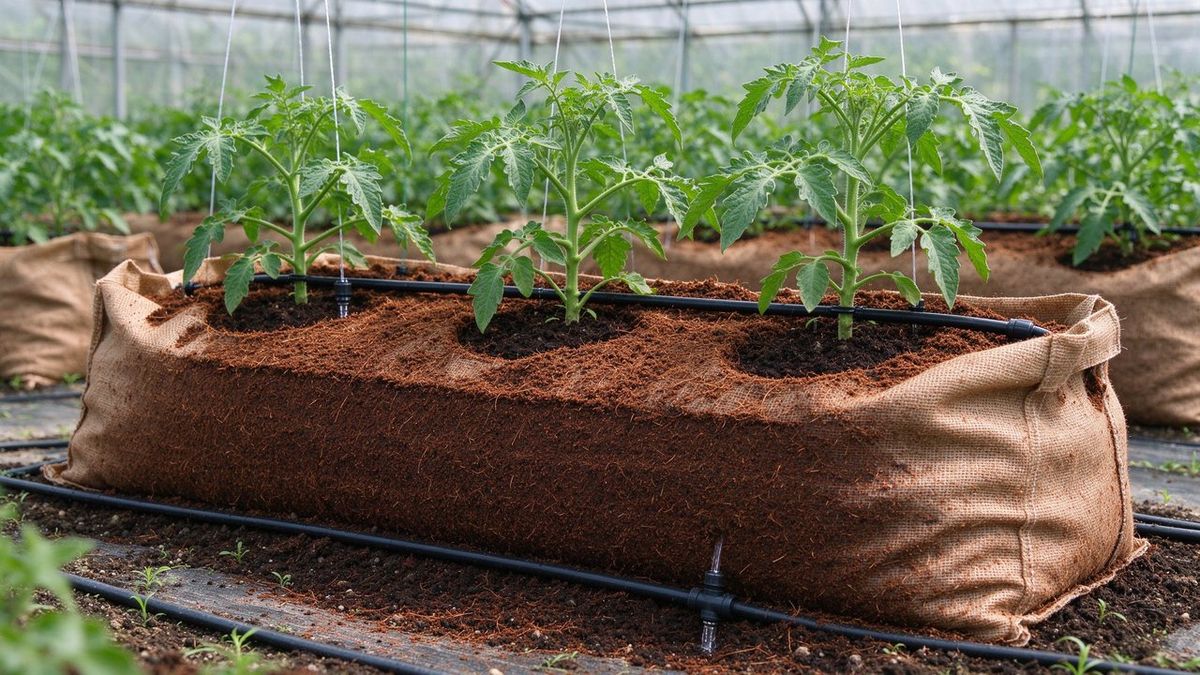
Coco coir has become the fastest-growing substrate for greenhouse tomatoes because it is renewable, oxygenates well, and drains faster than rockwool. A standard 100 by 20 cm coco bag holds 8 to 9 litres of water and supports two plants. But coco is not rockwool: it releases potassium over the first three weeks, buffers EC by 0.3 to 0.5 mS per cm, and requires a pre-wash to remove excess sodium. Growers who treat coco as a different substrate, not a cheaper rockwool, get 55 to 65 kg per square metre per year with lower Pythium pressure.
Choosing Buffered Coco
Buy coco that has been buffered with calcium nitrate. Target residual potassium below 2 mmol per litre and sodium below 1 mmol per litre on the supplier’s analysis sheet. Unbuffered coco locks out calcium for the first three weeks, causing transient BER on the first truss.
Fibre content matters. A 70 percent coco peat to 30 percent fibre ratio gives the best aeration. Pure p compacts within a month; pure fibre drains too fast. Bag weight should be 4.5 to 5.5 kg per 100 cm bag when dry.
Pre-Plant Conditioning
Pre-wash bags with pH 5.5 nutrient solution at 3 litres per bag, 24 hours before transplanting. Discard the wash water; it carries excess potassium and sodium. Puncture four drainage holes per bag, 10 mm diameter, along the bottom edge.
Place bags on a raised trough 15 cm above the floor. Slope the trough 1:200 so drain water runs to the gutter. A flat trough pools water and invites Pythium at the base of the stem.
Feed and EC Strategy
Set feed EC 0.2 mS per cm lower than rockwool because coco raises root-zone EC by 0.3 to 0.5. Target feed EC 3.3 to 3.8 mS per cm in spring, rising to 4.0 to 4.5 in bright summer. Monitor root-zone EC weekly; a swing above 0.5 from feed signals salt build-up.
pH target is 5.5 to 5.8. Coco buffers pH naturally, so smaller acid adjustments are needed than in rockwool. Use nitric acid rather than phosphoric to avoid phosphorus lock-out of iron.
Irrigation Scheduling
Irrigate 2 to 3 minutes per event, 8 to 12 events per day, targeting 25 to 30 percent drain. Start the first event at sunrise plus 1 hour; stop 2 hours before sunset. Use a light sensor to trigger the first event rather than a clock.
Weigh bags weekly. A healthy bag at field capacity weighs 6.5 to 7.5 kg; a dry bag weighs 5.5 kg. If weight drops below 6 kg between irrigations, increase event frequency. If drain exceeds 35 percent, reduce event volume.
Disease and End-of-Crop Handling
Coco drains fast, so Pythium root rot is 30 to 40 percent lower than in rockwool. But the stem base stays wet if bags sit flat. Use a stem clip to lift the stem 5 cm off the bag surface, and run a 0.5 percent hydrogen peroxide drench at 4 weeks after planting.
At crop end, lift bags immediately. Used coco can be composted for 6 months and reused as landscape soil at 10 percent by volume, or returned to the supplier for recycling. Do not reuse coco from a nematode or Fusarium crop; the cost of a new bag is less than one truss of lost yield.
Coco coir is a different substrate, not a cheaper rockwool. Buy buffered product, pre-wash, set feed EC 0.2 lower, weigh bags weekly, and lift bags at crop end. The 55 to 65 kg per square metre yield and the lower Pythium pressure justify the slightly higher bag cost. A weekly drain sample checks for potassium release from the coir and catches the first sign of sodium accumulation before it reaches the fruit.


