
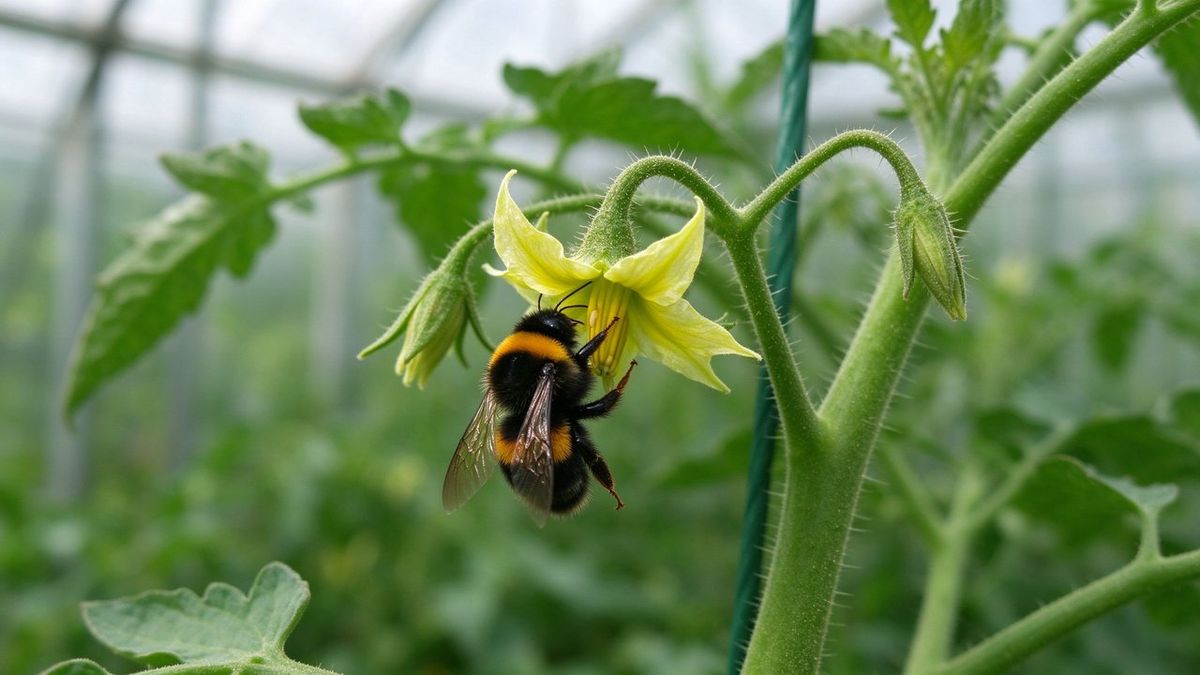
Standard long English cucumbers are parthenocarpic and set fruit without pollen, but fruit set is not automatic: flowers abort when temperatures, nutrition, or light fall outside a narrow window. Mini and Beit-alpha types, and some outdoor hybrids, still need pollinators. Getting fruit set right means keeping the plant in balance, knowing when bees help and when they cause ‘nubbins’, and intervening early when abortion starts.
Why Flowers Abort Without Pollen
A parthenocarpic cucumber flower can set fruit on its own, but only if the ovary receives enough assimilates from the leaves. Flowers abort when daily light integral drops below 8 mol per square metre in winter, when the day temperature exceeds 30 degrees Celsius for more than 4 hours, or when root zone temperature falls below 16 degrees. A combination of all three is the classic winter abortion event.
The ovary at the base of the flower swells within 48 hours of anthesis if set succeeds; a small, yellowing, shrivelling ovary after day 3 is a lost fruit. Pick aborted fruit off immediately because a rotting ovary attracts Botrytis. Expect a natural abortion rate of 10 to 15 percent; above 25 percent the climate is wrong.
When Bumblebees Help and When They Hurt
Bumblebee hives are required for seeded cucumber types and for Beit-alpha mini types bred as open-pollinated. Release one hive per 3000 m2 at first open flower; a hive should visit 80 to 120 flowers per hour at 20 to 26 degrees Celsius. Activity drops to zero below 12 degrees or above 30, so on cold days supplement with vibration pollination at midday.
On parthenocarpic long English cucumbers, bees are removed: a bee visit triggers fertilisation, produces seed, and creates the rounded, curved ‘nubbin’ fruit that the market rejects. Keep bee hives out of long-fruit bays entirely. Use bumblebee hives only where the variety sheet explicitly requires pollination.
Temperature and Light Windows for Set
Fruit set is most reliable at 22 to 26 degrees Celsius day and 18 to 19 night. Above 28 degrees, pollination success falls 40 percent and parthenocarpic set drops because pollen tubes and ovary development stall. Below 16 degrees, anthesis slows and flowers open over 5 rather than 2 days, stretching the set window.
Light matters. At daily light integral below 10 mol per square metre in January, keep the heat setpoint 1 degree lower to reduce respiration demand; supplemental assimilation lighting at 150 micromoles per square metre per second for 12 hours lifts set from 60 to 85 percent. Remove 10 to 15 percent of male flowers on partial-gynoecious types to direct assimilates to female fruit.
Nutrition and Fruit Load Balance
Overloaded plants abort flowers. A stem thinner than 10 mm at the growing tip, or internodes longer than 18 cm, means the plant is carrying too many fruit. Thin to one fruit every second node for one week until stem diameter recovers to 11 to 13 mm.
Calcium and boron directly affect ovary development. Keep calcium at 180 to 220 mg per litre and boron at 35 to 50 microgrammes per litre in the feed; boron below 25 microgrammes causes aborted flowers and hooked fruit. Foliar boron at 0.05 percent on two consecutive mornings corrects a deficiency within 10 days.
Pollinator Audit and Hive Management
Check hive strength weekly: 200 to 300 worker bees per hive is the working minimum. Refill sugar feeders every 10 days and keep the hive in a shaded corner at 18 to 22 degrees. Replace hives every 8 to 10 weeks because bumblebee colonies naturally decline. Mark visited flowers with a small tick by the first picker; if fewer than 60 percent of open flowers show the brown bite-mark, the hive is weak.
Close hives 2 hours before any spray and reopen only after leaves are dry, minimum 4 hours. Never apply neonicotinoids or pyrethroid sprays when hives are active; both kill bumblebees within hours. Zhongtian Agricultural Technology separates bee bays from spray bays by a solid wall so routine fungicide rotation never touches the pollinator block.
Fruit set is a balance of temperature, light, and load. Long English types set best without bees; seeded and mini types need a strong hive. Track the ovary swelling rate, keep stem diameter above 11 mm, and protect calcium and boron supply to hold abortion below 15 percent.


