
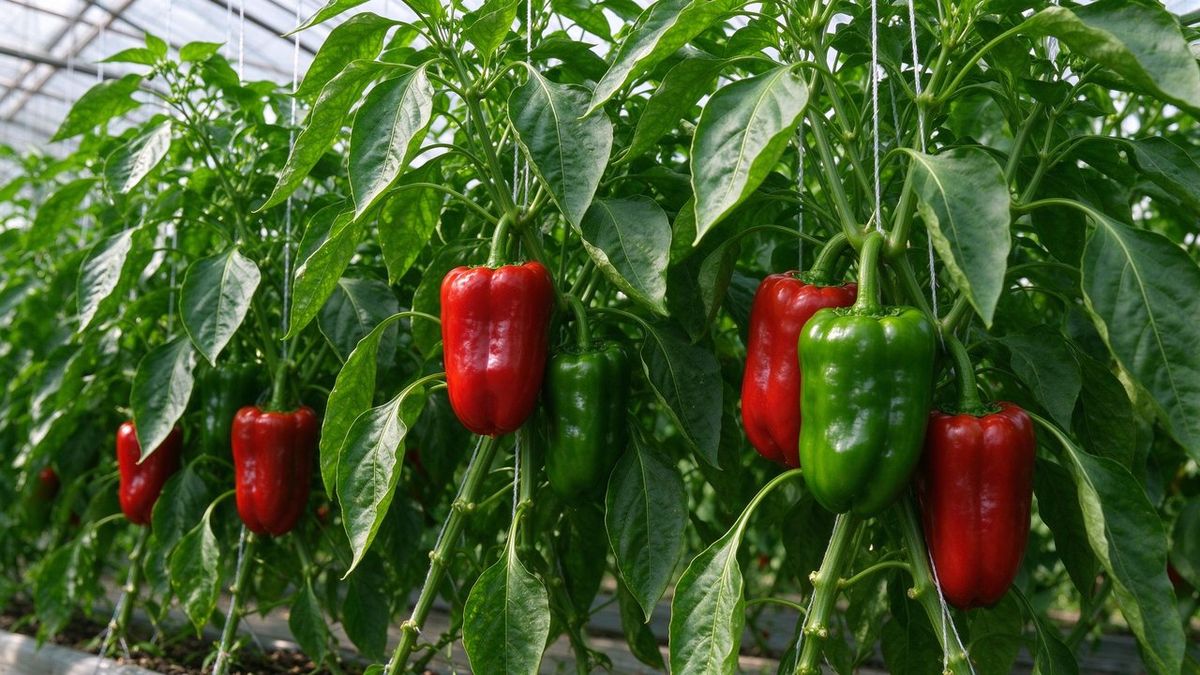
Pepper nutrient deficiencies show up first on older leaves (mobile nutrients: N, P, K, Mg) or on younger leaves (immobile nutrients: Fe, Mn, Zn, Ca, B). Recognising the pattern, not just the yellowing, is the skill that turns a 2-week correction into a 2-day fix. Diagnosis combines leaf symptoms, drainage analysis, and a quick sap test; by the time the whole plant is yellow, the deficiency has already cost yield.
Nitrogen and Phosphorus Deficiency
Nitrogen deficiency: older leaves turn uniformly pale green then yellow, with smaller leaves and stunted growth. Whole-plant yellowing signals severe N deficiency. Check drainage nitrate: below 80 mg per litre confirms it. Correct by raising nitrate to 150 mg per litre within 3 days; recovery visible in 7 days.
Phosphorus deficiency: older leaves develop a purple or bronze tint on the underside, especially along veins. Growth slows and fruit is small. Drainage phosphate below 30 mg per litre confirms. Raise phosphate to 40 to 50 mg per litre; do not exceed 60 because it ties up calcium.
Potassium and Magnesium Deficiency
Potassium deficiency: older leaves show marginal scorch and interveinal yellowing starting at the leaf edge. Fruit is small and thin-walled. Drainage K below 150 mg per litre confirms. Raise K to 220 mg per litre; recovery takes 10 to 14 days because K moves slowly in the plant.
Magnesium deficiency: interveinal yellowing on older leaves, veins stay green. Common in recirculating systems because Mg is leached. Drainage Mg below 30 mg per litre confirms. Foliar spray 0.5 percent magnesium sulphate at two consecutive mornings corrects within 5 days; root feed Mg to 50 mg per litre.
Calcium and Boron Deficiency
Calcium deficiency: blossom-end rot on fruit (sunken brown spot at the blossom end), and young leaves that are deformed and curled. Calcium is immobile; the fruiting tip is the first starved. Keep calcium at 200 to 240 mg per litre and ensure transpiration (RH below 80 percent). Foliar calcium 0.3 percent twice weekly during fruit development.
Boron deficiency: young leaves are thick, brittle, and cup-shaped; growing tip dies. Fruit shows brown corky patches. Drainage B below 25 microgrammes per litre confirms. Foliar borax 0.05 percent at two morning sprays corrects within 10 days. Do not exceed 60 microgrammes; boron is toxic at high levels.
Iron, Manganese, and Zinc Deficiency
Iron deficiency: interveinal yellowing on the youngest leaves, veins stay green. Common when pH drifts above 6.2. Lower pH to 5.6 and check drainage Fe: below 10 micromoles confirms. Foliar Fe-EDDHA at 0.1 percent gives green-up in 3 days.
Manganese deficiency: interveinal yellowing on young leaves with small brown spots. Zinc deficiency: small narrow leaves and interveinal mottling. Both are pH-related; correct pH first, then check drainage. Foliar Mn at 0.05 percent or Zn at 0.02 percent corrects in 7 days. Do not mix Mn and Zn sprays; they antagonise.
Diagnosis Workflow and Prevention
Workflow: identify which leaves are affected (old vs young), photograph the pattern, send a 250 ml drainage sample for full analysis, and run a quick leaf-sap nitrate and EC test. Within 48 hours you have a diagnosis. Do not guess; the cost of a wrong correction is 2 weeks of yield.
Prevention: weekly drainage analysis, monthly leaf tissue analysis, and calibrated sensors. Zhongtian Agricultural Technology treats nutrient deficiency as a monitoring failure first: if the sensor log and weekly analysis are correct, a deficiency should never reach visible leaf stage. By the time the leaf shows it, the crop has already been underfed for 2 to 3 weeks.
Nutrient deficiency diagnosis is pattern recognition plus lab confirmation: old-leaf patterns for N, P, K, Mg; young-leaf patterns for Fe, Mn, Zn, Ca, B. Weekly drainage analysis prevents most visible deficiency; when one appears, correct within 48 hours and the crop recovers in 7 to 14 days.


