
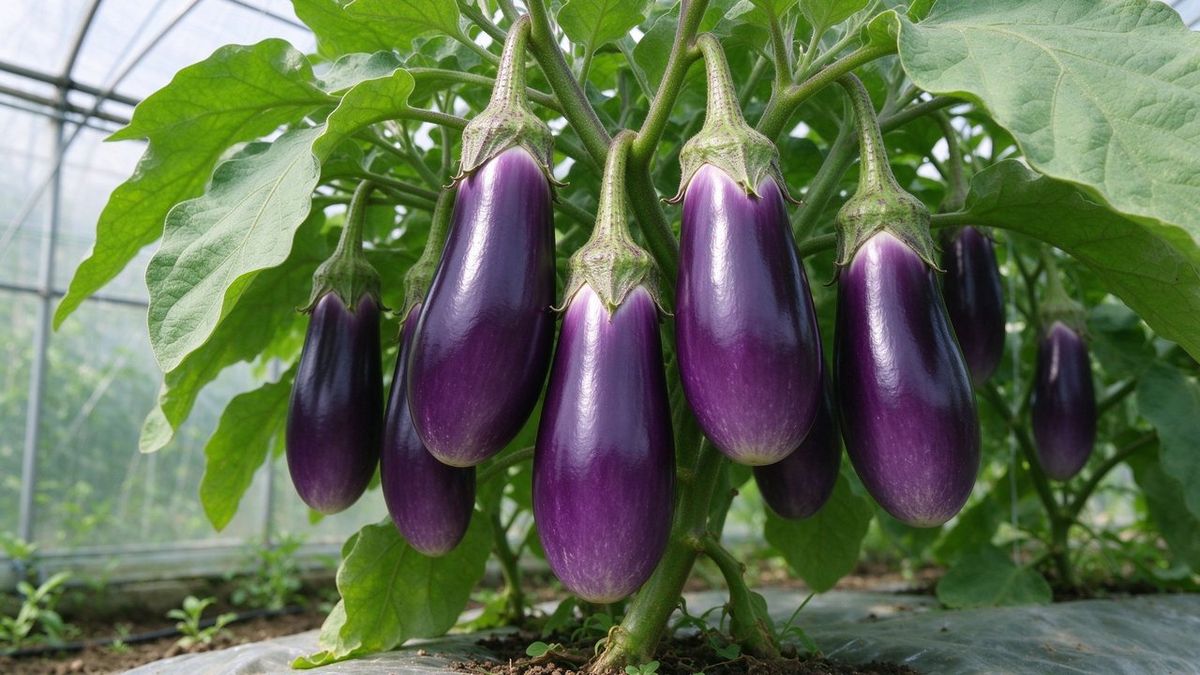
Woodiness and puffiness are the two most damaging internal quality failures in greenhouse eggplant. Woodiness is a hard, stringy flesh texture caused by excess lignification of the placental tissue; puffiness is a hollow, lightweight fruit with a thin flesh wall caused by poor pollination or extreme temperature. Both problems make fruit unmarketable even when the skin looks perfect. This article covers the physiological causes and the cultural levers that growers at Zhongtian Agricultural Technology use to keep woody or puffy fruit below 3 percent of harvest.
What Woodiness Is and Why It Happens
Woodiness appears when the placental and flesh tissue lignifies prematurely, making the fruit tough and fibrous. It is triggered by a heavy fruit load combined with cool root-zone temperature below 18 degrees Celsius, which slows assimilate transport. The plant responds by laying down extra lignin in the placental tissue to support the heavy fruit. The result is a fruit that looks normal on the outside but has a hard, stringy core when cut.
Woodiness is worse on the lower clusters, where fruit is largest. It is also triggered by potassium shortage during fruit expansion: tissue potassium below 4.0 percent correlates with 20 percent woody fruit. Over-mature fruit left on the plant beyond 28 days after pollination also lignifies, because the flesh continues to mature past its eating window.
What Puffiness Is and Why It Happens
Puffiness is a hollow, inflated fruit with a thin flesh wall and a large empty central cavity. When cut, the flesh is only 5 to 10 millimeters thick rather than the normal 15 to 20 millimeters. It is caused by failed or incomplete pollination: without viable seed development, the fruit expands by inflating rather than by filling flesh. Puffiness is most common at the temperature extremes above 32 degrees Celsius or below 16 degrees Celsius, when pollen is non-viable.
Puffiness also appears on over-fertilized plants with excess nitrogen: lush vegetative growth competes with fruit filling, and the fruit inflates on water rather than assimilates. Drought followed by heavy irrigation during fruit expansion causes a similar condition, because the fruit expands faster than the flesh can fill. Puffy fruit weighs 30 to 40 percent less than normal and is culled at pack-out.
Preventing Woodiness
Keep root-zone temperature above 20 degrees Celsius throughout fruit expansion. In winter, pre-heat nutrient solution to 20 degrees Celsius and use coco bags insulated on the bottom. Hold tissue potassium at 4.5 to 5.5 percent by running K at 7.0 millimoles per liter at peak load. Harvest fruit at 22 to 25 days after pollination, not later; never leave fruit beyond 28 days.
Thin fruit to one per axil to avoid overload. A plant carrying more than 12 fruit at once will lignify the lower ones. Maintain 30 to 35 healthy leaves per plant to supply assimilates; do not strip leaves aggressively during fruit expansion. Foliar potassium nitrate at 3 grams per liter every 10 days during the heaviest load reduces woodiness by 60 percent in trial plots.
Preventing Puffiness
Pollination is the first line: use bumblebee hives at one hive per 2,000 square meters, and supplement with mechanical vibration at 90 hertz on flower trusses every other morning. In summer above 30 degrees Celsius, switch to parthenocarpic cultivars or apply 10 ppm 4-chlorophenoxyacetic acid to open flowers within 24 hours of opening.
Keep daytime temperature between 25 and 28 degrees Celsius and night between 18 and 20. Ventilate at 28 degrees; use wet-pad cooling above 30. Do not over-fertilize: keep EC at 2.6 to 2.8, not above 3.0. Irrigate evenly; avoid cycles of extreme dryness followed by heavy watering. Maintain steady run-off at 25 to 30 percent.
Quality Checks at Harvest
Cut-test a sample of 10 fruit per block every week: slice across the middle and inspect flesh thickness and seed cavity. Flesh wall should be 15 to 20 millimeters thick with a compact seed cavity. If more than 3 percent of sampled fruit shows hollow center or stringy core, flag the block and adjust the recipe or pollination program.
Weigh fruit at harvest: average fruit weight should be 350 to 450 grams. Fruit below 250 grams on a normally heavy plant signals puffiness. At Zhongtian Agricultural Technology, a weekly cut-test log is kept per block, and any block exceeding 5 percent internal defects is investigated within 48 hours.
Woodiness and puffiness are preventable internal-quality failures driven by temperature extremes, nutrient imbalance, and poor pollination. Root-zone warmth above 20 degrees Celsius, tissue potassium held at 4.5 to 5.5 percent, harvest at 22 to 25 days, and reliable bumblebee or mechanical pollination keep both defects below 3 percent. Weekly cut-tests on 10 fruit per block catch problems before they reach pack-out, and the log guides recipe and climate corrections.


