
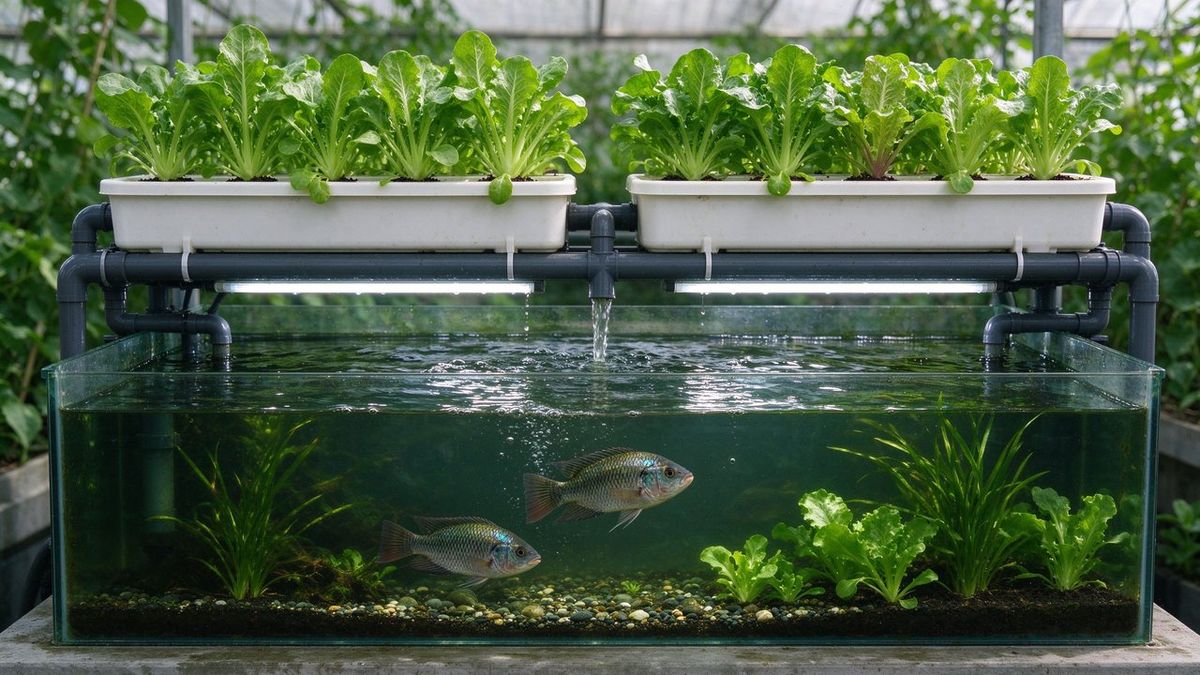
Watercress (Nasturtium officinale) is an aquatic brassica grown for its peppery, tender stems and leaves, and it thrives where a shallow, oxygenated flow of cool water crosses a gravel or raft bed. In a greenhouse, watercress is usually grown in recirculating channels 10 to 15 centimeters deep, held at 14 to 18 degrees Celsius, on a 25 to 35 day cut cycle. The crop is demanding about water quality: it will not tolerate warm, stagnant water, and nitrate in the feed must be kept moderate because excess nitrate dulls the flavor and shortens shelf life. Done correctly, a 200 square meter watercress bed supplies 15 to 20 kilograms of premium sprigs per week to high-end retail and foodservice buyers.
System Design and Water Flow
Use shallow food-grade channels or lined concrete troughs 1.2 meters wide and 10 to 15 centimeters deep, laid on a 1 percent slope. Maintain a water depth of 5 to 8 centimeters with a flow velocity of 0.05 to 0.10 meters per second; slow enough to keep stems upright, fast enough to oxygenate the root mat. Feed the channels from a 1000 liter sump through a 25 watt submersible pump that turns the full volume every 15 to 20 minutes.
A recirculating system needs mechanical and biological filtration. Fit a 200 micrometre drum screen or pad filter before the sump to catch leaf debris, and keep a small biofilter with moving-bed media to convert ammonia to nitrate. Dissolved oxygen should be held above 6 mg/L; if it drops below 5 mg/L, root slime and off-flavor appear within days. Water temperature is the single most important setting and should stay at 14 to 18 degrees Celsius year-round.
Planting and Propagation
Watercress is usually propagated from stem cuttings rather than seed, because cuttings root in five to seven days and preserve uniform, peppery-flavored lines. Place 10 to 15 centimeter cuttings directly into the gravel or into 2 centimeter net pots filled with expanded clay at 10 by 10 centimeter spacing. The basal 3 centimeters must be submerged at all times; emergent stems will produce new rootlets within a week.
Seed propagation is used for new varieties. Sow on a floating foam raft at 0.5 grams per square meter, keep water at 18 to 20 degrees, and transplant to production channels at the four-leaf stage, about 18 days after sowing. Maintain a two-week staggered planting schedule so that one bed reaches harvest while another is still establishing. Keep a backup mother bed of 10 percent of the production area to supply fresh cuttings.
Nutrient Management
Watercress needs only a dilute nutrient solution: target an electrical conductivity of 0.8 to 1.2 mS/cm, pH 6.5 to 7.2. Higher EC produces thicker stems but a harsh, bitter flavor. Nitrate should sit between 80 and 120 mg/L; above 180 mg/L the leaves accumulate excess nitrate, which is both a food-safety issue and a flavor defect. Use a calcium-rich brassica blend and supplement iron chelate weekly at 2 mg/L.
Because watercress is eaten raw, nutrient choice is constrained. Avoid urea and ammonium sources; use calcium nitrate, potassium nitrate, and monopotassium phosphate. Test the sump weekly for nitrate, pH, and dissolved oxygen. Dump and refill 30 percent of the sump volume each week with fresh, dechlorinated water, and fully rebuild the sump between every two harvest cycles to prevent pathogen buildup.
Light and Temperature
Watercress prefers partial shade; direct midday sun above 30 degrees causes leaf scorch and bolting. Run 30 to 40 percent shade netting from May through September and keep the greenhouse air at 18 to 24 degrees Celsius. In winter, drop the netting and let full sun reach the bed; water temperature, not air temperature, controls growth rate. Growth nearly stops below 12 degrees water temperature, so use a 1 kW immersion heater per 1000 liter sump if room temperature falls below 10 degrees.
Maintain air relative humidity between 60 and 75 percent. If the air is too dry, stems become fibrous and tips brown; if too wet, white rust (Albugo) appears as raised blisters on the leaf underside. Run a small exhaust fan on warm afternoons to keep air moving across the canopy at 0.3 m/s. Avoid overhead misting, which washes nutrients off the leaf surface and raises food-safety risk.
Harvest, Food Safety, and Yield
Harvest sprigs at 15 to 20 centimeters tall by cutting the top 10 to 12 centimeters with a sanitized knife, leaving 5 centimeters of stubble to regrow. Each bed produces three to four cuts over 60 to 75 days. Rinse sprigs in chilled iced water at 2 degrees, spin-dry gently, and pack in vented clamshells. Because watercress is eaten raw, the irrigation water must meet potable standards; test it monthly for E. coli and coliforms.
Expected yield is 15 to 20 kilograms per square meter per year across three to four cuts per planting, translating into roughly 4 to 5 cuts per 70 day cycle. Track water use carefully: a recirculating channel system loses only 20 to 30 liters per square meter per day to evaporation and transpiration, compared with 100 liters in open field culture. Zhongtian Agricultural Technology supplies UV sterilizers, dissolved-oxygen controllers, and temperature-regulated sumps that hold the 14 to 18 degree water band automatically, which is the condition most often responsible for a consistent peppery flavor.
Watercress is a niche crop that rewards disciplined water chemistry. Cool 14 to 18 degree flow, dilute 1.0 mS/cm feeding, partial shade, and a strict food-safety testing schedule turn a small recirculating bed into a premium, repeatable specialty revenue line.


