
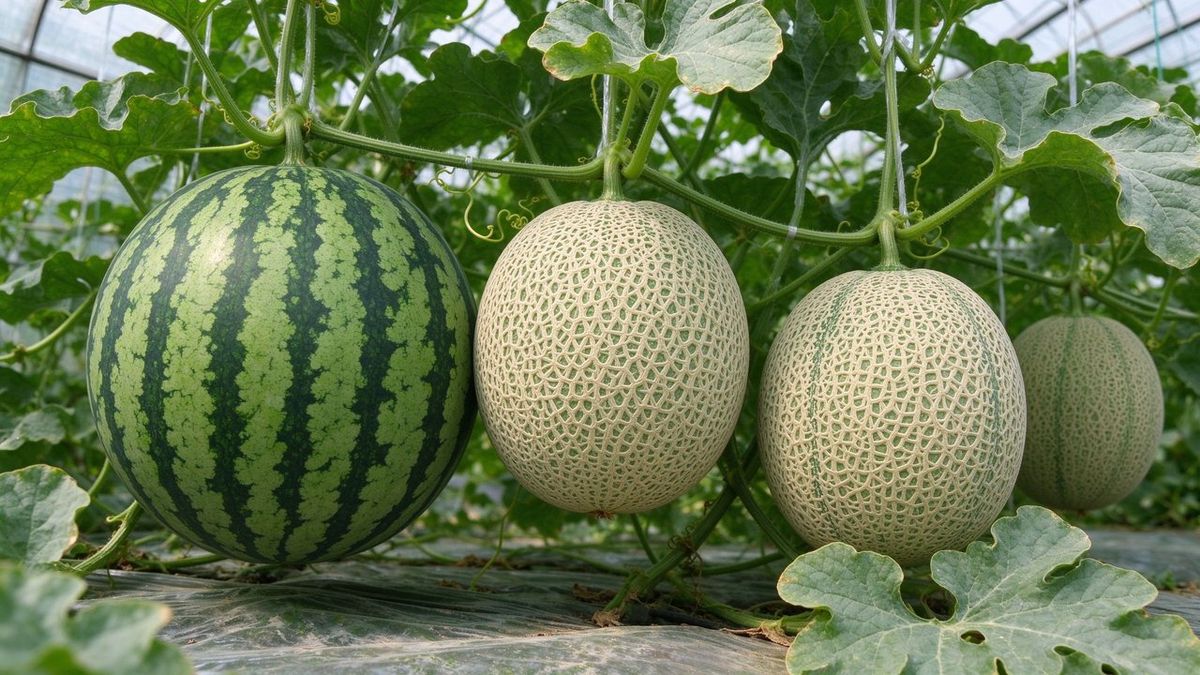
Greenhouse watermelon production has moved from a novelty to a high-value specialty crop, with fruit sold at premium prices for seedless triploid cultivars. A well-run glasshouse crop produces 45 to 60 fruit per 100 square metres, each weighing 4 to 6 kg, on a 90-day cycle from transplant to harvest. The crop demands high light, warm root zone, and disciplined pruning to a single stem with two fruit per plant. Compared with field watermelon, greenhouse fruit commands a 2 to 3 times price premium because of uniformity, thin rind, and extended shelf life.
Cultivar Choice and Transplant Establishment
Seedless triploid cultivars such as ‘Crisp Baby’, ‘Mini Love’, and ‘Solitaire’ dominate greenhouse production, because small personal-sized fruit fit retail punnets. Diploid polliniser cultivars are planted at one row per every four triploid rows to provide viable pollen. Seedless seed is expensive and germinates poorly: seed is sown into 5 cm rockwool plugs at 30 degrees Celsius soil temperature, and emerged seedlings are held at 25/18 degrees day/night for 25 to 30 days until the third true leaf unfolds.
Transplanting occurs when root-zone temperature reaches 20 degrees Celsius, which is the non-negotiable threshold for watermelon growth. Plants are set into 10 L coco coir bags at two plants per bag, spaced 40 cm apart in the row. Rows are 1.6 m apart centre-to-centre, giving 3.1 plants per square metre. The grafted plant is supported by a vertical string from the overhead wire, and the lateral vine is trained up the string. Fruit is supported by a nylon net bag slung from the wire once it reaches tennis-ball size.
Climate and Light Requirements
Watermelon is a warm-season cucurbit that requires 25 to 30 degrees Celsius day temperature and 18 to 20 degrees night temperature. Below 15 degrees, growth stops and female flower abortion rises. Daily light integral should exceed 20 mol/m²/day; in winter greenhouse bays, supplemental LED at 150 micromoles per square metre per second extends the day to 14 hours. Vents open at 28 degrees, and shade screens deploy at 800 W/m² to prevent leaf scorch on young plants.
Humidity is held at 60 to 70 per cent. Above 80 per cent, powdery mildew and leaf botrytis explode; below 50 per cent, pollen desiccates and fruit set fails. Horizontal airflow at 0.4 m/s keeps leaf surfaces dry and encourages even pollination. Vapor pressure deficit is targeted at 0.8 to 1.2 kPa during fruit swell. After fruit set, a 10 degree day-night differential promotes sugar accumulation; nights held below 16 degrees slow fill and nights above 20 degrees dilute flavour.
Fertigation and Nutrition
Watermelon in coco coir uses a standard cucurbit feed with EC ramping from 1.5 mS/cm at transplant to 2.8 to 3.2 mS/cm during fruit swell. Nitrate nitrogen runs at 180 mg/L, potassium at 280 mg/L, and calcium at 160 mg/L during fruit development. Phosphorus is modest at 40 mg/L because excess phosphorus delays fruit maturity. Magnesium at 60 mg/L prevents the interveinal chlorosis common on older leaves.
Irrigation is delivered through 2.2 L/h drip emitters, two per bag, with cycles starting at 3 per day and rising to 10 to 12 per day during fruit swell. Daily water use peaks at 1.5 to 2.0 L per square metre at full canopy. Drainage is held at 30 per cent to prevent salt buildup. A key practice is controlled water stress 7 to 10 days before harvest: reduce irrigation by 50 per cent to concentrate sugars in the flesh; over-watering at this stage dilutes Brix and causes fruit splitting.
Pollination, Pruning, and Harvest
Female flowers open at the 15th to 20th node on the main stem. Bumblebee hives at one per 2,000 square metres provide pollination, but hand pollination is more reliable for seedless triploids: a male flower from the diploid polliniser is rubbed directly onto the female stigma in the first two hours after anthesis. Hand-pollinated fruit sets 95 per cent, compared with 65 per cent relying on bees alone. The first female flower is removed; fruit is set on the second or third female flower at nodes 18 to 22.
Single-stem pruning removes all lateral shoots until the fruit-set node, then allows two laterals to develop as leaves for photosynthesis. All tendrils are removed weekly. Fruit harvest timing is judged by three signals: the tendril opposite the fruit dries, the ground spot turns cream-yellow, and a thumped fruit gives a low-pitched ring. Internal quality is 11 to 13 degrees Brix for a premium crop. Yields of 50 fruit per 100 m² at 5 kg each deliver 2,500 kg per 100 m² over a 90-day cycle.
Greenhouse watermelon is a precision crop: warm root zone above 20 degrees, single-stem training, hand pollination on the second female flower, and controlled water stress in the final week. When these steps are disciplined, fruit reaches 12 degrees Brix and commands the premium retail price that justifies the high value of greenhouse space.


