
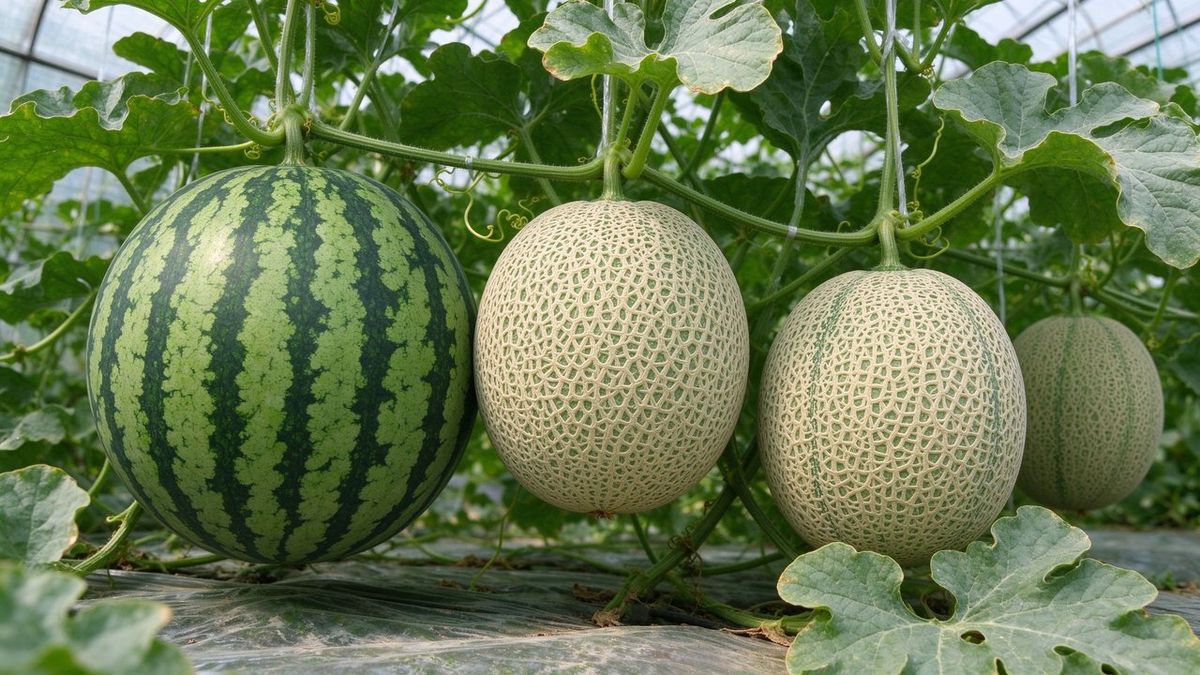
Muskmelon (Cucumis melo) and cantaloupe types grown in protected culture include netted sports such as ‘Galia’, ‘Charentais’, and ‘Honey Globe’. These crops demand more climate precision than watermelon because the netted rind and aromatic flesh develop only under specific temperature and humidity regimes. A greenhouse cantaloupe crop yields 35 to 45 fruit per 100 m² at 1.2 to 1.8 kg each, over an 80-day cycle. The financial reward is high Brix (12 to 15 degrees) and shelf life of 10 to 14 days when harvested at the correct slip stage.
Cultivar Segments and Planting
Three commercial segments dominate: the netted orange-fleshed cantaloupe types, the green-fleshed Galia types, and the smooth-skinned Honeydew types. Netted cultivars require dry weather during netting (10 to 20 days after pollination); wetness during this window produces poor corky netting. ‘Charentais’ is preferred for premium restaurant markets because of its intense aroma and small 600 to 800 g fruit. ‘Galia’ types are sweeter and ship better.
Seed is sown in rockwool plugs at 28 degrees Celsius, transplanted at the two-leaf stage into 8 L coco bags at 3.2 plants per square metre. Rows are 1.5 m apart, plants 40 cm apart in the row. Vertical strings support the main stem, and a nylon sling supports each fruit once it reaches 200 g. Planting density is slightly higher than watermelon because individual fruit is smaller and the canopy is more open.
Climate for Netting and Sugar
Muskmelon prefers 24 to 28 degrees Celsius day temperature and 16 to 18 degrees night temperature. The critical period is 10 to 20 days after pollination, when rind netting forms. During netting, relative humidity must stay below 70 per cent; if RH exceeds 85 per cent for more than 24 hours, netting remains smooth and the fruit is downgraded. Ventilation opens at 26 degrees, and a wet-wall cooler is used only when outside temperature exceeds 32 degrees, because evaporative cooling raises canopy humidity.
Sugar accumulation accelerates in the final 20 days before harvest. A day-night temperature differential of 10 degrees (28 day, 18 night) maximises Brix. Light integral must exceed 25 mol/m²/day; in winter, supplemental LED at 150 micromoles is essential. Shade screens are not used on sunny days unless leaf temperature exceeds 38 degrees, because every mol of light captured in the final three weeks converts directly into Brix points.
Fertigation Recipe by Stage
Feed EC starts at 1.5 mS/cm for the first three weeks, ramps to 2.2 mS/cm during vine growth, and peaks at 2.6 to 2.8 mS/cm during fruit swell. Nitrate nitrogen runs at 150 mg/L, potassium at 250 mg/L, calcium at 150 mg/L. A distinctive feature of muskmelon feeding is the reduction of nitrogen after fruit set: high post-set nitrogen produces large fruit with bland flavour and poor netting. Nitrogen drops to 90 mg/L once the fruit reaches egg size.
Irrigation cycles: 3 cycles per day early, rising to 8 to 10 cycles per day at full fruit swell. Each cycle is 60 seconds on a 2.2 L/h emitter. Drainage is held at 25 to 30 per cent. Calcium is critical for rind strength; if calcium drops below 120 mg/L in the drainage, blossom-end rot appears on the shoulder. Foliar calcium at 0.4 per cent calcium nitrate is sprayed twice during netting to reinforce rind.
Harvest Maturity and Shelf Life
Cantaloupe is harvested at the half-slip stage: the stem separates easily from the fruit with a slight twist, leaving a clean, shallow abscission scar. Full-slip fruit is too ripe for shipping. ‘Charentais’ types are harvested slightly earlier, when the skin turns from green to tan at the blossom end. Soluble solids are tested on a random sample each harvest; below 10 degrees Brix, the entire bay is held another three days.
Post-harvest handling is the make-or-break for aromatic cultivars. Fruit is forced-air cooled to 7 degrees within four hours of picking, then held at 7 to 10 degrees. Below 5 degrees, chill injury causes pitting and off-flavours. Shelf life at 7 degrees is 10 to 14 days for netted types, 21 days for Honeydew. Fruit is never wrapped in plastic film, because this raises humidity and promotes surface rot; breathable foam sleeves are preferred for retail display.
Protected muskmelon rewards precise climate control: dry air during netting, warm days and cool nights during sugar accumulation, and a controlled water reduction in the final two weeks. The premium price for 12-degree-Brix netted fruit is earned in those narrow climate windows, not in the volume of water applied. Growers who treat netting and sugar phases as special events consistently produce retail-grade fruit.


