
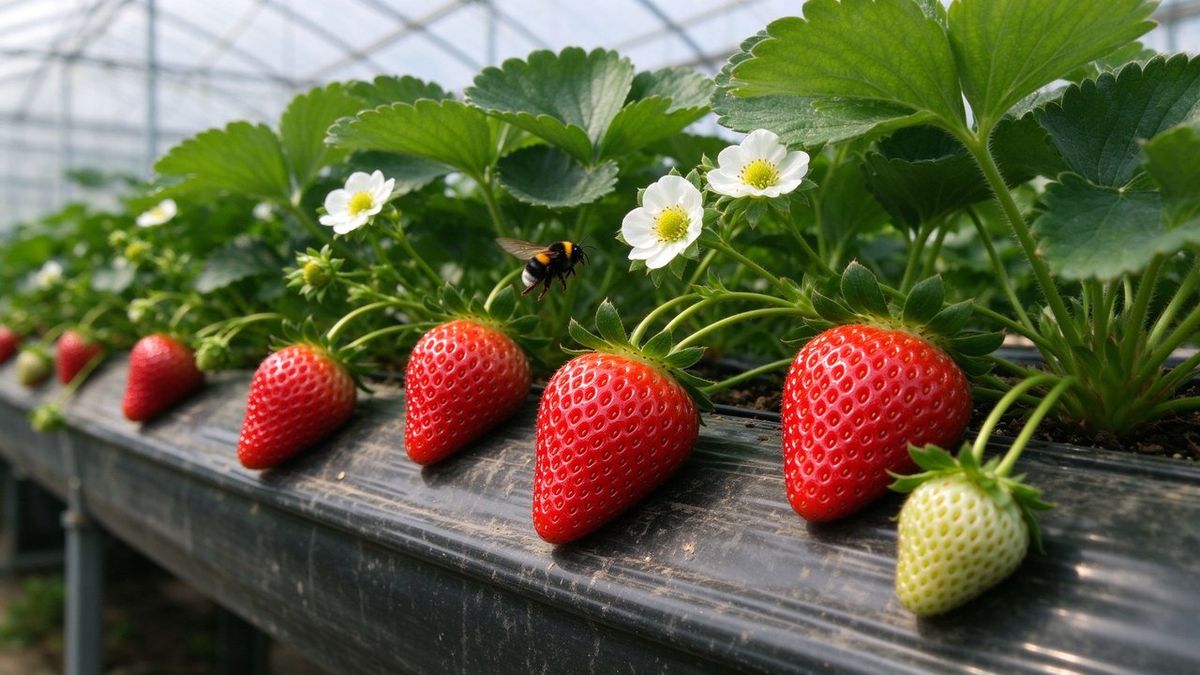
Everbearing (day-neutral) strawberry cultivars such as ‘Albion’, ‘San Andreas’, and ‘Camino Real’ have rewritten protected-culture economics by allowing harvest waves from late spring through autumn instead of a single compressed June window. Under cover, these cultivars respond to accumulated heat rather than photoperiod, so temperature management drives yield far more than day length. A well-run everbearing slab system in a glass or poly greenhouse can produce 3.5 to 5.0 kg per square metre over a nine-month cropping cycle, compared with 2.5 to 3.0 kg from a short-day forced crop. The system depends on raised substrate troughs, drip fertigation, and strict climate discipline.
Cultivar Choice and Planting Geometry
Everbearing plants are established from cold-stored frigo plugs or tray plants at a density of 9.0 to 10.5 plants per square metre. On 20 cm wide gullies spaced 1.5 m apart centre-to-centre, two parallel rows are planted 25 cm apart with in-row spacing of 17 to 20 cm. ‘Albion’ tolerates the higher end of this density, while ‘San Andreas’ performs better slightly more open at 8.5 plants per square metre to reduce crown overlap. Tray plants should be graded for crown diameter between 8 and 12 mm; anything below 6 mm produces a delayed first flush and is culled.
Planting depth is critical: the crown must sit exactly at the substrate surface, neither buried nor perched. A buried crown invites Rhizoctonia crown rot, while a perched plant dries out within two days. Substrate for everbearing systems is typically 70 to 80 per cent coco coir blended with 20 to 30 per cent perlite or pumice, buffered to a pH of 5.4 to 5.8 and an initial EC of 1.2 mS/cm. Gullies are laid on a 1:60 to 1:80 slope so drainage runs to an open collection channel rather than pooling under the root zone.
Climate Setpoints for Continuous Cropping
Day temperature is held at 18 to 22 degrees Celsius during light hours and dropped to 8 to 10 degrees Celsius at night. A diurnal fluctuation of 10 to 12 degrees Celsius keeps plant growth generative rather than vegetative; if night temperatures exceed 14 degrees Celsius, runners proliferate and fruit trusses become sparse. Ventilation opens when air temperature reaches 23 degrees Celsius, and horizontal airflow fans run continuously at 0.3 to 0.5 m/s to break boundary layers over the canopy.
Relative humidity is targeted between 65 and 75 per cent. Above 85 per cent for more than four hours, pollen viability drops and Botrytis cinerea colonises open flowers. A wet-wall evaporative cooler is used when outside temperature climbs above 28 degrees Celsius, but misting is kept below 10 minutes per cycle to avoid canopy saturation. Vapor pressure deficit is held at 0.6 to 1.0 kPa during the day and 0.3 to 0.5 kPa at night, which correlates directly with fruit size and shelf life.
Fertigation EC and Drainage Strategy
Nutrient solution is delivered through pressure-compensating drip emitters at 2.0 litres per hour, one emitter per plant. Irrigation frequency starts at 2 cycles per day at planting and rises to 8 to 12 cycles per day by full canopy, each cycle lasting 60 to 90 seconds. Drainage is maintained at 25 to 35 per cent of applied volume; if drainage falls below 20 per cent, salts accumulate in the coco and reduce calcium uptake. A target run-to-waste EC of 1.4 to 1.6 mS/cm in the drainage indicates a balanced feeding regime.
The feed EC is ramped by crop stage: 1.0 mS/cm for the first two weeks after planting, 1.2 to 1.4 mS/cm during crown and runner establishment, and 1.6 to 1.8 mS/cm once the first truss flowers open. Nitrate nitrogen is held at 120 to 150 mg/L, calcium at 140 mg/L, and potassium at 180 mg/L during fruit swell. Substrate pH drifts upward by 0.2 to 0.3 units over eight weeks; it is corrected by briefly lowering feed pH to 5.2 or adding nitric acid, never by over-acidifying in a single shock.
Flower Truss Management and Routing
Everbearing plants produce a new truss every 7 to 10 days under optimal temperature. Runners are removed weekly by hand; a clean routing operation channels leaves into the gullieside air channel so fruit hangs cleanly below the canopy. Each truss is allowed to set 8 to 12 fruit; excess blossoms are pinched at the open-flower stage so remaining fruit reach a commercial grade of 22 g or heavier. Under-thinned trusses produce small, soft fruit that command a lower price per carton.
Pollination is provided by bumblebee hives stocked at one hive per 1,500 to 2,000 square metres, with hive strength checked weekly by observing flight on calm mornings. A well-pollinated berry shows even achenes around the receptacle; misshapen, nubby fruit indicate poor pollination or temperatures below 14 degrees Celsius during anthesis. Hives are withdrawn 48 hours before any sulphur or fungicide application to avoid bee toxicity, then reintroduced once spray residues have dried.
Everbearing systems convert protected space into a year-round cash crop, but the margin is earned in climate and fertigation detail. Holding root-zone temperature near 18 degrees Celsius, drainage at 30 per cent, and VPD inside the 0.6 to 1.0 kPa band separates profitable operations from those that watch flower trusses abort in heat spikes or collapse in Botrytis during wet weeks.


