
Grafting watermelon onto Cucurbita moschata x Cucurbita maxima hybrid rootstocks is now standard practice in protected culture. The practice controls Fusarium oxysporum f.sp. niveum race 2, Monosporascus root rot, and root-knot nematodes, while also boosting cold tolerance and yield by 20 to 30 per cent. The technique adds 0.30 to 0.45 euro per transplant but pays back through reduced soil fumigation, longer cropping cycles, and higher fruit weight. In greenhouse substrate systems, grafting is less about disease and more about vigour and uniform fruit size.
Rootstock Selection
The dominant rootstock group is the C. maxima x C. moschata hybrid, marketed as ‘Shintoza’ or ‘Tetsukabuto’ types. These provide strong vigour and Fusarium resistance. For greenhouse coco production, less vigorous rootstocks such as ‘RSL 89’ or ‘Strongtoa’ are preferred because hyper-vigorous rootstocks delay fruit set and reduce sugar concentration. Bottle gourd (Lagenaria siceraria) rootstocks are an alternative but are susceptible to Fusarium race 2 and are falling out of favour.
Rootstock choice also affects fruit quality. Vigorous squash rootstocks can dilute Brix by 0.5 to 1.0 degrees if not controlled by root pruning; grafted plants need stricter EC management to keep fruit sweet. Trials show that a balanced rootstock such as ‘Carnivor’ delivers both resistance and unaltered fruit flavour. Seedlings are sown 5 to 7 days before the watermelon scion, so stem diameters match at grafting: target 2.5 to 3.0 mm at the cotyledon node.
Grafting Technique
The one-cotyledon (hook) graft is the standard method. Rootstock stem is cut at a 45-degree angle just above the cotyledons, leaving one cotyledon intact. The scion is cut at a matching angle below its cotyledons. The two angled surfaces are aligned and held by a 1.5 mm silicone grafting clip. The whole operation is done under clean conditions: workers wear gloves, blades are replaced every 200 plants, and surfaces are wiped with 70 per cent alcohol.
After grafting, plants go into a healing chamber for 4 to 6 days. The chamber holds 28 degrees Celsius, 95 per cent RH, and 50 micromoles/m²/s light. Humidity starts at 95 per cent and is reduced by 5 per cent per day to harden the union. Light starts at 0 and ramps to 100 micromoles by day 4. Graft success is 90 to 95 per cent when temperature and humidity are held precisely. Any plant showing wilting on day 3 is culled; it will never recover.
Post-Graft Nursery Care
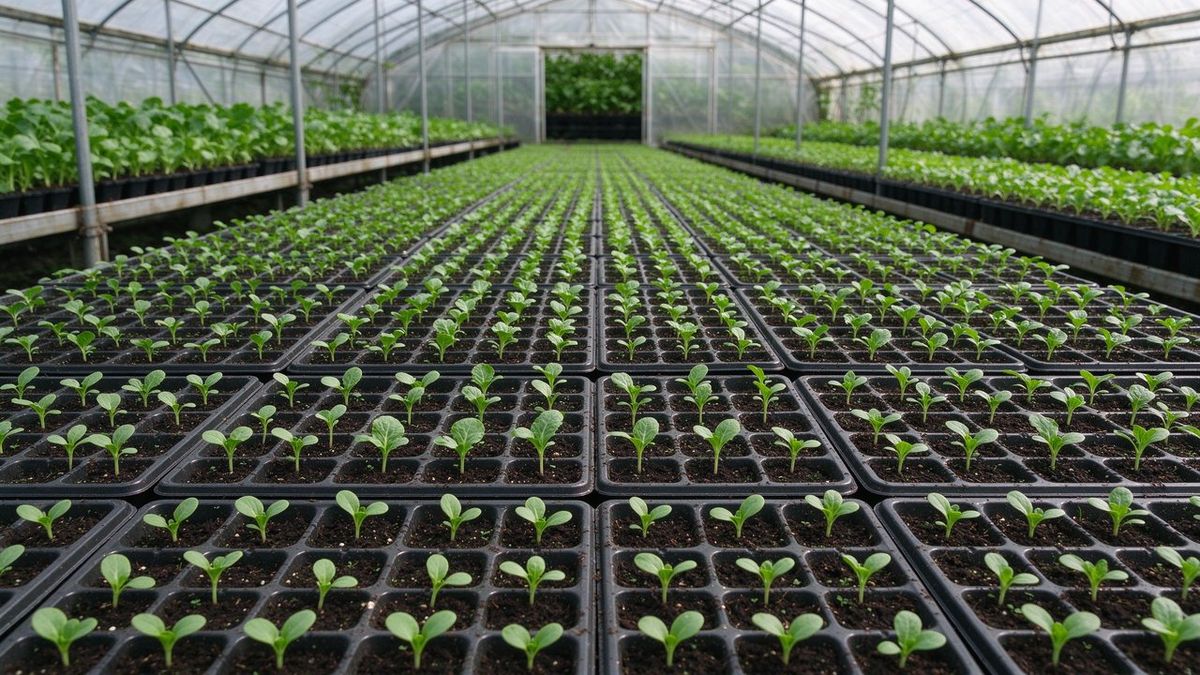
After healing, grafted plants move to a 22/18 degrees day/night greenhouse for 18 to 25 days until the third true leaf unfolds. Suckers emerging from the rootstock cotyledon axil are pinched weekly; if left, they outgrow the scion and steal the plant. Clip removal occurs at 10 to 12 days after grafting, when the union has callused. Plants are hardened by reducing temperature by 3 degrees over three days before transplant.
Grafted transplants are more expensive and more sensitive to root-zone temperature than ungrafted ones. Transplanting into coco bags occurs only when root-zone temperature reaches 22 degrees; below 20, the graft union slows and root rot takes hold. Planting depth must keep the graft clip 3 to 4 cm above the coco surface, because burying the union allows the scion to root on its own and defeats the purpose of grafting.
Yield, Quality, and Economics
Grafted watermelon yields 15 to 25 per cent more marketable fruit per square metre than ungrafted, and average fruit weight increases by 0.5 to 1.0 kg. The main risk is excessive vegetative vigour, which delays fruit set by 7 to 10 days and reduces Brix by 0.5 degrees. This is controlled by raising EC during fruit swell to 3.0 to 3.2 mS/cm and by allowing only two fruit per plant rather than three.
Economics: grafted transplants cost 0.35 euro more than ungrafted. Over a 100 m² bay with 310 plants, that is 108 euro extra. The return is 15 per cent higher yield of premium fruit, worth 400 to 600 euro per bay, plus avoided soil fumigation. Grafting is therefore mandatory for continuous greenhouse production where substrate cannot be rotated out; for single-season soil crops, the economics depend on land cost and Fusarium pressure.
Grafting turns watermelon from a one-season soil crop into a repeatable greenhouse performer. The key discipline is matching rootstock vigour to the production system: mild rootstocks for coco substrate, strong rootstocks for soil with known disease pressure. When the graft union is kept above the medium and vigour is controlled by EC, grafted crops deliver the disease resistance and consistent yield that justify the extra transplant cost.


