
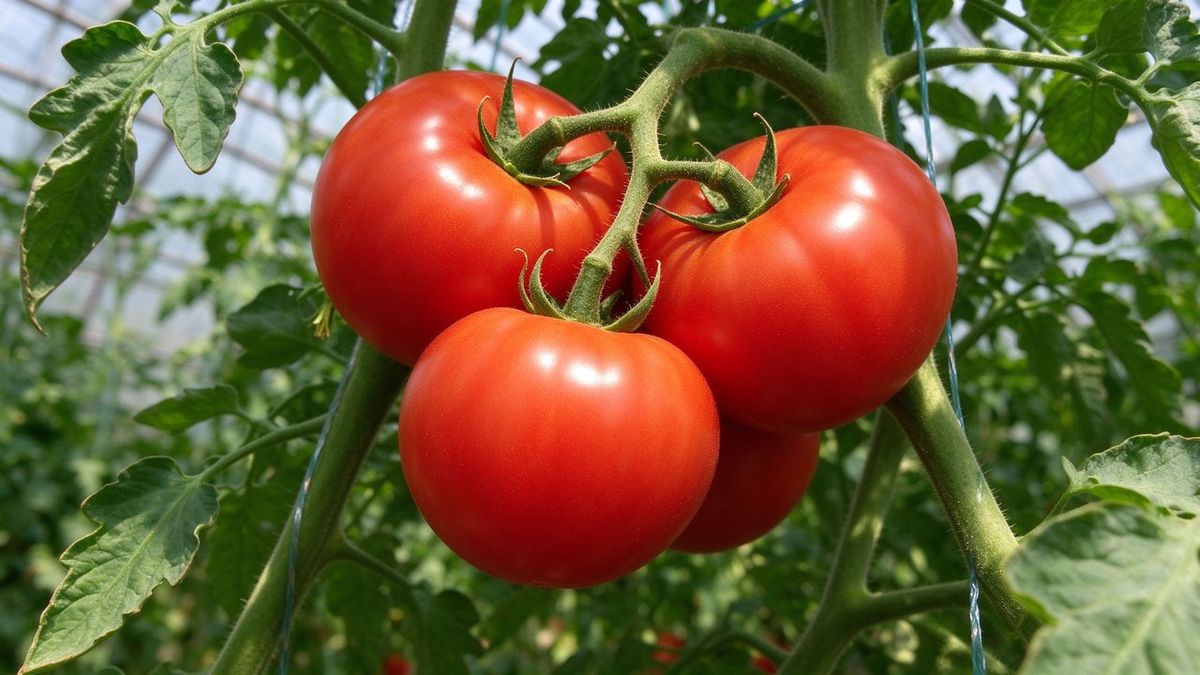
Heirloom tomatoes command a two to three times higher price at farmers markets and specialty grocers, but they yield half to two-thirds of a modern hybrid on the same greenhouse floor. The choice between them is not emotional; it is arithmetic based on market channel, labour availability, and disease pressure. A high-wire hybrid returns 55 to 70 kg per square metre per year at 2 euros per kg; an heirloom returns 25 to 35 kg at 5 euros per kg. Both can win, but only if the grower matches the crop to the sales contract and budgets for the extra hand work that heirlooms demand.
Yield and Market Math
A modern round hybrid on Maxifort rootstock averages 60 kg per square metre per year on a high-wire system. A standard heirloom such as Brandywine or Cherokee Purple yields 25 to 35 kg on the same floor, because the plant sets fewer trusses and aborts fruit under any stress. At 2.50 euros per kg the hybrid earns 150 euros per square metre; at 6 euros per kg the heirloom earns 165 euros.
The gap closes on shelf life. Heirlooms hold 4 to 6 days at 12 degrees Celsius, hybrids 14 to 18 days. A grower shipping 200 km loses 15 percent of heirloom fruit to soft rot, erasing the price premium. Local direct sales are the only channel where heirlooms consistently win.
Disease and Climate Tolerance
Hybrids carry stacked resistances: ToMV, Fol, For, Va, Vd, and often TYLCV. Heirlooms carry almost none of these, so they require stricter hygiene, lower humidity, and a weekly scouting walk for leaf mold and early blight. A 1 percent Botrytis incidence costs 8 percent of an heirloom crop; the same incidence costs 3 percent of a hybrid.
Heirlooms are also less tolerant of heat. Fruit set drops above 28 degrees Celsius, and pollen dies at 32 degrees. Hybrids set fruit up to 32 degrees. In a greenhouse without active cooling, the heirloom gap widens in July and August.
Training and Labour
Heirlooms grow vigorous, branching stems that need suckering twice per week instead of once. Average labour on a high-wire hybrid is 8 hours per square metre per year; on an heirloom, 12 to 14 hours. Thin fruit hard: 3 to 4 fruit per truss for large beefsteak heirlooms, otherwise fruit splits and misshapes.
Harvest is slower because heirlooms ripen unevenly within a truss. Crews pick 60 to 80 kg per hour on hybrids and 35 to 50 kg per hour on heirlooms. Budget this when quoting a weekly supply contract.
Flavour and Eating Quality
Heirlooms score 7.5 to 8.5 on a 9-point taste panel; modern hybrids score 6.0 to 7.0. The difference is mostly in the soluble sugar and volatile profile. Modern taste-improved hybrids close the gap to 7.0 to 7.5, but they still lack the acidic bite that heirlooms show at 8.5 to 9.5 degrees Brix.
Flavour is climate-dependent. Heirlooms grown under a daily light integral below 18 mol per square metre per day taste watery even when genetics are correct. Wait for spring planting, or run 100 micromol of LED interlighting, before committing to an heirloom block.
Block Planning and Risk Spread
Growers usually hedge: 70 percent of floor in hybrid for cash flow, 30 percent in heirloom for premium channels. This spreads the risk of a Botrytis outbreak, which would wipe out an all-heirloom house but only dent a hybrid house.
Test three heirloom varieties on 50 square metres for one season before scaling. Record yield, Brix, shelf life, and customer feedback. Zhongtian Agricultural Technology runs a 100-square-metre heirloom trial block each spring so growers can compare Brandywine, Cherokee Purple, and Green Zebra side by side.
Heirlooms win on price and flavour, hybrids win on yield, shelf life, and disease tolerance. The right mix is a market decision, not a sentimental one. Calculate the per-square-metre revenue for your actual channel, budget the extra labour, and test on a small block before committing a full house.


