
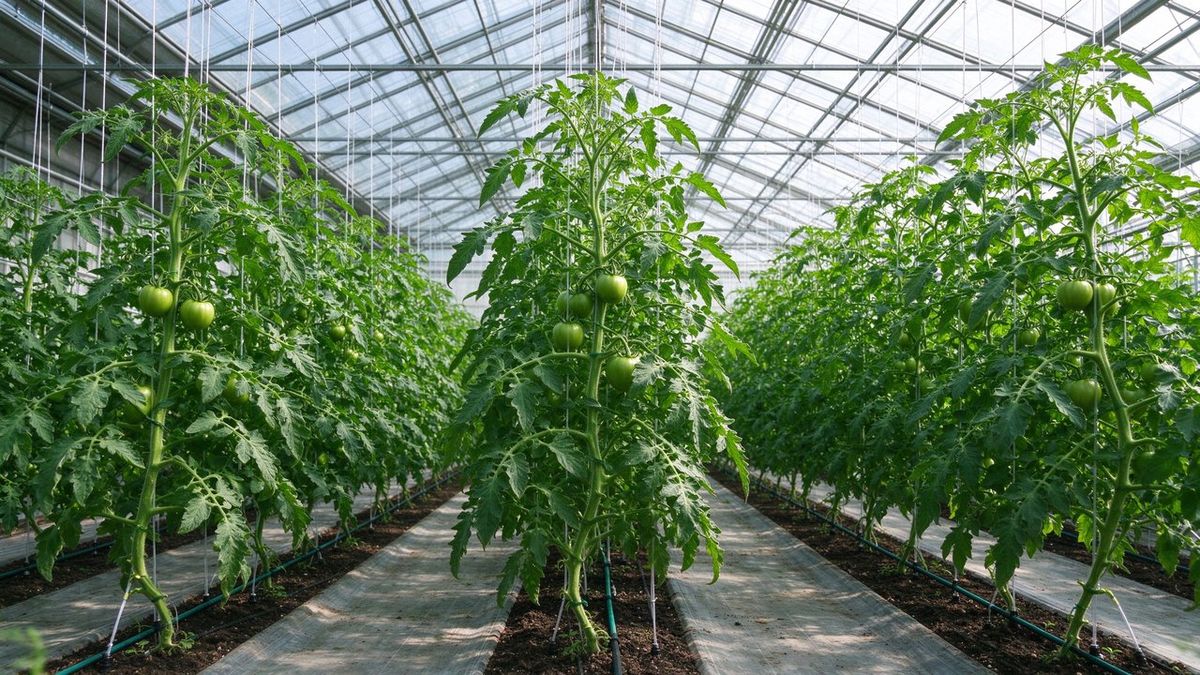
The high-wire tomato system is the standard for year-round greenhouse production. A single overhead wire 2.2 to 2.4 m below the gutter supports stems that are leaned and lowered weekly as they grow. A well-run high-wire crop yields 55 to 75 kg per square metre per year, with harvest every Monday and Thursday. The system demands disciplined suckering, a fixed leaning schedule, and a 12-truss rotation, but it gives the most predictable cash flow of any greenhouse tomato method.
System Layout
String overhead wires at 2.2 to 2.4 m below the gutter, aligned 1.6 to 1.8 m apart. Run twine from the wire to each plant base. Plant at 2.5 to 3.3 stems per square metre depending on winter or summer density. The walkway between rows is 80 cm wide, enough for a harvest cart.
Install a harvest rail or conveyor at 1.2 m height on one side of each row. This cuts harvest time by 20 percent because crews do not carry crates. The rail cost is recovered in one season on a 5000-square-metre house.
Leaning and Lowering Schedule
Lean and lower plants once per week, on a fixed day. Lower by 25 to 40 cm per week, creating a horizontal tail of old stem on the floor. Keep the growing point 30 to 40 cm below the overhead wire at all times.
Follow a fixed lean direction row by row, marked on a whiteboard at the end of each row. Crossed stems break and invite disease. After 12 trusses, the horizontal tail carries 6 to 8 old leaves; strip them only when 30 percent yellow.
Stem Density by Season
Run 2.5 stems per square metre in winter when daily light integral is below 12 mol. Move to 3.0 to 3.3 stems in spring and autumn at 18 to 22 mol. Allow 3.6 stems in bright summer. Denser canopies intercept more light but raise humidity above 90 percent at night.
Thin stems if the canopy closes too early. Remove one stem per square metre in mid-winter if leaves overlap by more than 20 percent. A crowded canopy yields 10 percent less than an open one.
Truss Rotation and Harvest Flow
Plan a 12-truss rotation: a new truss every 3 to 4 days, with harvest every Monday and Thursday. Track truss number on a tag at the base of each plant. A 12-truss crop finishes in 10 to 12 months.
Green harvest one truss ahead of full colour to even out weekly supply. Cut trusses at 5 to 10 percent colour and finish in a 18 to 20 degrees Celsius ripening room. This lets crews work on a fixed schedule and avoids weekend harvest.
Labour and Economics
A high-wire crop needs 8 to 10 labour-hours per square metre per year: suckering 2, leaning 1.5, thinning 1, harvest 3, scouting and spraying 1.5. Budget 0.8 to 1.0 euro per square metre per year in labour.
At 60 kg per square metre and 2.50 euros per kg, revenue is 150 euros per square metre. Substrate, energy, and seed cost about 70 euros; labour 10 euros; net margin 70 euros per square metre. A 5000-square-metre house returns 350,000 euros per year.
Plan the crop calendar around two 12-truss cycles. A summer crop finishes in 10 months; a winter crop needs 12 months. Overlap the last truss of the old crop with the first truss of the new so harvest never stops. Zhongtian Agricultural Technology supplies the overhead wire, twine, and truss clips as a complete high-wire kit.
The high-wire system is the most reliable year-round tomato method. Fixed weekly leaning, 12-truss rotation, and season-adjusted stem density give 55 to 75 kg per square metre. The disciplined labour schedule is the price of predictable cash flow. A weekly stem diameter check at 30 cm above the slab flags overcrowded rows before yield drops, and a whiteboard lean direction prevents crossed stems that break under fruit load.


