
Hydroponic tomato production has moved far beyond the simple Dutch bucket. Today’s protected horticulture chooses between rockwool slabs, coco coir bags, perlite bags, drip-fed NFT channels, and closed aquaponics loops, each with a different cost structure, oxygen reserve, and disease profile. The right system is the one that matches the grower’s water quality, labour calendar, and sales window. A careful comparison of root-zone temperature control, drain-to-waste versus closed-loop nutrient recovery, and capital cost per square metre prevents the costly mistake of buying a system that suits someone else’s climate.
Rockwool Slabs
Rockwool remains the benchmark in high-wire tomato production because it is inert, uniform, and drains predictably. Standard slabs measure 100 by 20 by 8 cm and hold about 5 litres of water at field capacity. Two plants per slab gives 2.5 to 3.3 stems per square metre depending on bed width. pH is buffered by pre-watering with a pH 5.5 nutrient solution; fresh slabs start at pH 7.5 and must be conditioned over 24 hours before transplanting.
Drain-to-waste is typically 25 to 30 percent of irrigation volume. Recirculating rockwool systems require a slow sand filter or UV at 254 nm before the drain returns to the tank, because Fusarium oxysporum and Pepino mosaic virus move easily in recirculated water. Slab cost is about 0.80 to 1.20 euro per crop, and disposal requires a waste stream contract in most regions.
Coco Coir Bags
Coco coir has replaced rockwool in many nurseries because it is a renewable raw material and holds 8 to 9 litres of water per 100 by 20 cm bag. Buffered coco with a potassium wash below 2 mmol per litre avoids the potassium lock-out that used to plague coco crops. EC in coco rises 0.3 to 0.5 mS per cm above the feed EC due to cation exchange, so feed EC is set 0.2 lower than rockwool.
Coco drains fast and oxygenates well, which reduces Pythium root rot compared with rockwool. However, coco releases potassium over the first three weeks, so weekly root-zone analysis is required. Disposal is easier: used coir can be composted or incorporated into landscape soil at 10 percent by volume.
Perlite Bags and Dutch Buckets
Perlite bags are popular in Mediterranean climates where water is cheap and labour is low-cost. A 15-litre perlite bag supports two plants, drains within minutes of irrigation, and is reused for three to four crops after steam sterilisation at 95 degrees Celsius for 30 minutes. Perlite holds almost no nutrient buffer, so EC must be monitored daily; a 0.5 mS per cm swing in root zone is common.
Dutch buckets filled with perlite or pumice are the closest equivalent in recirculating systems. Each bucket holds 8 to 12 litres and is watered by one 2-litre-per-hour drip emitter. Buckets are easy to move between crop cycles and allow spot replacement of a diseased plant without breaking the row.
NFT and Deep Water Culture
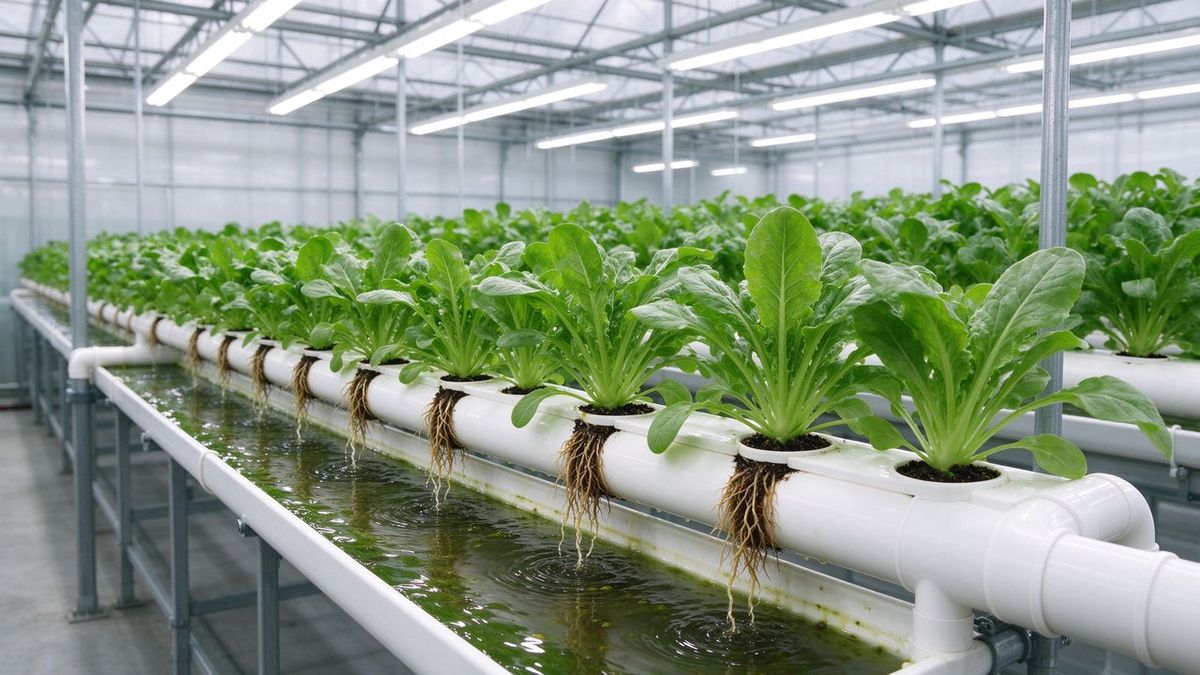
Nutrient film technique uses a thin 3 to 5 mm layer of solution flowing through 10 cm gullies. Lettuce and herbs suit NFT, but tomatoes are risky: root mat temperature rises above 28 degrees Celsius on bright days, oxygen drops below 4 mg per litre, and Blossom end rot follows. NFT tomato crops are limited to short-cycle cherry varieties in cool greenhouses.
Deep water culture with floating rafts works for leafy crops but not for indeterminate tomatoes. The large air pump and aeration cost cannot compete with drip slabs for a 12-month tomato crop. Where aquaponics is required, media beds with expanded clay pebbles give tomatoes the structural support they need.
Closed Loop versus Drain-to-Waste
Closed-loop systems capture 95 percent of drain water and cut fertilizer use by 30 to 40 percent, but they demand a disinfection step. Slow sand filtration at 0.5 cubic metres per square metre per hour removes 99 percent of fungal spores; UV at 40 mJ per square centimetre inactivates viruses; heat treatment at 95 degrees Celsius for 30 seconds is the most reliable but uses 0.4 kWh per cubic metre.
Regulation in many regions now requires closed loops for new greenhouses. The investment of 8 to 15 euro per square metre for a disinfection and blending unit pays back in 3 to 5 years on fertilizer savings alone. Zhongtian Agricultural Technology supplies both drain-to-waste slab systems and fully closed loops with automatic EC and pH blending for tomato growers across northern China.
No single hydroponic system wins on every axis. Rockwool gives predictable uniformity, coco gives a renewable substrate and fast oxygenation, perlite gives cheap reuse with steam, and closed loops give regulatory compliance and water savings. Match the substrate to your water quality, labour, and sales window, and budget for disinfection from day one if you plan to recirculate.


