
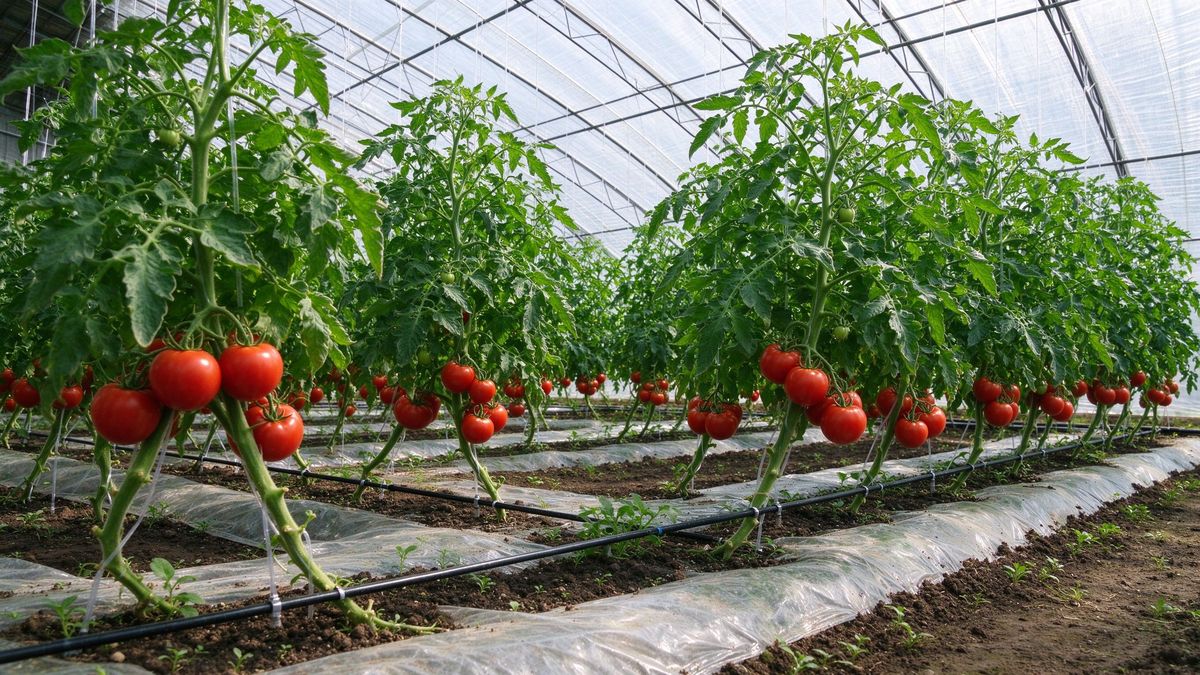
Protected horticulture has become one of the most important production methods for ensuring year-round vegetable supply. As facility agriculture continues to advance, greenhouse vegetable growing has evolved from a season-specific supplement into a fully industrialized, high-efficiency production system. Zhongtian Agricultural Technology has been at the forefront of this transformation, helping growers move from trial-and-error farming to data-driven, precision cultivation. This guide systematically outlines the key technical stages of modern greenhouse vegetable production to provide practitioners with scientific and refined management guidance.
Site Selection and Greenhouse Structure Optimization
Choosing the right site is the foundation of a profitable greenhouse operation. The ideal plot is flat, sheltered from prevailing winds, fully exposed to sunlight, and conveniently connected to irrigation and drainage systems. Soil should have a pH between 6.0 and 7.5, with organic matter content of at least 1.5 percent. Zhongtian Agricultural Technology recommends maintaining a buffer distance of 300 meters or more from major roads to reduce dust and exhaust pollution.
Regarding structure design, a single-span greenhouse typically has a width of 8 to 12 meters and a ridge height of 3.5 to 4.5 meters, fitted with a double-layer inflatable film system. Multi-span greenhouses adopt a sawtooth roof design with a top height of 5 to 6 meters and are equipped with automatic shading systems. In northern regions, a semi-subterranean structure, sunk 0.8 to 1.2 meters below ground level, significantly improves heat retention and reduces winter heating costs.
Intelligent Environmental Control
Temperature management follows a gradient control strategy. During the day, air temperature is maintained at 25 to 28 degrees Celsius; at night, it is held between 15 and 18 degrees Celsius, while soil temperature stays at 18 to 20 degrees Celsius. In winter, a three-film-plus-curtain insulation system provides reliable frost protection. In summer, an evaporative cooling pad combined with exhaust fans and a top-spray system can reduce internal temperature by 5 to 8 degrees Celsius.
Light regulation uses light-conversion films with a transmittance of at least 85 percent. On overcast days, LED supplementary lighting with 660nm red and 450nm blue diodes runs for 4 to 6 hours daily. Carbon dioxide concentration is maintained at 800 to 1200 ppm through an intelligent fertilizer applicator, while relative humidity is kept between 60 and 80 percent using circulation fans.
Precision Cultivation Practices
Soil improvement begins before crop rotation with deep plowing to 30 to 40 centimeters and the application of 5 to 8 tons of decomposed organic fertilizer per mu. Calcium cyanamide at 30 kilograms per mu is used for high-temperature solarization. An EC monitoring system keeps soil salinity below 2.5 mS/cm, preventing the salinization common in intensive greenhouses.
Water and fertilizer integration uses drip irrigation with 30 cm emitter spacing and 2 L/h flow. Formula fertilization follows N-P-K ratios of 1:2:1 during seedlings and 2:1:3 during fruiting. Chelated trace elements are supplemented 2 to 3 times per season. Solanaceous crops are trained to a single stem with 6 to 8 fruit clusters; bumblebee pollination improves fruit set by over 30 percent.
Green Pest and Disease Management
Prevention starts with 60-mesh insect-proof screens and yellow-blue sticky cards at 30 per mu. Biological control releases Encarsia formosa against whiteflies, Bt sprays against caterpillars, and Trichoderma against soil-borne diseases. When intervention is needed, fungicides are alternated to avoid resistance, with strict observation of the 7-to-15-day safety interval.
Digital and Automated Applications
Zhongtian Agricultural Technology deploys IoT sensor networks updating every 5 minutes or less. An AI decision engine automatically adjusts environmental parameters based on crop growth models. Automated transplanters operate at 1,200 seedlings per hour, and rail-mounted spray vehicles reduce chemical exposure. A blockchain traceability system records every stage from nursery to harvest.
By optimizing facility structure, implementing intelligent environmental control, adopting green pest management, and integrating IoT technology, growers can increase vegetable yields by over 40 percent while reducing pesticide use by 60 percent. As plant factories and vertical farming continue to develop, protected vegetable cultivation will open even broader prospects.


