
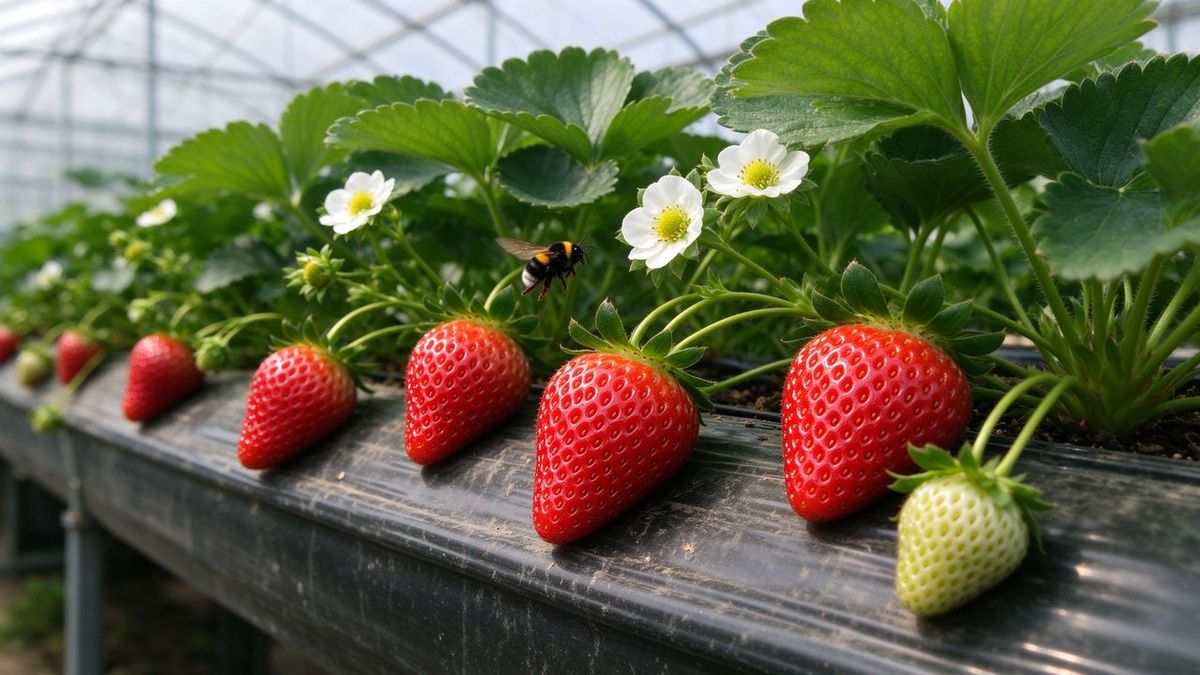
Botrytis cinerea, the grey mould, destroys more greenhouse strawberry fruit than every other pest combined. Infection starts on dead petals trapped against green fruit and explodes into soft brown rot within 48 hours when relative humidity exceeds 90 per cent. A 5 per cent loss at harvest translates into 8 to 12 per cent at retail, because latent lesions bloom in the punnet. The prevention programme combines climate dehumidification, canopy architecture, biological sprays, and a tightly limited chemistry rotation.
The Infection Cycle and Climate Triggers
Botrytis spores germinate in free water at 15 to 25 degrees Celsius. A single open flower exposed to a wet leaf surface for four hours at 18 degrees Celsius has a 30 per cent infection probability. The pathogen then grows as endophytic mycelium through the receptacle and only expresses symptoms when the berry softens at maturity. This is why seemingly healthy packed fruit rots in transit: the infection was invisible at harvest.
Climate controls the cycle directly. Vents open when canopy temperature reaches 21 degrees Celsius, and horizontal airflow fans run at 0.4 m/s to keep leaf surfaces dry. At dusk, heating is used to maintain a 1.5 to 2.0 degree Celsius temperature rise for two hours; this lowers relative humidity by 10 to 15 per cent and prevents dew formation on fruit. Dew points are monitored with a wet-dry bulb sensor, and heating kicks in whenever canopy temperature approaches the dew point.
Canopy Sanitation and Petal Removal
Dead petals are the primary infection court. A weekly de-handing walk removes spent petals and any leaves lying on fruit trusses. Trusses are routed so fruit hangs below the canopy in the dry air channel, never resting on a leaf. Dense ‘Albion’ canopies are trimmed of every third older leaf at week 6 and again at week 10 to open the centre; this reduces humidity within the truss by an estimated 15 per cent.
Harvest hygiene is equally important. Pickers wash hands before entering each bay, and picking trays are disinfected with peracetic acid at 0.2 per cent at the start of every shift. Any berry showing a brown patch is dropped into a separate discard pail, never back into the harvest crate, because a single rotting fruit contaminates 20 surrounding berries in a packed carton. Cull waste is removed from the greenhouse immediately; it is never dumped between bays.
Biological and Botanical Programmes
Gliocladium catenulatum strain J1446 is applied as a substrate drench and foliar spray at 10 g per 100 m² every 14 days from first open flower. It colonises the petal surface and outcompetes Botrytis germ tubes. A second biocontrol, Bacillus amyloliquefaciens strain QST 713, is alternated at 2 kg per hectare in 500 litres of water at 7-day intervals. These two products rotate to avoid selection pressure on either antagonist.
Chitosan-based products at 0.2 per cent (2 mL/L) trigger induced resistance and thicken the fruit cuticle. Sprays are applied in the morning and allowed to dry before evening humidity builds. Trials show that a full biocontrol programme keeps Botrytis incidence below 3 per cent of fruit in dry years, but rises to 7 to 9 per cent during prolonged wet weeks when climate setpoints cannot hold RH below 80 per cent.
Chemistry Rotation and Resistance
When biocontrols reach their limit, a short, targeted chemistry programme is used. Cyprodinil plus fludioxonil at 0.8 kg per hectare is applied at first open flower and again at 50 per cent harvest, with a 3-day pre-harvest interval. Penthiopyrad is used for one application in mid-crop, rotating modes of action so no single chemistry is used more than twice per cycle.
Resistance monitoring is essential: Botrytis populations in intensive strawberry regions already show resistance to benzimidazoles and dicarboximides, so those chemistries are excluded from protected programmes. Spray volumes are kept at 600 to 800 litres per hectare with fine-dropleat nozzles at 800 kPa to reach petal surfaces; a high-volume coarse spray washes petals off rather than coating them. Hive boxes are sealed during any fungicide application and reopened 24 hours after residues dry.
Botrytis is won before the fruit rots: in the climate setpoints at dusk, in weekly petal removal, and in disciplined rotation. A grower who spends more on heating than on fungicides typically has lower fruit loss, because dehumidification is cheaper per kilogram of marketable berry than rescue sprays. The principle is simple: keep petals dry, keep fruit off leaves, and keep chemistry as the last lever rather than the first.


