
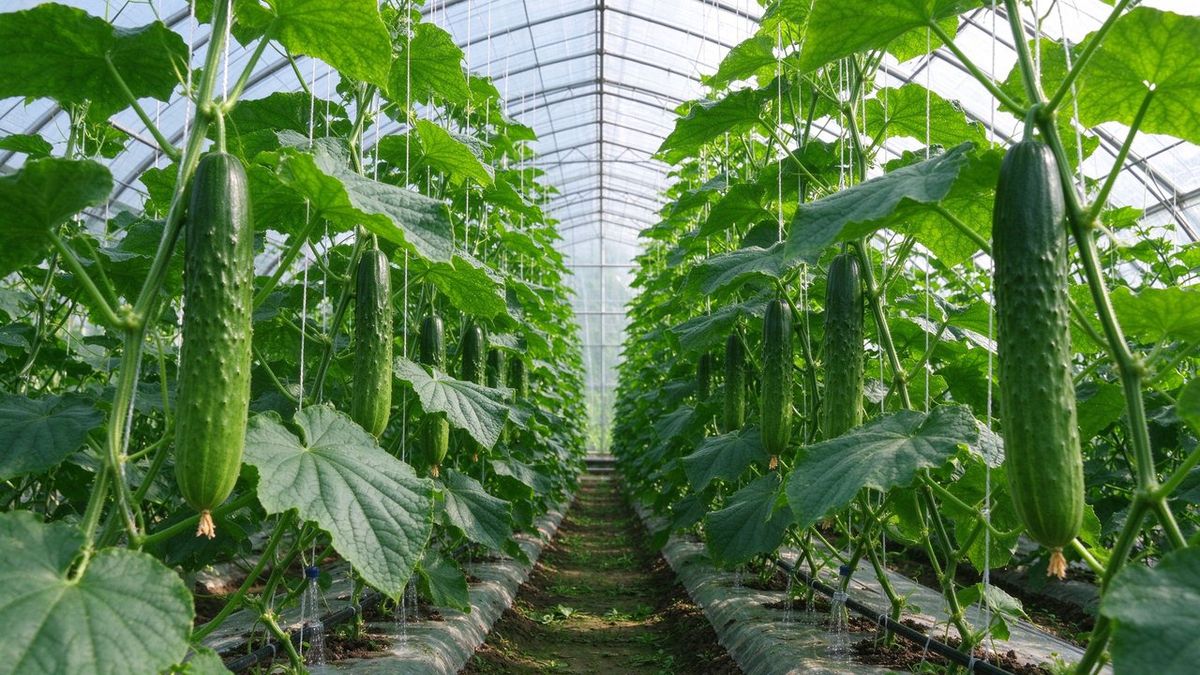
Single-stem cordon pruning is the backbone of high-yield English cucumber production in multi-span high tunnels. By removing lateral shoots and restricting the crop to one vertical leader, growers raise fruit quality, improve light interception, and keep harvest teams working on a uniform plane. The system demands weekly, sometimes twice-weekly, intervention once plants exceed 1.8 m. Done correctly it supports 3.5 to 4.5 kg per square metre of weekly harvest; done late it invites powdery mildew, crooked fruit, and a collapsing canopy.
Why Single-Stem Training Pays Off
Cucumber is a fast-growing vine that, left unpruned, builds a dense canopy which traps humidity and blocks the horizontal air flow needed to dry leaf surfaces. A single leader trained up vertical twine at 1.4 to 1.6 stems per square metre opens a 40 cm working aisle below the first fruit node and concentrates assimilates into marketable long-fruit cultivars rather than wasteful lateral biomass. A density of 2.0 to 2.4 plants per square metre on a rockwool or coco slab, with one stem per plant, is the recognised balance between light and airflow in a 7.5 m wide bay.
The economic case rests on uniformity. Single-stem fruit develops at a consistent height between 1.5 and 2.2 m, where bumblebee activity and the greenhouse microclimate are most stable, and where pickers harvest without ladders. Commercial records show pruned cordons carry a higher share of grade-1 straight fruit because every cucumber hangs free of foliage instead of pressing against leaves that cause bending scars and constriction rings during rapid elongation.
Pinching Lateral Shoots the Right Way
Begin disbudding lateral shoots at the fourth to sixth true leaf and continue every 7 days. Snap side shoots out by hand while they are still under 5 cm long, before the cut woody stem opens a wound that Botrytis and Didymella can exploit. Remove the lateral together with its tiny tendril but leave the subtending leaf intact; leaves below the first two fruit nodes are the main photosynthetic engines feeding the lower truss.
Do not strip more than one leaf node per plant per visit. Cucumber needs roughly 28 to 32 functional leaves per square metre of floor area to fill the crop. Removing lateral shoots too early, before they are large enough to pinch cleanly, leaves ragged stubs that weep sap and attract thrips. A sharp, alcohol-dipped blade is preferred once shoots exceed 8 mm diameter.
Managing Fruit Load on the Leader
Long English cucumbers set one fruit per node. Start letting fruit develop from node 8 to 10 upward; abort the first four to six fruit by snipping them off, because early fruit on a weak rooted transplant will pinch stem growth and delay the whole crop. Retain one fruit per node on every node from node 10 onward, which yields roughly 28 to 32 fruit per plant over a 12 to 14 week picking window.
If stem diameter drops below 10 mm or internodes stretch past 18 cm, the crop is overloaded. Thin back to one fruit every second node for one week to restore vigour. Conversely a thick, vegetative stem with aborted flowers means the climate is too hot or too wet; raise fruit load by keeping every fruit node until the ratio of stem length to fruit weight rebalances.
Lowering the Crop and Height Control
Once the leader reaches the overhead wire at 2.6 to 2.8 m, stop the growing tip above the last two fruit nodes or begin the lowering and leaning (V-crop) procedure. Lowering means untying the twine and letting the stem wind down in a gentle spiral along the slab, so the growing tip stays at 1.8 to 2.0 m. Never bend the stem below a 60 cm radius; cucumber stems snap easily and the wound admits bacterial wilt pathogens.
At each lowering, remove the lowest two to three leaves so a 0.5 m stem base is visible and dry. Aim for a leaf layer between 1.5 and 2.5 m above the slab and a fully transparent floor-level band. Lower on a dry morning so wounds scab over within hours; avoid lowering when relative humidity is above 85 percent, because wet wounds double the Botrytis infection rate.
Sanitation and Tool Discipline
Pruning wounds are the principal entry point for cucumber green mottle mosaic virus and Corynespora leaf spot. Tools must be disinfected between bays using a 0.5 percent sodium hypochlorite or 70 percent dip, and workers should prune healthy plants first before moving to blocks showing symptoms. Do not prune and harvest with the same gloved hands in one pass.
Collect all pruned leaves into closed crates and remove them from the tunnel the same day; rotten leaf piles on the slab are a reservoir for powdery mildew conidia and thrips pupae. Zhongtian Agricultural Technology recommends scheduling pruning on a dry, ventilated morning and following every pass with a short climate lift of 1 degree Celsius and 15 percent opening of the roof vent to drop surface humidity below 75 percent before evening.
Single-stem pruning is not a cosmetic job; it is the load-management tool that keeps fruit straight, disease pressure low, and picking heights safe. Weekly intervention, controlled fruit numbers, dry-morning lowering, and strict tool hygiene convert a vigorous vine into a predictable 3.5 to 4.5 kg per square metre weekly harvest through the whole season.


