
Why Watermelon Is Grafted
Watermelon is the most widely grafted cucurbit worldwide. Fusarium wilt devastates susceptible varieties in continuous cropping, and soil fumigation is increasingly restricted. Grafting onto resistant rootstocks solves the disease problem and delivers vigour benefits that raise yield.
Interspecific hybrid squash rootstocks, crosses of Cucurbita maxima and Cucurbita moschata, are the standard choice for disease resistance and salinity tolerance. Bottle gourd rootstocks are used where greater vigour and different soil adaptation are preferred. Variety selection depends on soil conditions, water quality, and market requirements.

Fruit Quality Considerations
Grafting influences fruit quality, sometimes favourably and sometimes not. Vigorous rootstocks can increase fruit size, but excessive vigour may reduce soluble solids if the canopy outgrows the fruit load. Firmness and rind thickness generally improve, which benefits transport.
The practical control is crop load management. Thinning fruit to a target number per plant, combined with balanced potassium nutrition late in the season, maintains sugar content. Growers should taste-test grafted fruit from their own site rather than rely on published reports, because rootstock effects interact strongly with local conditions.
Grafting Methods and Healing
Watermelon grafting commonly uses the one-cotyledon splice method or the hole-insertion method. In the one-cotyledon approach, the rootstock's growing point is removed and the scion is inserted into the hypocotyl, which prevents rootstock regrowth from competing with the scion.
Healing chambers maintain high humidity and temperatures near twenty-five degrees for three to five days. Light is increased gradually to avoid scorching tender unions. After healing, plants are hardened before field or greenhouse planting.

Field and Greenhouse Management
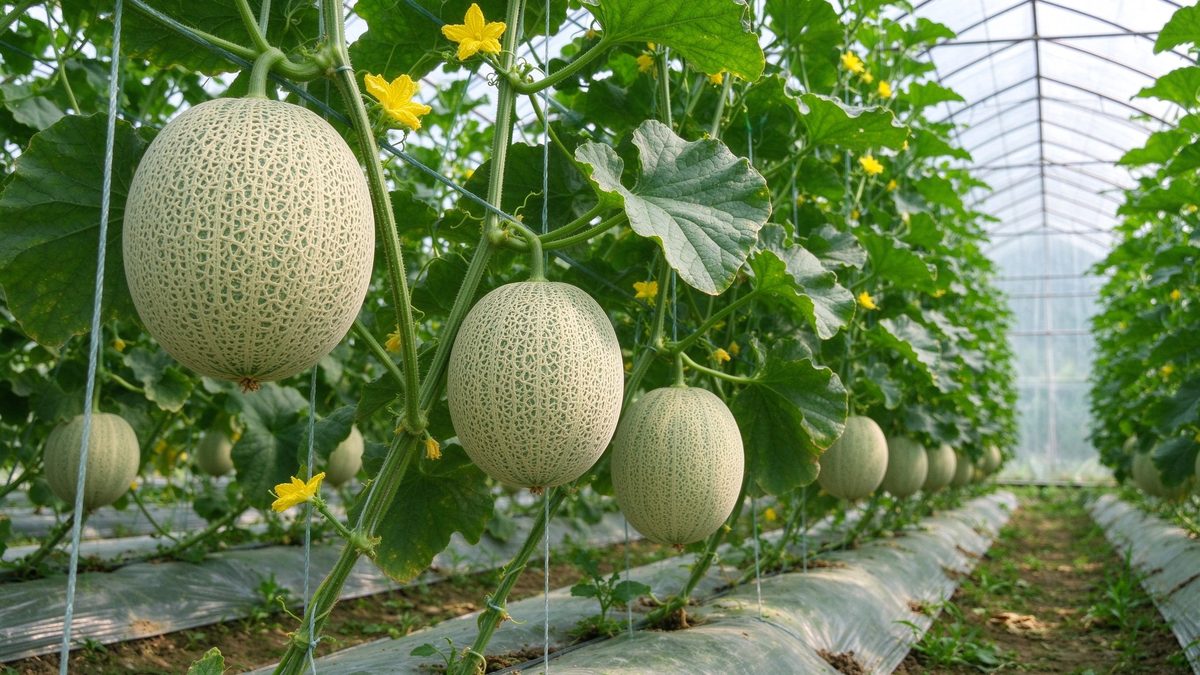
In greenhouse production, grafted watermelon is trained vertically on trellis with fruit supported in nets. Grafted plants tolerate the higher salinity that often develops in substrate culture, and their stronger root systems support the heavier fruit load that vertical training allows.
In field production, the graft union must sit above the soil surface and irrigation must avoid burying it. Drip irrigation suits grafted plantings because it delivers water precisely without eroding soil around the union. Early season vigour usually translates into earlier harvest, which captures premium prices.
Irrigation scheduling should follow substrate moisture rather than a calendar. Overwatering dilutes flavour and promotes root disease; underwatering during fruit enlargement reduces final size. The balance is easiest to hold when substrate sensors guide decisions and drainage volume is measured every irrigation.
Grafted watermelon tolerates higher salinity than ungrafted plants, but tolerance is finite. In greenhouse substrate systems, sodium accumulation must be managed through controlled leaching and, where necessary, blending with better-quality water.
Salinity and Water Management
Transport conditions matter as much as nursery practice. Seedlings held in hot vehicles or stacked under pressure arrive damaged even when they left the nursery in good condition. Scheduling delivery for cool periods and specifying loading practice prevents avoidable losses.
Grafted watermelon seedlings are more fragile than tomato grafts because cucurbit stems are hollow and the union heals differently. Union quality at delivery largely determines field performance. Inspecting deliveries for stem cracking, root vigour, and clean callus formation is worthwhile.
Nursery Quality and Delivery
Grafted watermelon has become routine in regions where soil-borne disease makes ungrafted production impractical, and the technology is now well enough understood to plan confidently. The remaining variables are nursery quality, union handling, and crop load management, all of which respond to disciplined practice rather than to exotic inputs. Growers who standardise these three elements find grafted production predictable from season to season. Shouguang Zhongtian supplies grafted seedlings and protected structures for consistent, high-value watermelon output.
Conclusion
Grafting has become the default technology for watermelon wherever soil-borne disease limits production. It requires nursery discipline and careful field handling, but delivers reliable results. Shouguang Zhongtian supplies grafted watermelon seedlings and protected production systems for growers seeking consistent quality and yield.


