
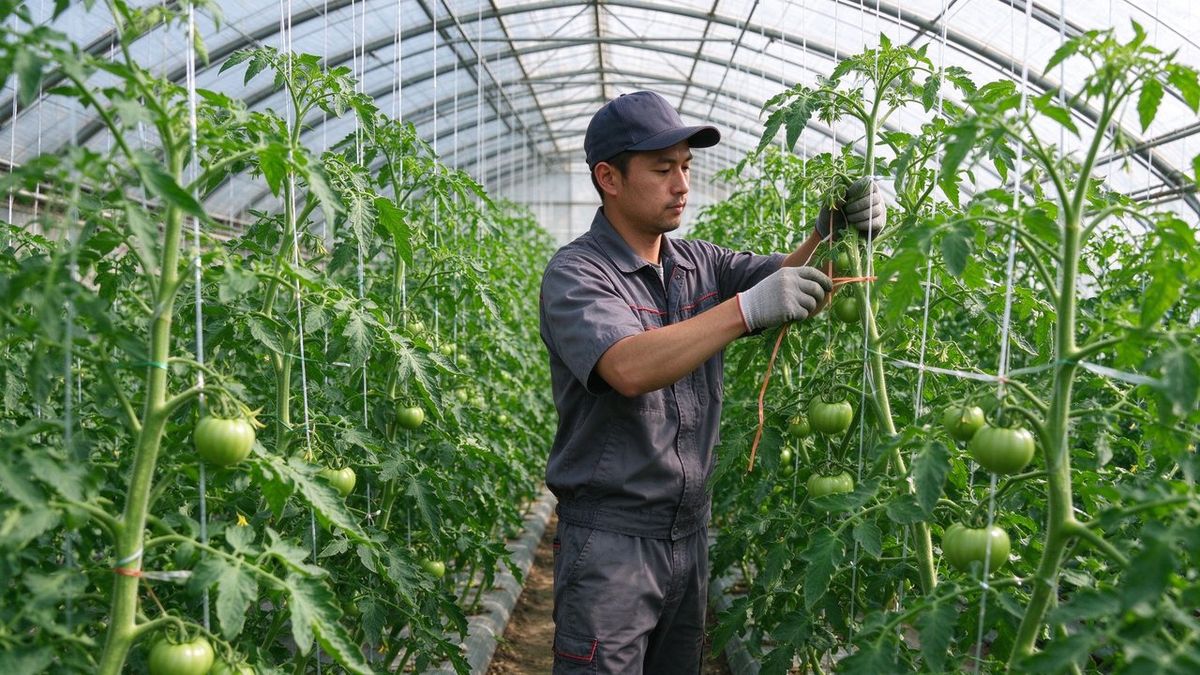
Greenhouse tomatoes grown on high-wire systems yield 55 to 75 kg per square metre per year only when pruning and trellising are disciplined from the day of transplanting. Left unmanaged, a tomato plant produces 25 or more competing shoots, shades its own fruit, raises leaf wetness, and slows truss development. The goal of pruning is to convert leaf area into photosynthate that flows to fruit, while the goal of trellising is to keep that fruit off the floor and evenly lit. Growers who standardise both operations usually report 10 to 15 percent more marketable fruit and a measurable drop in Botrytis and Oidium pressure.
Single-Stem Training and Suckering
Maintain a single stem by removing every axillary shoot that grows in the angle between leaf petiole and main stem. Suckers should be snapped out when they reach 5 to 8 cm long, before they become woody and leave a wound that invites stem canker. Work twice per week, early in the morning when turgor is high and wounds dry quickly. Never remove more than two leaves per plant per session; excessive defoliation causes sunscald on fruit and a sudden rise in fruit temperature above 32 degrees Celsius.
Lower-leaf stripping begins when the first truss is harvested. Remove yellowing or senescent leaves below the lowest ripe truss, one or two at a time, so that air moves freely beneath the canopy. Aim for a leaf layer of 12 to 14 active leaves above the highest truss. Prune with clean, sharp scissors and dip blades in 70 percent alcohol between blocks of 50 plants to reduce the spread of tobacco mosaic virus and tomato brown rugose fruit virus.
Trellising Materials and Twine Systems
Use a 2.2 to 2.4 m overhead wire strung 20 cm below the gutter, and 2.2 to 2.5 m of hanging twine per square metre of growing area. Twine must be UV-stabilised polyester or recycled PLA rated for 12 months in full sun. Anchor the twine at the base of the stem with a loose open loop, never a cinch knot, because the stem will thicken to 18 mm diameter by the tenth truss. Twine spaced at 16 to 20 cm along the row matches a planting density of 2.5 to 3.3 stems per square metre.
Wrap the stem clockwise around the twine every two to three leaves, starting at the second truss. Re-twist the row once or twice per week, lowering and leaning the plant as it reaches the wire. A standard high-wire crop is lowered by 25 to 40 cm per week, creating a horizontal tail of old stem on the floor. Keep that tail at least 10 cm above the rockwool slab or coco bag to avoid contact with nutrient solution.
Leaning and Lowering Schedule
Plan the leaning schedule so that the growing point remains 30 to 40 cm below the overhead wire at all times. Plants that reach the wire bend sharply, break stems, and lose their apical dominance. On a 12-truss-per-year rotation, a 40-day crop cycle corresponds to roughly one leaning pass every 7 days. Record the lean direction on a whiteboard at the end of each row so that every worker follows the same direction and no stem is crossed over its neighbour.
After lowering, the horizontal tail carries 6 to 8 old leaves that contribute little photosynthesis but still consume water. Strip leaves on the tail only when they are 30 percent yellow. If you strip them green, sudden sap flow to the apex can trigger fruit cracking on the ripening truss. Maintain a minimum stem diameter of 9 mm measured 30 cm above the slab; thinner stems signal that the plant is overcropped and requires a leaf or fruit thinning.
Density and Light Balance
Stem density is chosen from the daily light integral, not from habit. In northern latitudes with a winter DLI below 12 mol per square metre per day, run 2.5 stems per square metre; in spring and autumn at 18 to 22 mol, run 3.0 to 3.3 stems; in bright summer, allow up to 3.6 stems. Denser canopies intercept more light but also push up the humidity to above 90 percent at night, raising Botrytis risk.
Use a PAR sensor at canopy height to verify that at least 25 percent of incoming light reaches the fruit zone. If less, remove one leaf per week from the middle of the canopy rather than the bottom. Reflective diffuse film on the floor can lift fruit-zone light by 12 to 18 percent and improves colour uniformity on the lower trusses.
Pruning to Reduce Disease Pressure
Every wound is a gateway for Botrytis cinerea. Prune only when the screen vents are open and the house can drop relative humidity below 80 percent within two hours. Avoid pruning after an irrigation or when condensation is present. Apply a wound dressing containing 5 percent boric acid or a registered Botrytis product immediately on large stem wounds greater than 1 cm.
Dispose of pruned material in closed bags and remove it from the greenhouse the same day. Piles of sucker growth on the floor are the single largest source of grey-mold spores in a tomato house. A scouting walk twice weekly for lesions on leaf scars catches new infections within 48 hours, when a single fungicide application can still contain the outbreak.
Pruning and trellising are not one-off jobs but recurring rituals that set the upper bound of yield. A single-stem crop maintained at 12 to 14 active leaves, twined on UV-stabilised string, and leaned on a fixed weekly schedule gives the grower predictable truss development, lower disease pressure, and fruit that colours evenly. Zhongtian Agricultural Technology recommends documenting the suckering day, the lean direction, and the stem count per row so that the operation stays repeatable through every season.


