
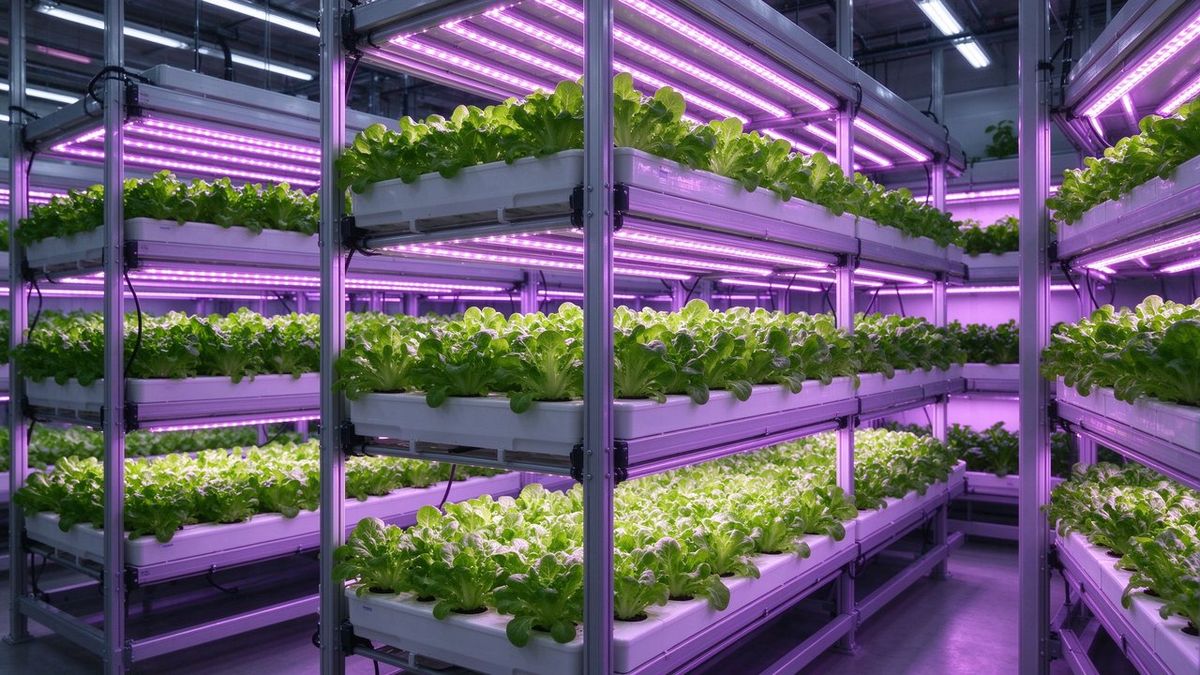
Low light in winter greenhouses drops daily light integral to 8 to 12 mol per square metre per day, well below the 18 to 22 mol that tomatoes prefer. Under these conditions pollen is weak, fruit set falls by 30 to 50 percent, and the fruit that does set is small and slow to colour. Growers in northern latitudes manage low light with LED interlighting, lower plant density, truss thinning, and a cooler day-night temperature strategy. The goal is not to maximise yield in winter, but to keep the plant productive enough that spring harvest starts on time.
Light Levels and Fruit Set
Tomato pollen germinates best at 18 to 22 degrees Celsius and 18 mol daily light integral. Below 12 mol, pollen viability drops by 40 percent, and flowers abort before fruit set. A 5-day stretch below 10 mol can lose the entire truss.
Measure PAR at canopy height weekly. Below 12 mol, reduce stem density to 2.5 per square metre. Thinner canopies intercept more light per leaf and set more fruit per truss.
LED Interlighting
Run LED interlighting at 100 to 150 micromol per square metre at truss level, 12 hours per day. Use red and far-red diodes; blue light at ripening stage does not help. Interlighting lifts fruit set by 15 to 20 percent in winter.
The electrical cost is 0.8 to 1.2 watts per square metre of LED, or 0.08 to 0.12 kWh per square metre per day. At 0.10 euro per kWh, that is 250 to 350 euros per 1000 square metres per winter. The 15 percent yield gain pays for it.
Temperature Strategy
Run a cooler day-night difference: 20 degrees day, 15 degrees night. A smaller swing keeps the plant from wasting energy on vegetative growth. Ventilate only when house temperature exceeds 24 degrees Celsius.
Avoid heating and venting at the same time. That dries the air without raising canopy temperature and stresses the plant. Use a humidity setpoint of 85 percent at night to prevent condensation on flowers.
Truss and Fruit Thinning
Thin fruit hard in winter: 4 to 5 per truss for beefsteaks, 6 to 7 for round salads. A plant that sets 9 small fruit in January yields less than one that sets 5 large ones. Reallocate assimilates to the fruit that will actually ripen.
Strip one leaf per week from the middle of the canopy if light is below 10 mol. Extra leaves in winter shade the fruit zone. Maintain 12 active leaves above the highest truss.
Nutrition Adjustment
Drop feed EC by 0.3 mS per cm in winter. High EC on a low-light plant pushes stress. Target EC 3.0 to 3.3, pH 5.5 to 5.8. Keep calcium at 140 mg per litre, slightly lower than summer.
Reduce nitrogen by 10 percent and raise potassium by 5 percent. Winter plants do not need lush growth; they need firm fruit. Track stem diameter weekly; below 9 mm signals overloading.
Raise root-zone temperature to 20 degrees even if air is cooler. Roots at 15 degrees take up nutrients at half the rate, and a winter plant already short on light cannot afford nutrient stress. Heat pipes beneath the slab at 20 degrees pay back in the first truss.
Low light is managed, not beaten. Drop density to 2.5 stems per square metre, run LED interlighting at 100 micromol, thin fruit hard, and cool the day-night swing. The goal is a plant that reaches spring with 12 active trusses, not a winter yield record. A weekly PAR measurement at canopy height confirms whether the interlighting is reaching the fruit zone, and a stem diameter check below 9 mm signals that the plant is overloaded and needs an extra fruit thinning.


