
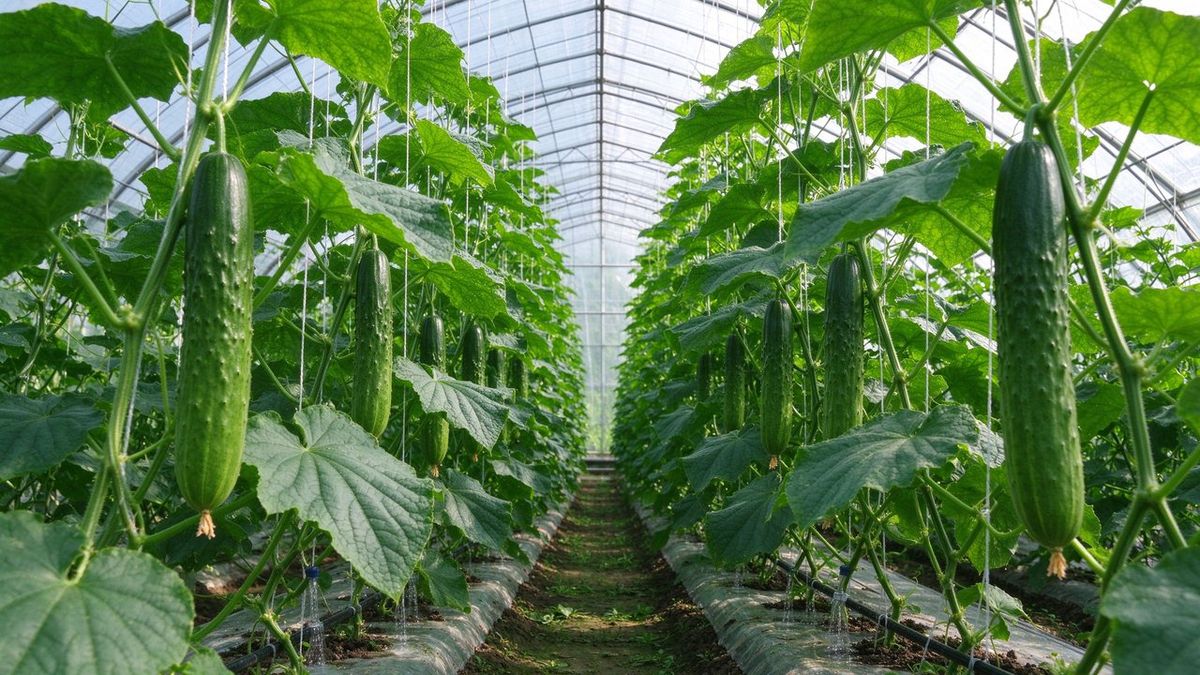
Crooked cucumbers and narrow-necked fruit are the two most common quality losses in greenhouse cucumber, cutting grade-1 pack-out by 15 to 25 percent in a single season. Both defects are physiological, not genetic, and both track back to the same root causes: uneven water, mechanical pressure on the growing fruit, and temperature swings during the 7 to 10 days from fruit set to harvest. Fixing them is a training and climate exercise, not a variety change.
Why Fruit Bends
Cucumber fruit grows fastest on its upper surface and slowest on its lower surface. When a developing fruit presses against a leaf, twine, or neighbour’s stem, the contact side cannot expand and the fruit curves away from the obstacle. A fruit hanging free in air expands symmetrically. The defect is set within the first 3 days after flowering, when fruit length is only 5 cm.
A second cause is transient water deficit. A plant that wilts for 2 hours at midday during fruit expansion produces a constricted ring or a bent tip, because the fruit stops elongating then resumes. The slab must stay between 60 and 80 percent of its water-holding capacity during the 7-day fruit window; a dry-back below 50 percent guarantees a deformed fruit.
Training Fruit to Hang Free
Position every fruit so it hangs vertically in the open air, 10 cm clear of leaves and twine. Gently loop the fruit onto a small plastic hook or let it hang free; do not rotate the fruit more than once per day, because rotating creates micro-scars that remain visible at pack-out. Harvest teams are trained to lift a fruit and check the underside before cutting.
Spacing on the leader matters. One fruit per node, spaced 15 to 20 cm apart vertically, prevents fruit touching fruit. When two fruit develop at the same node (twin set), remove the smaller one immediately; twin fruit always bends because they press against each other. Check node spacing at weekly pruning: internodes shorter than 10 cm mean the crop is too dense.
Narrow Ends and Blossom-End Defects
Narrow, pointed blossom ends signal calcium shortage during the last 3 days of fruit growth. Calcium moves with the transpiration stream, and the blossom end is the furthest point from the roots. Keep calcium in the feed at 180 to 220 mg per litre and maintain leaf wetness-free conditions so transpiration stays strong. A RH above 85 percent drops transpiration by 60 percent and starves the fruit tip.
A sudden temperature spike above 32 degrees Celsius during fruit expansion causes the same symptom: the fruit tip stops expanding while the base continues, producing a narrow end. Shade the house by 25 percent on forecast hot days, and keep the vapour-pressure deficit between 0.6 and 1.2 kPa through the fruit window.
Water and EC Stability During Fruit Expansion
A cucumber fruit expands 90 percent of its length in the last 4 days before harvest. During this window, slab water must stay within 5 percent of field capacity. Schedule irrigations every 45 to 60 minutes from 08:00 to 18:00, with 200 to 300 ml pulses per plant. Drainage should run at 25 to 30 percent; below 20 percent the slab dries too fast, above 35 percent you waste fertiliser.
EC swings are the other culprit. If the feed EC jumps from 2.4 to 3.2 mS per cm between irrigations, osmotic stress shrinks the fruit tip. Keep the slab EC within plus or minus 0.2 mS of target; check by squeezing drainage solution at 10:00 and 16:00 each day. A stable EC curve is more important than the absolute value.
Harvest Timing and Post-Harvest Handling
Harvest at 32 to 36 cm length and 350 to 450 g for long English types. Fruit left on the vine past 450 g develops a swollen blossom end and soft texture; fruit picked below 300 g lacks shelf weight. Cut with a sharp knife, never twist the fruit off; twisting tears the stem and admits Botrytis to the remaining truss.
Pack straight into flow-wrap bags within 30 minutes of harvest to prevent transpiration shrink. Store at 10 to 12 degrees Celsius, never below 8, because chilled cucumbers develop translucent water-soaked patches. Zhongtian Agricultural Technology audits every harvest team with a daily grade-out log; a block running below 85 percent grade-1 triggers an immediate climate and training review.
Curvature and narrow ends are training and climate defects, not variety problems. Keep fruit hanging free, maintain slab water and EC within narrow bands during the 7-day expansion window, and protect calcium flow with good transpiration. Grade-1 pack-out above 85 percent is achievable in every block that audibly walks its rows.


