
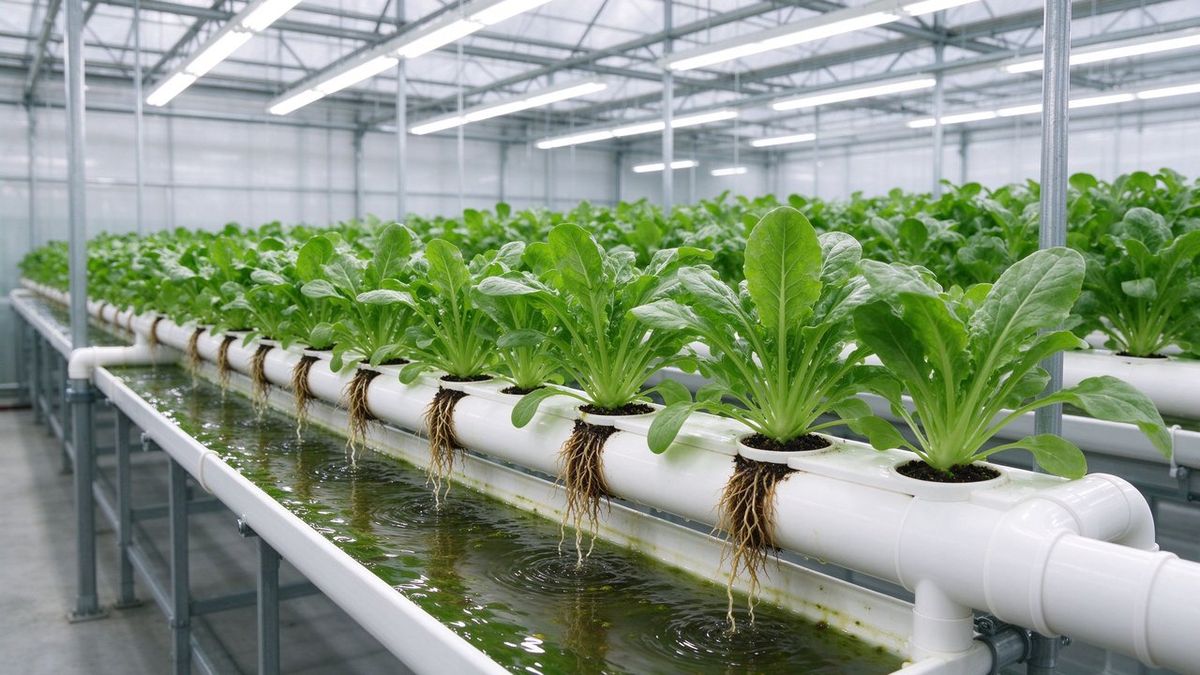
Choosing between drip-irrigated slabs and nutrient-film channels is one of the first architecture decisions a new cucumber greenhouse makes, and it changes everything downstream: water use, root oxygen, labour, and capital cost. Drip on rockwool or coco slabs is the industry default for long cucumbers; NFT is rare for large-fruit cucurbits but occasionally used for mini and Beit-alpha types. The right choice depends on fruit size, climate, and how much recirculation the grower is prepared to manage.
How Each System Works
Drip culture grows the plant on a 100 x 20 x 8 cm rockwool or coco coir slab, watered by one or two 2-litres-per-hour emitters per plant. The slab holds 2 to 3 litres of substrate and acts as a buffer; 25 to 35 percent of applied solution drains to waste or recirculates. Root zone is a moist, air-filled medium with 70 percent of its pore space filled with air.
NFT flows a shallow 5 to 8 mm film of nutrient solution down a 12 cm wide sloped channel at 1.5 to 2 percent grade. Roots hang in the film and the rest of the root mat is exposed to humid air. There is no substrate buffer: the plant’s water supply is the continuous film. Flow rate per channel is 1.5 to 2.0 litres per minute, split across two return lines per bay.
Root Oxygen and Temperature
Cucumber roots need dissolved oxygen above 6 mg per litre. Slab drip culture delivers this naturally because the slab is 70 percent air; even with recirculation, the root mat is never submerged. In NFT, the channel must slope perfectly and the film must stay thin; if the film thickens past 12 mm, oxygen diffusion into the root mat drops sharply and Pythium takes over within 10 days.
Root temperature is harder to control in NFT because roots are directly exposed to solution temperature. A 22 degree tank keeps the roots happy; a 28 degree summer day in an uninsulated channel pushes root temperature to 30 and stunts growth. Slab culture buffers temperature swings better because the substrate itself stores heat.
Yield and Fruit Size
Long English cucumbers on drip slabs average 3.8 to 4.5 kg per square metre weekly at peak, because the slab buffer supports steady fruit expansion even between irrigations. Mini cucumbers on NFT reach 3.0 to 3.5 kg per square metre weekly. Large-fruit cucurbits in NFT suffer occasional fruit abortion when a pump stops for 30 minutes; the slab buffer survives that interruption without visible damage.
Fruit quality is similar, but NFT-grown cucumbers show straighter fruit when the channel slope is uniform; slab-grown fruit is straighter when emitters are correctly spaced. Neither system wins on cosmetic quality by itself; installation quality decides.
Water, Fertiliser, and Disease Risk
Drip on slabs drains 30 percent to waste in open culture, or recirculates that 30 percent after disinfection. Water use is 1.5 to 2.0 litres per plant per day. NFT recirculates nearly 100 percent and uses 0.9 to 1.2 litres per plant per day, but the closed system means any root pathogen introduced once races through the whole bay in 24 hours.
NFT therefore demands a continuous ultraviolet or slow-sand filter on the return line, plus a weekly peroxide shock at 15 ppm. Slab drip culture in open mode has lower disease amplification because each slab is physically separate. Recirculating slab systems without disinfection are a known disease risk and should not be used for more than one crop cycle without a bleaching treatment.
Capital and Labour Comparison
Slab drip hardware costs about 12 to 18 euro per square metre including slabs, drippers, and drain lines; NFT channels cost 20 to 28 euro per square metre because of the sloped aluminium channels, pump redundancy, and filtration. Slabs are replaced each crop cycle at 1.2 euro per plant; NFT channels are cleaned and reused for 8 to 10 years.
Labour differs subtly. Slab culture needs weekly lowering and leaf removal, same as any trained cucumber. NFT demands daily checks of channel slope, pump function, and root mat thinning; a blocked channel kills a whole row before lunch. Zhongtian Agricultural Technology standardises on slab drip for long English cucumbers and reserves NFT for high-density mini-cucumber blocks where the water saving pays back the extra pumps.
Drip on slabs is the safer, buffered, lower-risk choice for long cucumbers; NFT wins only on water and fertiliser economy for mini types, and only when pump redundancy and disinfection are built in. Choose by fruit size first, then by whether the team can audit a closed system every day.


