
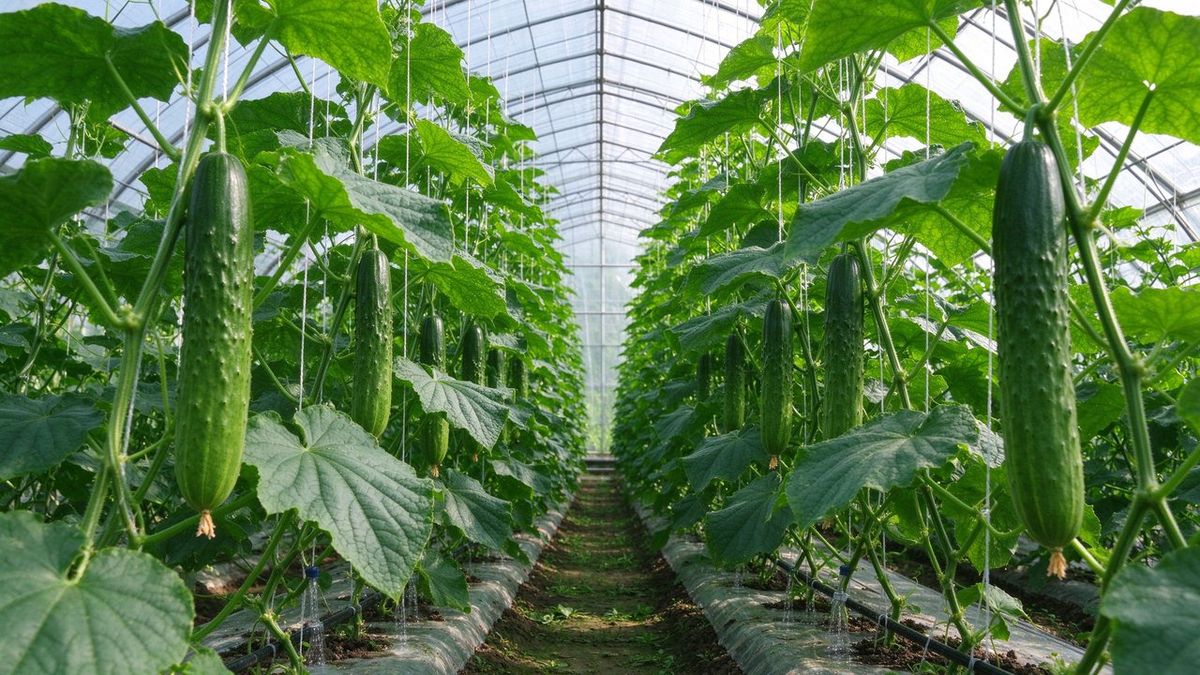
Pseudoperonospora cubensis, the cause of cucumber downy mildew, is a wind-borne oomycete that destroys a fully planted cucumber house in 14 days under cool, wet conditions. Unlike powdery mildew it needs free water: spores germinate in 2 hours on a film of water at 15 to 22 degrees Celsius. The yellow angular lesions on the upper leaf and grey-violet sporangia on the underside cut photosynthesis so fast that fruit stops expanding within a week.
Recognising the Early Symptoms
The first sign is a pale yellow, angular lesion bounded by leaf veins, 5 to 10 mm across, appearing on the oldest middle-canopy leaves. On the underside, a fine grey-violet fuzz appears within 48 hours when relative humidity exceeds 90 percent. Mist the underside in the evening and check at 07:00; the sporangia are easiest to see before the sun dries them.
Downy mildew spreads upward through the canopy. Once lesions reach the top 30 cm, the plant loses 50 percent of its photosynthetic area in 5 days. Walk every bay twice weekly at right angles to the rows and mark any suspicious leaf with a flag; ignore a single random leaf, but three flags in one bay means trigger the spray protocol.
The Wetness Management Protocol
Free water is the pathogen’s trigger. Start the climate 1 hour before sunrise: open roof vents 20 percent and raise heat setpoint by 1 degree to drive leaf temperature above air dew point. Keep leaves dry by 10:00 every day. A leaf wetness sensor per bay gives the ground truth; aim for zero hours of wetness after 10:00.
Avoid drip irrigation at night. Schedule all irrigation pulses between 08:00 and 18:00, and run the final pulse no later than 2 hours before sunset. Run horizontal air-flow fans at 0.5 m/s through the night to mix boundary-layer air. In recirculating NFT, do not let nutrient solution splash onto the lower leaves; a 30 cm gap between channel and leaf prevents splash inoculation.
Resistance and Forecast Triggers
Cultivar resistance is partial: no long cucumber is immune, but tolerant hybrids delay outbreak by 7 to 10 days and reduce lesion area by 60 percent. Use a downy-mildew-tolerant hybrid in autumn and spring; in dry summer the susceptible premium-yield hybrid may still win. Record every outbreak date per bay; over three seasons this builds a local forecast that beats national models.
Trigger protective sprays the day a local weather station records 4 consecutive hours of leaf wetness at 18 to 22 degrees Celsius. This simple rule, adopted from cucumber advisory systems, beats calendar spraying by 30 percent in product volume and halves the number of in-field outbreaks.
Fungicide Rotation for Oomycetes
Downy mildew is an oomycete, so standard powdery-mildew chemistry fails. Use mandipropamid at 0.6 ml per litre, cymoxanil at 0.4 g per litre, or the phosphonate fosetyl-Al at 2.5 g per litre. Rotate FRAC groups 40, 11, and 33 every spray; never repeat the same group twice. Apply in 600 litres of water per hectare, targeting the lower leaf angle where sporangia sit.
Add a spreader-wetter at 0.05 percent to ensure the fungicide reaches the underside. Do not spray when bumblebee hives are active; close hives 2 hours before treatment and reopen 4 hours after spray has dried. Post-spray, raise the temperature setpoint 1 degree for 6 hours to keep leaf surfaces dry while the product dries.
Roguing and Clean Boundaries
Remove the three worst leaves on any infected plant and bag them immediately; do not drop them on the floor. At harvest, discard plants with more than 30 percent lesion coverage rather than trying to rescue them, because each infected leaf produces 100,000 sporangia per night.
Boundary cleanliness matters. Wild cucumber and gourd weeds within 200 m are a permanent inoculum source. Mow the ditch line, remove volunteer cucurbits, and keep a 3 m bare-soil buffer around every glasshouse. Zhongtian Agricultural Technology treats downy mildew as an area-wide problem rather than an in-house spray job; the buffer and leaf-wetness protocol together reduce disease pressure by more than the spray budget ever could.
Downy mildew is beatable with discipline: dry leaves by 10:00, forecast sprays from leaf-wetness hours, rotate oomycide FRAC groups, and keep a clean buffer outside. The crop is lost only when the grower treats the first yellow leaf as cosmetic rather than as the start of a 14-day countdown.


