
Cucumber roots stop growing below 14 degrees Celsius and start cooking above 32, yet most growers monitor only the air. Root zone temperature on rockwool or coco slabs drives water uptake, nutrient mobility, and fruit expansion directly: a slab held at 20 to 23 degrees Celsius produces 20 percent more fruit per plant than one drifting at 16 to 18. In winter houses the difference between 18 and 21 degrees at the root is the difference between acceptable and excellent yield.
Why Roots are the Bottleneck
Cucumber roots are shallow, 90 percent of them within the top 8 cm of a slab, and they depend on thermal diffusion from the slab itself. When the nutrient solution runs at 14 degrees Celsius in a winter night, root membrane permeability collapses, water uptake falls by 40 percent, and the plant shows leaf wilting even though the slab is wet. This is the classic cold-root symptom: flaccid leaves at midday despite a saturated slab.
Conversely a slab at 30 degrees Celsius accelerates root respiration, depletes dissolved oxygen below 4 mg per litre, and encourages Pythium and Fusarium foot rot. Optimal root zone temperature for long cucumbers is 20 to 23 degrees Celsius day and 18 to 20 degrees at night. Aim for a diurnal swing of no more than 3 degrees.
Measuring the Slab, Not the Air
Insert one temperature sensor per 200 m2 at 5 cm depth in the wettest zone of the slab, midway between two drippers. Log the value every 15 minutes and feed it to the climate computer; do not rely on air temperature sensors 2 m above the slab, which read 3 to 5 degrees warmer in winter. Calibrate each sensor against a mercury probe at least once per season.
Run a recirculating solution sample cup next to the slab to measure nutrient solution temperature at the dripper outlet. The solution must arrive within 1 degree of the slab target; cold solution applied at each irrigation pulse drags slab temperature down 0.2 to 0.4 degrees per event. In winter the daily drip volume of 1.5 to 2.0 litres per plant carries a surprising thermal load.
Heating the Root Zone Efficiently
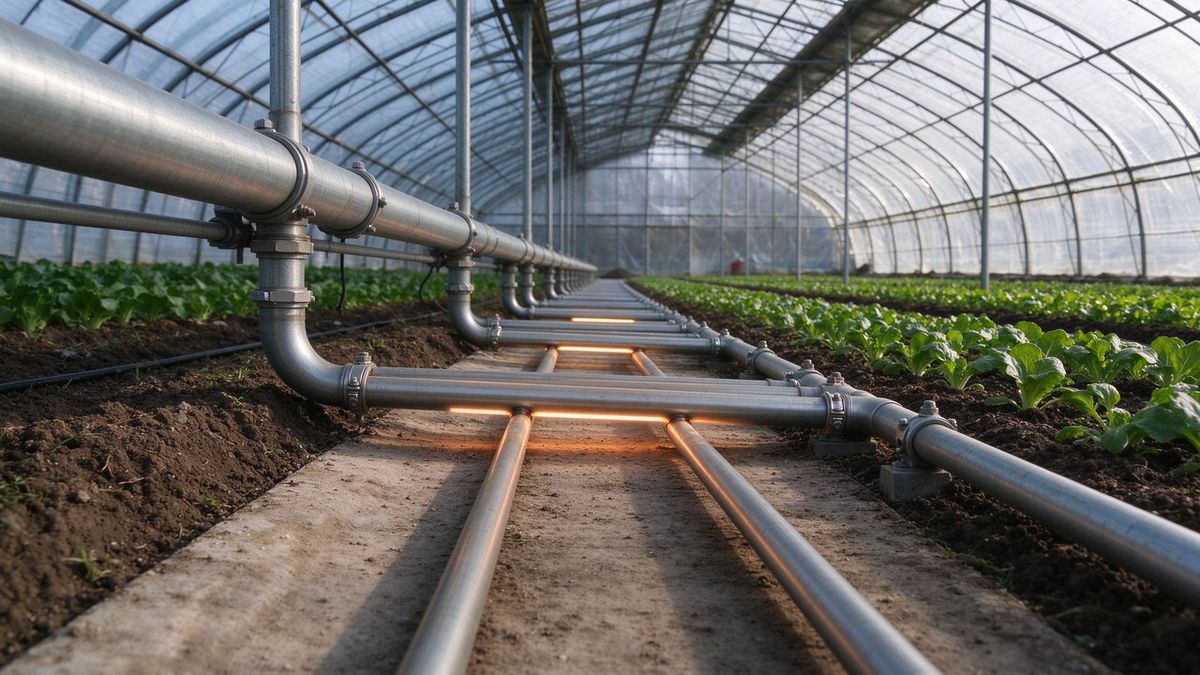
Under-slab hot-water pipes at 35 to 40 degrees Celsius supply the most even heat. Space pipes 20 cm apart on a 5 cm insulating foil layer under each slab; this keeps slab temperature within 0.5 degrees across the bay and costs 30 percent less than air heating alone. Set the return-water differential to 3 degrees to avoid local hot spots above 28.
Root-zone heating can be combined with the nutrient solution itself: hold the mixing tank at 22 degrees Celsius with a small immersion heater, sized at 2 kW per 1000 plants. Recirculating systems use the solution temperature to balance slab temperature, but a non-recirculating slab still needs the under-slab pipe because drainage leaves the slab between irrigations.
Summer Cooling and Oxygen Supply
In summer, slab temperature tracks the glasshouse and can climb past 28 degrees. Shade the slab base with white coir sheeting, run the wet-wall at 65 percent pump duty, and keep the recirculation tank shaded and insulated. Dissolved oxygen must stay above 6 mg per litre in the tank; inject venturi oxygen at 0.3 litres per litre of flow if it drops below 5.
Schedule irrigations to flatten the slab temperature curve. Early-morning irrigation at 06:00 pre-cools the slab before solar load, and a final pulse at 18:00 keeps the slab through the hot evening. Avoid irrigating when slab temperature exceeds 28 degrees; cold water shocks roots and triggers transient wilting.
Matching Nutrition to Root Temperature
Cold roots take up nitrate and calcium poorly; raise the feed EC to 2.6 to 2.8 mS per cm in winter to keep total dissolved salts high even though volume uptake is low. In summer, drop EC to 2.2 to 2.4 because water volume rises and nutrient concentration should not. Keep pH at 5.5 to 5.8 in both seasons; cold roots lock iron if pH drifts above 6.0.
Calcium uptake is the most temperature-sensitive: a 16 degree slab cuts calcium flow by half and triggers blossom-end rot on fruit. Foliar calcium at 0.4 percent calcium nitrate applied every 7 days during cold snaps is the short-term patch; root-zone heating is the real cure. Zhongtian Agricultural Technology ties its climate setpoints to slab temperature sensors rather than to the calendar, so heating never runs blind.
Root zone temperature is the single most under-managed variable in greenhouse cucumber. Hold the slab at 20 to 23 degrees in winter with under-slab pipes, cool it below 28 in summer, and adjust EC and calcium supply to match. A 3 degree slab shift changes weekly yield by 15 to 20 percent, far more than most other climate tweaks.


