
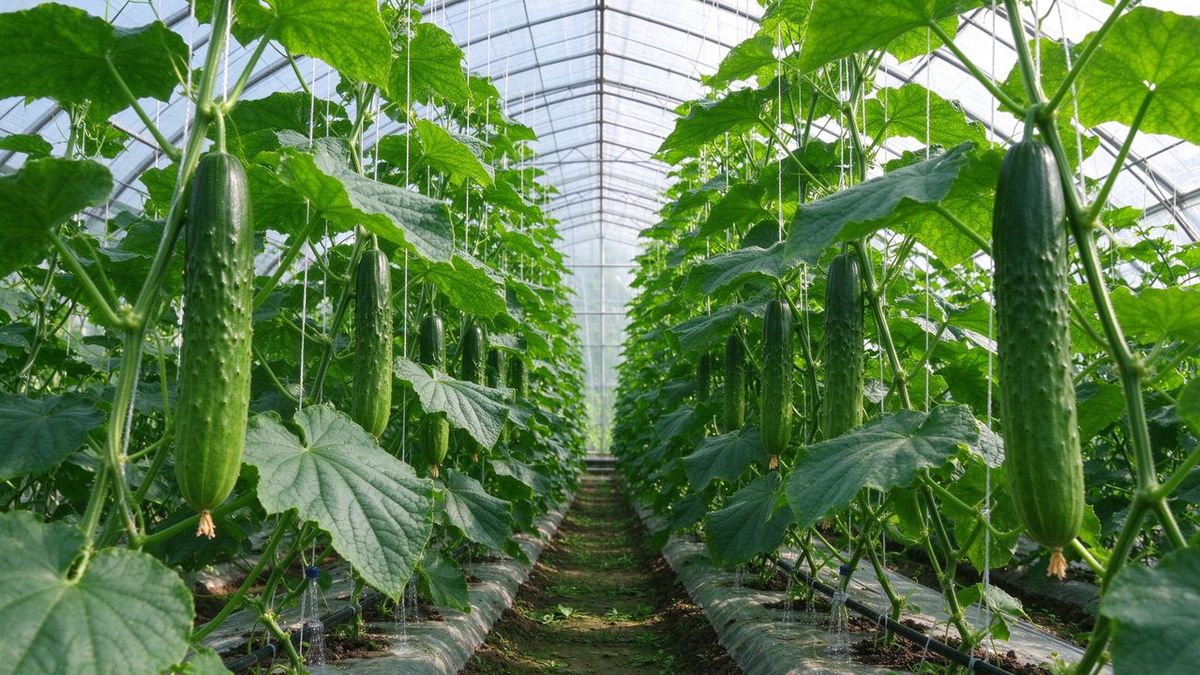
Parthenocarpic long cucumbers set fruit without pollination, which is why they dominate greenhouse production and why the bumblebee hives used in tomato houses are removed from cucumber bays. The right parthenocarpic variety decides whether a harvest averages 4 kg per square metre weekly or stalls at 2.5 kg. Selection is a balance of fruit length, gynoecious flowering, heat tolerance, disease package, and shelf life, not a single glossy picture on a seed catalogue.
Define the Market Before the Variety
A 32 to 36 cm smooth, dark-green fruit weighing 350 to 450 g is the standard long English cucumber for wholesale packs. If the target is local loose retail, a 22 to 26 cm Beit-alpha type at 220 to 260 g yields more fruit per plant and tolerates rougher handling. Match fruit length to the shipping pack before even looking at disease resistance.
Calculate the economic yield target. Long types produce 28 to 34 fruit per plant per season at 2.4 plants per square metre; Beit-alpha types produce 45 to 60 smaller fruit. At a 12-week picking window the long type delivers 3.6 kg per square metre weekly while Beit-alpha delivers 3.1 kg, but the smaller fruit commands 15 to 20 percent less per kilogram. Price per fruit, not per kilogram, decides.
Gynoecious Flowering and Fruit Load
Modern parthenocarpic hybrids are almost fully gynoecious, producing a female flower at nearly every node from node 6 upward. Partial gynoecious types with 20 to 30 percent male nodes are cheaper seed but demand more fruit thinning. A fully gynoecious hybrid lets the grower set one fruit per node automatically and avoids the awkward step of removing male flowers by hand.
Watch for the balanced-fruit index. Good cultivars hold a stem diameter of 11 to 13 mm while carrying one fruit per node; weak hybrids balloon the first 5 fruit and abort the rest, producing a lopsided harvest. Trial three hybrids on 200 m2 strips in the same block before committing a full 1 ha to one name, because cultivar-by-season interactions are large.
Disease and Climate Package
Insist on intermediate resistance to cucumber mosaic virus, zucchini yellow mosaic virus, and powdery mildew race 2, plus tolerance to closterovirus (CABYV) where the virus is endemic. Downy mildew tolerance is a bonus rather than a given; in a wet autumn, even tolerant hybrids need protective sprays. Root-knot nematode resistance is irrelevant in soilless culture but essential if the house is ever grown in soil.
Heat tolerance decides autumn and spring shifts. Varieties rated for 28 to 32 degrees Celsius day temperature hold fruit set and avoid hollow heart; cold-tolerant types below 18 degrees Celsius are needed for unheated tunnels in winter. Zhongtian Agricultural Technology keeps a seasonal variety chart matching each block’s forecast average temperature to the hybrid that will not drop fruit on the first warm week.
Shelf Life and Internal Quality
A 350 g long cucumber must hold firmness above 22 Newton for 10 days at 10 degrees Celsius and 90 percent relative humidity. Measure the endocarp cavity index: poor varieties develop a hollow cavity that widens past 8 mm and splits under bagging. Fruit colour must stay below a chroma score of 38 on the grey card at harvest; lighter fruit gets discounted by 10 percent at pack-out.
Bitterness from cucurbitacin is triggered by cool nights below 14 degrees Celsius combined with water stress. Choose a non-bitter (Bi+) hybrid; the recessive bitter gene expresses randomly under stress and single bitter fruit destroys a whole retail pack. Taste-test the first harvest of every new variety in a blind panel before scaling.
Seed Cost vs Return on Investment
Hybrid seed cost for long English cucumber runs 0.6 to 1.1 euro per seed; for a 2.4 plants per square metre house that is 1.4 to 2.6 euro per square metre before any fruit. A 10 percent yield gain from a better hybrid pays back 4 to 8 times the seed premium, while a 10 percent loss from a wrong choice costs more than the entire seed bill.
Negotiate a seed-rate test. Most suppliers will reserve 100 seeds of two competing hybrids for side-by-side evaluation on 50 m2 blocks. Record fruit count, average fruit weight, grade-out percentage, and shelf life at day 7. Use that data rather than catalogue brochures when committing the next crop.
Variety selection is the highest-leverage decision a greenhouse cucumber grower makes. Start from the market pack, add disease and climate tolerance, then validate with a small strip trial before committing. A 10 percent yield or shelf-life gain dwarfs the seed premium, and a bad choice is invisible until the first pack-out.


