
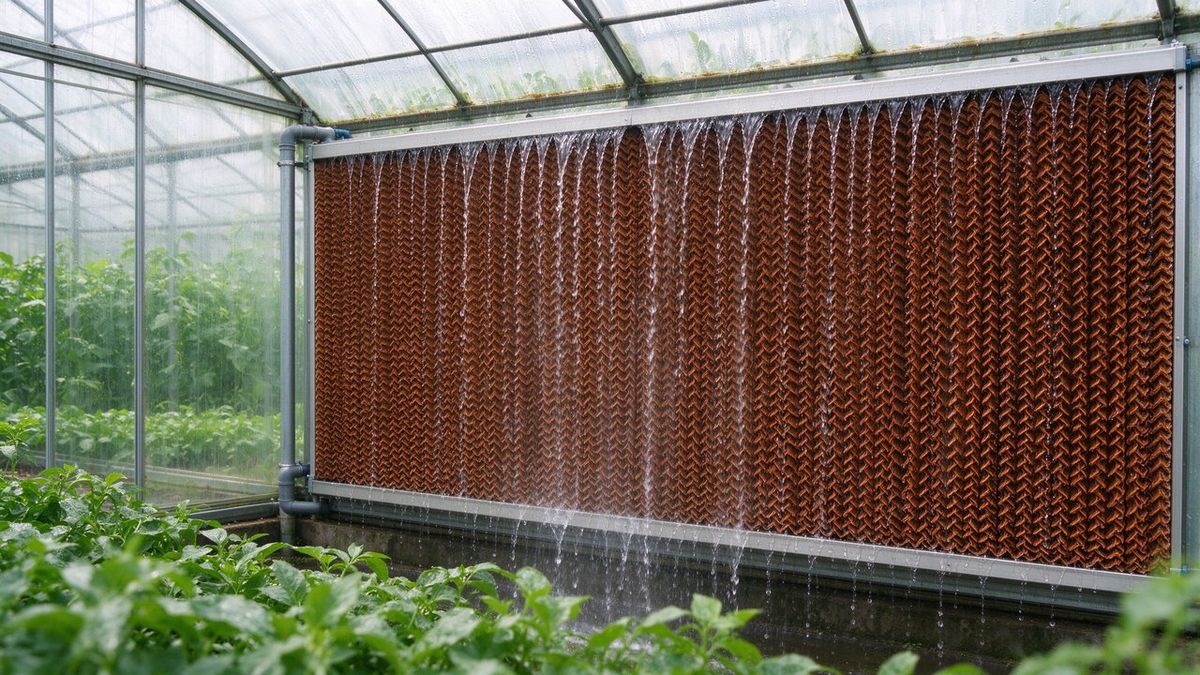
Pepper fruit set collapses above 30 degrees Celsius: pollen loses viability, flowers abort, and the ovary fails to swell. In summer greenhouse crops, heat stress can cut fruit set by 50 to 70 percent in a single 3-day warm spell. Managing fruit set under heat is a combination of cooling the canopy, timing nutrition, and choosing heat-tolerant varieties. Without intervention, the summer crop becomes a vegetative bush with almost no harvest.
How Heat Kills Fruit Set
Pepper pollen is sensitive: at 32 degrees for 2 hours, 80 percent of pollen grains fail to germinate. The flower opens but never fertilises, the ovary shrivels, and the flower drops within 3 days. The plant survives perfectly well at 35 degrees; it just stops making fruit.
Heat also accelerates flower development: at 32 degrees, a flower matures in 18 days instead of 25, with shorter filaments and poorer pollen release. The problem is not visible in leaf growth; only the lack of swelling ovaries reveals it. Pollen germination drops below 20 percent after 4 hours above 33 degrees, and that damage is permanent even if the temperature drops the next night.
Cooling the Canopy Below the Air Setpoint
Wet-wall and evaporative cooling drops canopy temperature by 4 to 6 degrees below the outside air. Run the wet-wall at 100 percent pump duty when outside temperature exceeds 28 degrees. Combined with 50 percent shade screen, canopy temperature holds at 26 to 28 even on a 35 degree day.
Overhead misting at 500 micrometre droplets for 30 seconds every 10 minutes at midday cools the canopy another 2 degrees but raises RH to 85 percent. Use misting only when air exchange is strong; otherwise Botrytis follows. Target leaf temperature, not air temperature: hold leaves at 26 to 28 degrees.
Timing Irrigation and Nutrition
Heat stress worsens when the slab dries. Irrigate more frequently in heat: pulse every 30 minutes instead of 60, keeping slab water at 70 to 80 percent of field capacity. A cool, wet slab transpires more and keeps leaf temperature down.
Foliar calcium at 0.3 percent calcium nitrate, applied in the early morning twice per week during heat waves, reduces flower drop. Calcium strengthens the ovary wall and improves pollen tube growth. Avoid high nitrogen in heat; succulent growth aborts fruit faster. Keep potassium at 240 mg per litre during heat waves because potassium regulates stomatal opening and keeps transpiration steady even on hot afternoons.
Choosing Heat-Tolerant Varieties
Heat-tolerant hybrids set fruit at 30 to 32 degrees where standard hybrids abort 80 percent. They are identified by trials at 32 degree day setpoint. Switching to a heat-tolerant variety for the May to September planting recovers 60 percent of lost fruit set.
Heat-tolerant types often have smaller leaves and more open canopy, which naturally reduces canopy temperature. They yield 10 percent less in cool weather but 40 percent more in hot weather. Match variety to the forecast summer average, not the annual average.
Pollination Backup During Heat
Bumblebee activity drops sharply above 30 degrees. On hot days, supplement with manual or electric vibration at midday: a small wand vibrates each flower truss for 1 second, releasing pollen. This recovers 30 percent of set that bees miss.
Release fresh bumblebee hives every 6 weeks through summer; a stressed hive weakens fast. Keep hives in a shaded corner with a cool water supply. Zhongtian Agricultural Technology combines wet-wall cooling, shade, heat-tolerant variety, and midday vibration to hold fruit set above 70 percent even on 35 degree days.
Heat stress kills pepper fruit set through pollen failure, not leaf damage. Cool the canopy to 26 to 28 degrees with wet-wall and shade, irrigate more frequently, use heat-tolerant varieties, and supplement pollination by vibration. The summer yield gap is recoverable with these four steps.


