
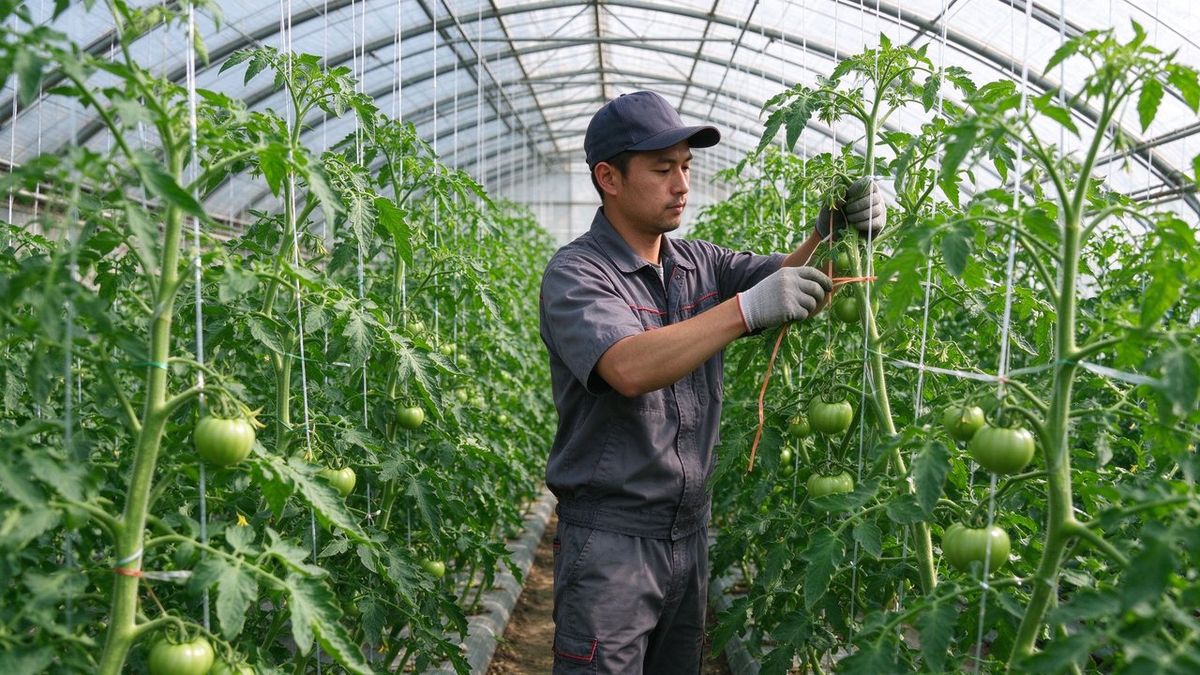
Bell and chili peppers grown under protected structure form dense, self-shading canopies within eight weeks of transplanting, and without deliberate pruning the leaf-to-fruit ratio swings against marketable yield. Canopy management in the greenhouse is not simply about removing leaves: it is a controlled redistribution of assimilates so that fruit set, fruit expansion, and fruit wall thickness stay synchronized with the light integral. This guide covers the training systems, timing, and microclimate trade-offs that professional growers at Zhongtian Agricultural Technology use to hold yields above 4.5 kg per square meter while keeping blossom-end rot and sunscald under threshold.
Why Peppers Need a Managed Canopy
Peppers are determinate-to-semi-determinate shrubs that branch sympodially; every internode can terminate in a flower and produce a flush of fruit. Under a glasshouse with 18 to 26 degrees Celsius daytime and 16 to 18 degrees Celsius night temperatures, a single plant can carry 18 to 24 marketable fruit at once if light is not limiting. Without pruning, inner canopy leaves drop below the light compensation point of roughly 120 micromoles per square second, respire more than they fix, and become a sink for carbohydrates. The result is small, soft fruit with thin walls and a high percentage of Class C culls at harvest.
A managed canopy raises the average intercepted photosynthetically active radiation to 65 to 75 percent of incident light while keeping air speed at the fruit zone between 0.2 and 0.5 meters per second. That balance suppresses Botrytis on calyxes and reduces the relative-humidity-driven condensation that triggers bacterial spot lesions. Yield trials on layered canopy systems at 3.2 plants per square meter show a 22 percent increase in Class A fruit over unpruned controls by the end of the spring cycle.
The Two-Stem and Four-Stem Training Systems
The most common protected-crop system is the two-stem (V) train: at the first true branching above the cotyledons, two strong sympodial branches are retained and all laterals pinched at the first leaf above the flower. Plants are then lowered along a horizontal string at 1.8 meters above the growing medium, spaced at 0.35 meters within the row and 1.2 meters between rows, giving a density of about 2.4 plants per square meter. The four-stem system doubles stems per plant and is used for high-wire trellises at 1.6 plants per square meter; it is best suited to bell pepper cultivars with compact internodes and a strong root system, because stem density raises disease pressure if humidity is not actively managed.
Whichever system is chosen, the vertical cordon should be rewrapped every seven to ten days during rapid growth to avoid girdling, and the hanging wire should be offset so that stems do not rub on each other at midday when the canopy is heavy with transpiring leaves. Lateral shoots below the first flower cluster should be removed while they are still less than 8 centimeters long; once they exceed 15 centimeters, pruning wounds become entry points for Erwinia and Botrytis and the plant wastes energy recovering.
Leaf Stripping and Suckering Rhythm
Lower-leaf removal begins after the first fruit on the lower cluster reaches mature green and begins its color break. Growers at Zhongtian Agricultural Technology strip only two to three leaves per plant per week, targeting leaves below the lowest red fruit, and never remove more than 15 percent of the leaf area in a single pass. Removing too many leaves at once drops daily assimilation by 20 to 30 percent and can trigger flower abscission on the next two open clusters, a condition visible as dropped yellow buttons two to three days after a heavy strip.
Suckers emerging from the axil above a flowering cluster should be pinched back to one leaf, not removed entirely, because that leaf feeds the adjacent fruit. Suckers below the first fork should be removed completely. Any sucker that has already set a fruit should be retained until that fruit is harvested, then the sucker is cut back to its basal leaf. Tools should be dipped in 70 percent ethanol between blocks of 50 plants to limit mechanical transmission of tobacco mosaic virus and bacterial spot.
Light, Temperature, and Humidity Interactions
Canopy geometry changes the climate the fruit experiences. An open, two-stem canopy with 25 to 30 leaves per stem allows direct light to reach the fruit wall, which accelerates color break but raises sunscald risk when midday fruit-zone temperature exceeds 35 degrees Celsius. Ventilation should be set to open at 28 degrees Celsius and shade screens deployed when external radiation exceeds 650 watts per square meter to keep fruit temperature below 32 degrees Celsius. Night temperature should be held at 17 to 18 degrees Celsius during fruit expansion; below 15 degrees Celsius, assimilate translocation slows and fruit becomes misshapen.
Relative humidity should be modulated between 65 and 75 percent. Above 80 percent, Botrytis cinerea sporulates within 48 hours on wounded pedicels; below 60 percent, stomata close, calcium uptake falls, and blossom-end rot appears on the earliest fruit. Horizontal airflow fans should run continuously during the day at 0.3 meters per second to break up thermal layers and ensure that RH at the fruit zone matches the sensor reading at the headhouse.
When to Stop Pruning and Transition to Lowering
Once the crop reaches 32 to 36 weeks after transplant, productivity per new node declines and the cost of lowering outweighs the gain. At that point, growers stop stripping lower leaves and allow the canopy to self-shade the stem base, which reduces heat load on the woody trunk. The final four clusters are left unpruned and the crop is terminated once average fruit weight drops below 180 grams for bell types or below 18 grams for chili types. On perennial-style operations in southern China, the crop is cut back to two 30-centimeter stumps after a 48-hour warm-up at 24 degrees Celsius; regrowth begins in 14 to 18 days and a second production cycle yields 70 to 80 percent of the first.
Pruning waste must be removed from the greenhouse within 24 hours and composted off-site, because pruned leaves harbor Botrytis spores and Western flower thrips pupae. Scissor disinfection, single-pass stripping quotas, and a rigid climate post-pruning (2 degrees Celsius warmer, 5 percent lower RH for the first 12 hours) together keep wound healing fast and secondary infections negligible.
Canopy management is the single highest-return cultural intervention in protected pepper production. A two-stem or four-stem system, stripped at the rate of two to three leaves per week and kept in balance with a 17 to 26 degrees Celsius climate, will deliver a steady Class A harvest from the eighth week through the thirty-sixth. When pruning rhythm, leaf removal quota, and post-wound climate are treated as one coupled system, growers at Zhongtian Agricultural Technology consistently record yields above 4.5 kg per square meter with cull rates below 8 percent.


