
Bacterial spot, caused by Xanthomonas euvesicatoria and X. vesicatoria, is the most economically damaging foliar disease of greenhouse peppers once relative humidity climbs above 80 percent. Under protected cultivation the pathogen usually arrives on infected transplants or in surface-irrigation water, then spreads through gutters, worker hands, and overhead condensate dripping from roof panels. Management in the greenhouse is preventative first: once lesions reach 5 percent of leaf area, yield loss accelerates sharply because defoliation exposes fruit to sunscald. This article lays out the thresholds, chemistry, and cultural controls used in commercial protected-pepper programs.
Disease Cycle and Greenhouse Entry Points
Xanthomonas survives on seed for up to two years and on infected crop debris for three to six months. In the greenhouse it enters through stomata and hydathodes at 25 to 30 degrees Celsius when a film of free water is present for more than 60 minutes; symptoms appear seven to fourteen days after infection as small, water-soaked lesions that turn necrotic and coalesce into irregular scabs. Fruit lesions, called “bird’s-eye” spots, are the most damaging because they downgrade marketability even at low incidence.
The primary entry points in protected culture are infected transplants from the propagation house, overhead condensate dripping onto open flowers, and splash from recycling irrigation water containing 10^4 colony-forming units per milliliter or more. Tools, shoe soles, and pruning hands move the bacterium from block to block; one contaminated row of 50 plants can infect an entire 0.5-hectare greenhouse within three weeks if the climate is warm and wet.
Exclusion: Clean Seed, Clean Transplants, Clean Water
Start with seed tested and certified free of Xanthomonas, then disinfest with a 20-minute soak in 1.5 percent sodium hypochlorite at 20 degrees Celsius followed by a rinse in clean water. Transplants should be grown in a separate propagation house with dedicated tools and footwear; never move seedlings from a house with any symptomatic plant into the production block. At Zhongtian Agricultural Technology, incoming trays are inspected at 10x magnification and rejected if any lesion or leaf curl is observed on the cotyledons or first true leaves.
Irrigation water should be treated with a combination of sand filtration, UV-C at 40 millijoules per square centimeter, and 1 to 2 milligrams per liter of copper-free oxidant such as peracetic acid. Drip lines should be flushed at the end of each cycle with 50 parts per million of hydrogen peroxide to reduce biofilm. Overhead sprinkling for seedling establishment should stop as soon as the first true leaf expands; from that point onward, irrigate strictly through drip emitters to keep leaf surfaces dry.
Climate and Cultural Controls
Bacterial spot is suppressed when leaf wetness is kept under 30 minutes per day. In practice this means venting to lower relative humidity below 75 percent at night, heating 1 to 2 degrees Celsius above the ventilation setpoint for the first hour after sunrise to drive off condensate, and running horizontal airflow fans at 0.3 meters per second. Leaf temperatures should not drop below 18 degrees Celsius at night, because cold, wet leaves are ideal infection courts.
Plant spacing matters: at densities above 3.2 plants per square meter, canopy humidity stays above 85 percent between rows and disease doubles. Keep the lowest 15 centimeters of stem defoliated and remove infected lower leaves on a Monday so the wound can dry through the week. Crop residue must be bagged and removed the same day; do not compost it on the farm. A minimum 24-month rotation out of peppers, tomatoes, and eggplants is required before replanting the same soil-bedded greenhouse.
Chemical and Biological Program
Copper-based products remain the backbone of curative control: apply copper hydroxide at 0.3 grams per liter of spray volume at 7-day intervals when conditions favor disease, alternating with mancozeb at 2 grams per liter to slow copper-resistance selection. Add a non-ionic spreader at 0.05 percent v/v to improve coverage on waxy pepper leaves. Tank-mixing copper with the biological antagonist Bacillus amyloliquefaciens strain QST 713 applied at 2 kilograms per hectare on alternate weeks reduces copper load by 50 percent while holding disease index below 5.
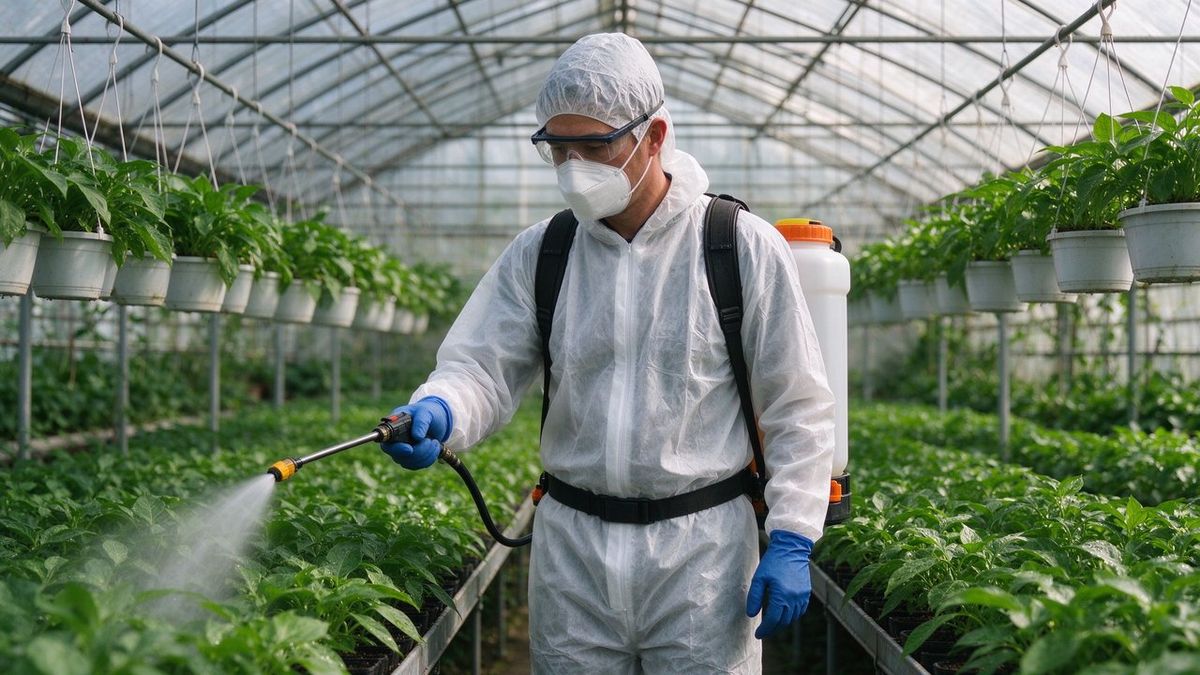
For organic and reduced-chemistry programs, acibenzolar-S-methyl at 30 grams per hectare triggers systemic acquired resistance and is rotated with copper at 14-day intervals. Spray coverage must reach both leaf surfaces; use a low-volume boom at 200 liters per hectare with twin-jet nozzles operating at 8 bar. Stop all sprays seven days before harvest to keep residue below the 10 parts per million MRL and avoid phytotoxic flecking on green fruit.
Scouting Thresholds and Decision Rules
Scout every week by walking a W-shaped transect and recording percent leaf area diseased on 20 randomly selected plants per 1,000 square meters. The economic threshold is 1 percent of leaves with active lesions; above that, a protective spray must go on within 48 hours. Fruit lesions reaching 2 percent trigger an immediate copper application plus removal and bagging of symptomatic fruit from the rows.
At the end of the season, run a 48-hour thermal disinfestation: heat the empty greenhouse to 60 degrees Celsius air temperature with fans running, and solarize any reusable gutters or walkways with clear plastic for four weeks. Disinfect all pruners, strings, and sprayers with 10 percent household bleach, then rinse. With these protocols, Xanthomonas pressure in the next crop typically drops below the detection limit.
Bacterial spot in protected pepper is managed by exclusion, climate discipline, and a tightly rotated spray program rather than by reaction. Clean seed, drip-only irrigation, 60-to-75-percent relative humidity, weekly scouting against a 1 percent threshold, and copper alternated with Bacillus antagonists will hold the disease index below 5 and keep fruit marketable. Programs run this way at Zhongtian Agricultural Technology consistently finish the season with less than 2 percent cull from bacterial causes.


