
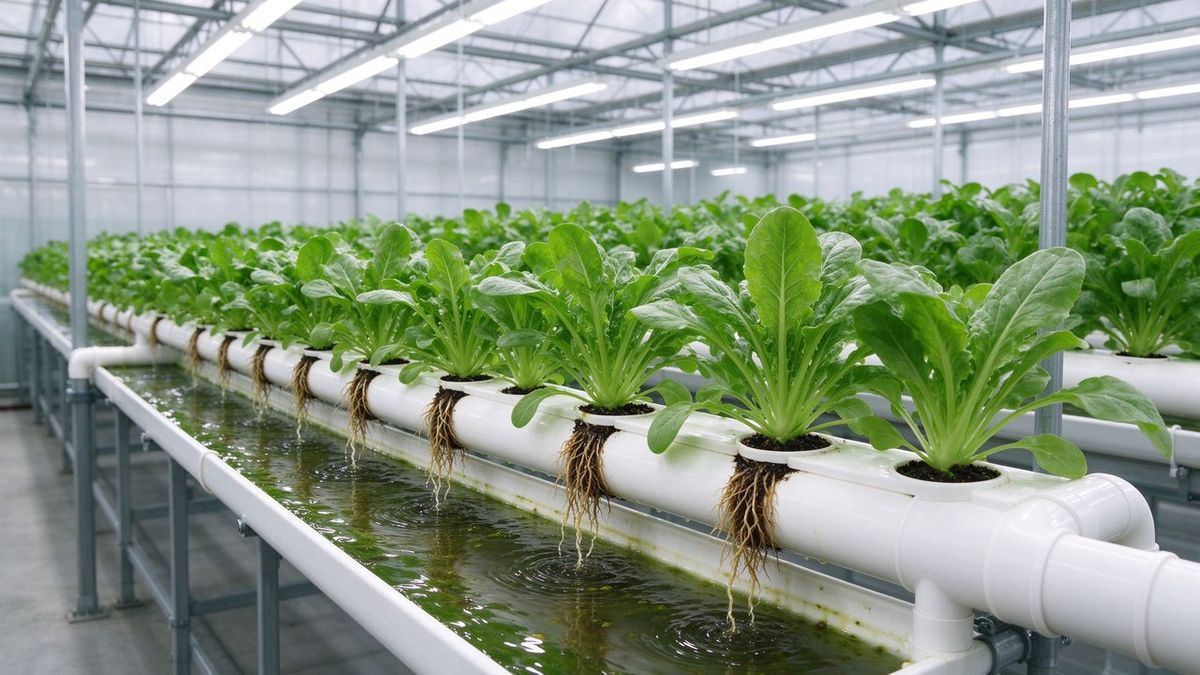
Hydroponic bell pepper production in protected horticulture delivers fruit of uniform size and color while cutting water use by 40 to 55 percent compared with soil culture. The two dominant commercial systems in China are the coco-coir bag drip system and the recirculating nutrient-film channel system; both require tight control of root-zone temperature, electrical conductivity, and dissolved oxygen. This article walks through the substrate, nutrient recipe, climate window, and disease-management rules that growers at Zhongtian Agricultural Technology use to average 4.5 kg per square meter over a ten-month spring-to-autumn cycle.
System Choice: Coco Bags versus NFT Channels
Coco-coir bags are the default for bell peppers because the substrate buffers pH and EC between irrigations, which forgives minor pump and dosing errors. A standard bag weighs 10 to 15 liters dry, is laid at 2.5 bags per square meter, and is planted with two plants per bag. Drainage holes are slit 2 centimeters above the bag bottom to retain a wetted zone of 40 percent of bag volume. Nutrient-film channels are reserved for high-throughput multi-tier operations where root temperature can be actively controlled; they give finer EC and pH stability but demand daily monitoring.
Rockwool slabs at 7.5 by 20 by 100 centimeters remain common in northern operations because they hold a stable 18 to 20 degrees Celsius root zone in winter. Perlite and peat-perlite mixes are cheaper but degrade after one cycle and cannot be steam-sterilized reliably. Whichever substrate is chosen, ensure the run-off volume is kept between 25 and 35 percent of the irrigation dose to avoid salt buildup in the root zone.
Nutrient Recipe for Bell Pepper
The base nutrient solution for bell pepper in coco coir targets an EC of 2.4 to 2.8 mS per square centimeter in the run-off during fruit expansion, with a pH of 5.5 to 5.8. Macroelement concentrations in the stock solution, expressed as millimoles per liter, are 12 nitrate-N, 1.2 ammonium-N, 1.2 phosphorus, 5.5 potassium, 4.5 calcium, and 2.0 magnesium. During the first four weeks after transplant, reduce EC to 1.8 to 2.0 mS per centimeter to encourage root exploration; raise it by 0.2 mS per centimeter each week until the fruit on the first cluster reaches 5 centimeters diameter.
Micronutrients are supplied at 20 iron, 5 manganese, 0.75 zinc, 0.5 copper, 0.5 boron, and 0.05 micromoles per liter of molybdenum. Potassium-to-calcium ratio in the run-off should be held near 1.1:1, because an excess of either element blocks uptake of the other and triggers blossom-end rot or edema. Check run-off EC and pH daily at 08:00 before the first irrigation; adjust the dosing pump in 0.1 mS per centimeter steps rather than making large recipe changes.
Irrigation Scheduling
Irrigation starts at sunrise plus two hours and stops two hours before sunset. Each irrigation pulse delivers 200 to 250 milliliters per emitter at 2 liters per hour, with emitter spacing of 0.33 meters along the row. The trigger to irrigate is a combination of light integral (cumulative radiation of 1.5 megajoules per square meter since the last pulse) and substrate weight (a load-cell under representative bags showing 85 percent of saturated weight). Run-off should stabilize at 25 to 35 percent of applied volume by midday.
During cloudy days with mean daily radiation below 4 megajoules per square meter, cut the irrigation dose by 40 percent and skip pulses after 14:00 to keep root-zone oxygen above 6 milligrams per liter. In winter, pre-heat the nutrient solution to 20 degrees Celsius before dosing; cold feed below 16 degrees Celsius suppresses root activity and causes tip burn on new leaves. Drainage water is captured and disinfected with UV-C at 40 millijoules per square centimeter before blending with fresh stock at a 1:1 ratio.
Climate and Canopy Management
Air temperature setpoints are 22 to 26 degrees Celsius by day and 17 to 18 degrees Celsius by night during fruit expansion. The vapor-pressure deficit should be held between 0.6 and 1.0 kilopascals; above 1.2 kPa, stomata close and fruit wall thickness drops. Ventilation opens at 28 degrees Celsius, and the thermal screen closes at 18:00 to save heat and hold night temperature. Horizontal airflow fans run continuously at 0.3 meters per second to break up thermal layers.
Train plants to two stems on a vertical string at 1.8 meters height, spaced at 2.4 plants per square meter. Strip two to three lower leaves per week once the first fruit turns red. Bumblebee hives are introduced at 10 percent open flowers, at a density of one hive per 1,500 square meters; hive activity should be checked daily and replaced when foraging drops below 50 percent.
Crop Protection and End-of-Cycle
Hydroponic peppers are prone to Pythium root rot if dissolved oxygen falls below 4 mg per liter for more than 24 hours. Bio-sterilize the nutrient circuit every two weeks with a root-drench of Trichoderma harzianum at 1 gram per liter. Western flower thrips and broad mite are managed with Amblyseius swirskii mites released at 100 per square meter every four weeks, supplemented by sticky blue cards at 20 per 1,000 square meters.
At the end of the ten-month cycle, the nutrient circuit is emptied, flushed with 20 parts per million of hydrogen peroxide, and refilled with a 2 percent nitric-acid solution for a 24-hour circulation to remove scale. Coco bags are discarded and the gutters steam-treated at 80 degrees Celsius for 30 minutes before the next crop.
Hydroponic bell pepper is a precision-crop: coco bags buffered at pH 5.5 to 5.8 and EC 2.4 to 2.8, irrigated on light-integral triggers, and trained to a two-stem cordon will deliver 4.5 kg per square meter over a ten-month cycle. When run-off is recycled after UV disinfection and biocontrols are scheduled on a fixed calendar, chemical load drops by half and fruit quality stays Class A. The protocols used at Zhongtian Agricultural Technology are built around daily run-off checks and disciplined climate setpoints.


