
Western flower thrips, Frankliniella occidentalis, is the primary insect pest of protected bell peppers worldwide. Adults are 1.2 millimeter long and live 30 to 45 days, each female laying 60 to 100 eggs inside leaf tissue. Damage appears as silvery feeding scars on leaves and dimpled, russeted fruit; the same vector also transmits Tomato Spotted Wilt Virus, which can wipe out an entire block in two weeks. In the greenhouse, successful control relies on a stacked program of exclusion, biocontrol, monitoring, and targeted chemistry. This article lays out the thresholds and release rates used at Zhongtian Agricultural Technology to hold thrips below one per flower.
Biology and Greenhouse Entry
Thrips thrive at 25 to 30 degrees Celsius and 60 to 70 percent relative humidity; above 35 degrees Celsius their reproduction drops sharply. Females insert eggs into leaf and petal tissue, and the larval stages feed for 6 to 8 days before dropping to the soil or substrate to pupate. The pupal stage lasts 4 to 7 days, which is why a single clean-up spray rarely achieves control — the pupae in the substrate re-infest the crop two weeks later.
Thrips enter the greenhouse through screened vents, on workers’ clothing, and on incoming transplants. A fine-mesh screen of 0.25 by 0.75 millimeter (about 160 by 600 micron aperture) cuts entry by 90 percent but reduces ventilation, so vent area must be upsized by 30 percent. At Zhongtian Agricultural Technology, a yellow delta trap at the entry door is checked weekly; more than 20 thrips per trap per week signals a breach.
Biological Control Program
The backbone of thrips control in protected pepper is Amblyseius swirskii predatory mites, released at 100 mites per square meter at transplant and supplemented at 50 per square meter every four weeks. Swirskii feeds on first-instar larvae and establishes on leaf hairs within a week. For second-instar larvae and adults, release the predatory bug Orius laevigatus at 0.5 per square meter at first flower, repeated at 0.2 per square meter every three weeks.
The soil-dwelling pupal stage is targeted by the soil-dwelling predatory mite Stratiolaelaps scimitus at 250 per square meter, applied as a bran carrier on the substrate surface at planting and again after eight weeks. This combination suppresses thrips by 85 to 90 percent within six weeks if no insecticide drift kills the biocontrols. Pollen supplementation — distributing cattail pollen at 0.5 grams per square meter per week — helps swirskii persist between prey peaks.
Monitoring and Decision Thresholds
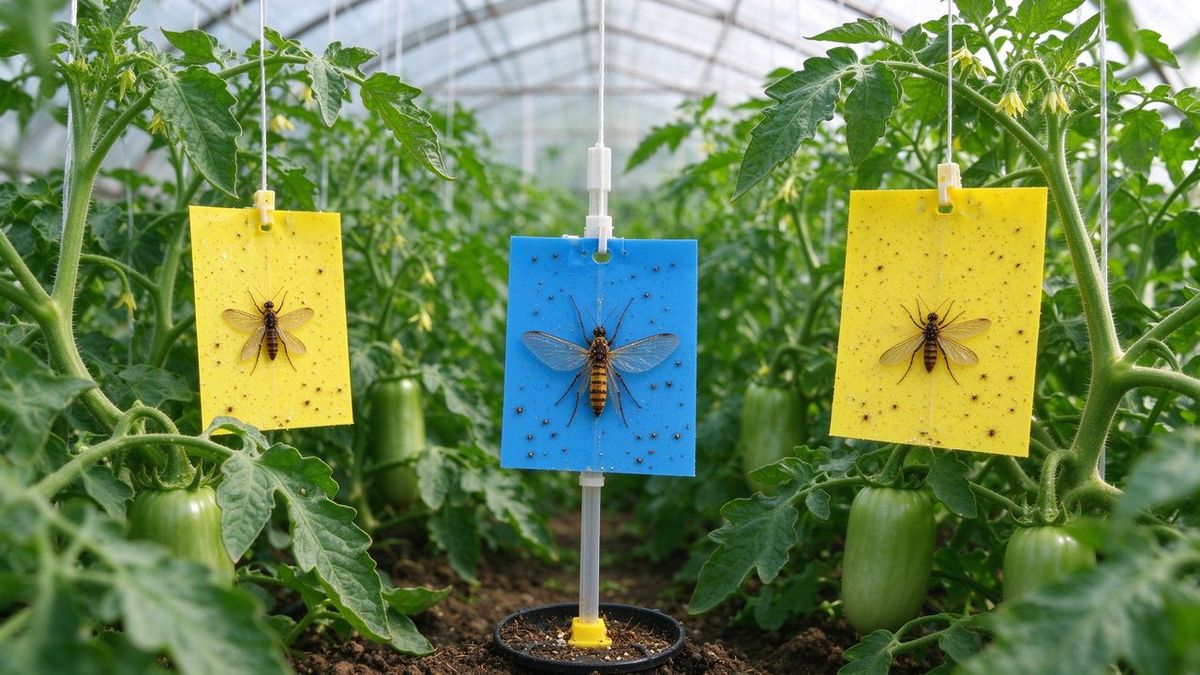
Use blue sticky cards at 10 per 1,000 square meters, positioned at canopy height and replaced weekly. The economic threshold for biocontrol intervention is 5 thrips per card per week; above that, release an extra batch of Orius. For chemical intervention, sample 20 open flowers per block and count thrips per flower; the trigger is 1 thrips per flower on average. Below that threshold, damage remains negligible.
Fruit scar monitoring is equally important: inspect 50 fruit per block weekly, and if more than 2 percent show feeding dimples, a corrective spray is required within 48 hours because thrips move rapidly onto newly set fruit. Record card counts in a weekly log so that seasonal peaks — typically early summer and late autumn — can be anticipated with preemptive releases.
Selective Chemistry and Resistance Management
Soft chemistry compatible with biocontrols includes spinosad at 0.3 milliliters per liter, applied at 7-day intervals only when the 1-per-flower threshold is crossed; it kills larvae but is safe for Orius after 48 hours. Rotate with acetamiprid at 0.1 grams per liter on the next threshold event, then with chlorfenapyr at 0.4 milliliters per liter, to avoid resistance. Never apply pyrethroids in the same greenhouse as biocontrols, because they wipe out Orius and swirskii for six weeks.
Sprays should target the evening when Orius are less active, with coverage directed at the flower trusses and leaf undersides. Use a fine-mist boom at 150 liters per hectare at 8 bar. Do not spray within 7 days of a planned biocontrol release; after a spray, wait 10 days before re-releasing Orius so residues drop to non-toxic levels.
Sanitation and End-of-Cycle Clean-up
Thrips survive on weed reservoirs in the floor drains and on crop volunteers between rows. Walk the greenhouse once a week and remove any Solanaceous weeds; thrips reproduce 30 percent faster on pigweed than on pepper. At the end of the cycle, remove all crop debris within 24 hours, then run an empty-crop heat treatment at 35 degrees Celsius for 48 hours to kill remaining pupae in the substrate.
Disinfect drip lines and benches with 1 percent hydrogen peroxide, and leave the greenhouse empty for at least 7 days between crops. New transplants should be inspected under a 10x lens for thrips larvae before introduction; any tray with visible larvae is rejected. With this stacked program, average thrips pressure across commercial blocks at Zhongtian Agricultural Technology stays below 0.3 thrips per flower year-round.
Western flower thrips in protected peppers is managed through a stacked program: screened vents, swirskii and Orius releases on a fixed calendar, weekly sticky-card monitoring against a 5-per-card threshold, and selective chemistry rotated on a 7-day cycle. When pupal predation by Stratiolaelaps is included, thrips pressure stays below one per flower and Tomato Spotted Wilt Virus never establishes. The result is Class A fruit with less than 1 percent russeting at harvest.


