
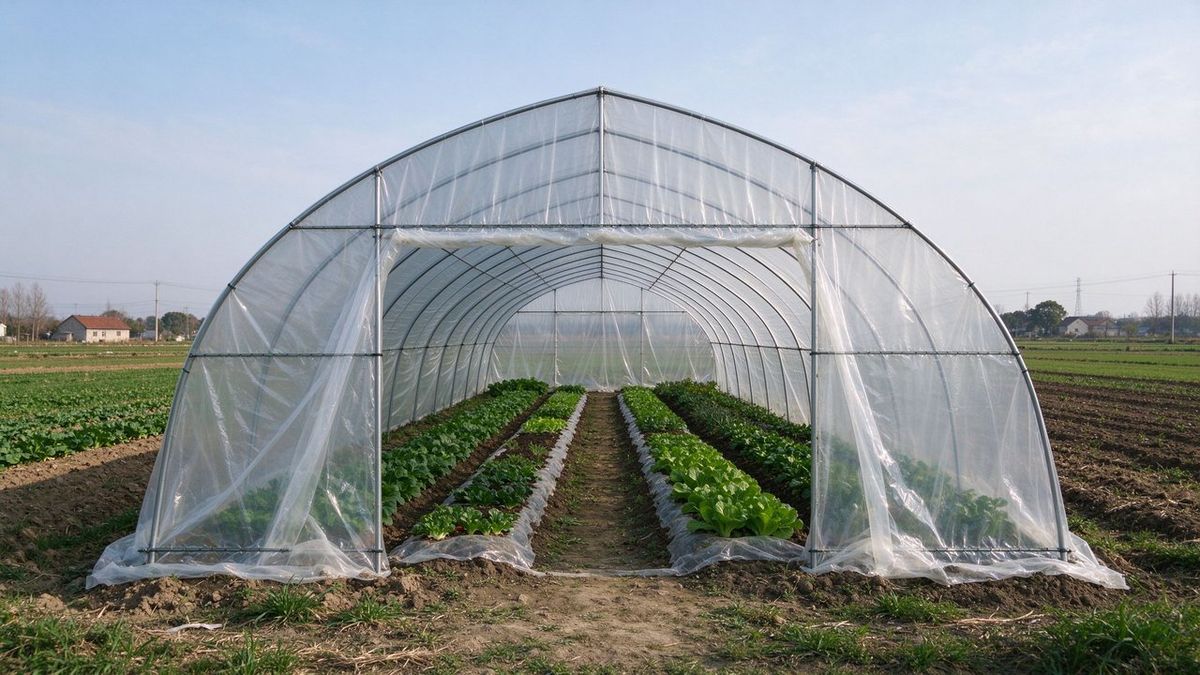
Organic bell and chili peppers in high tunnels combine the yield lift of protected culture with the input restrictions of certified organic production. In a hoop-house tunnel the grower trades climate control for longer growing seasons, lower disease pressure, and a 30 to 40 percent price premium from organic buyers. This article covers the fertility program, crop rotation, allowed pest controls, and the winter soil-rest protocol used on commercial organic tunnels at Zhongtian Agricultural Technology to average 3.2 kg of marketable pepper per square meter.
Tunnel Structure and Microclimate
A high tunnel is a Quonset-style hoop house 6 to 8 meters wide, 30 to 60 meters long, and 3 meters at the ridge, covered with 150-micron polyethylene film for two growing seasons. Sidewalls roll up 1 meter from the ground for ventilation; ridge vents are optional but recommended. The tunnel passively warms the soil by 4 to 6 degrees Celsius in early spring, allowing transplanting three to four weeks earlier than open field. Winter snow load dictates frame spacing at 1.5 meters between hoops.
Inside the tunnel, beds are raised 20 centimeters and covered with organic mulch of weed-suppressing landscape fabric or straw. Plant density is 3.0 plants per square meter on 1.0-meter bed centers, with two rows per bed. The tunnel should be oriented east-west in northern regions to maximize winter light interception, and north-south in southern regions to reduce summer heat buildup on sidewalls.
Fertility Program
Organic peppers need 180 kilograms per hectare of nitrogen over the season, supplied as a combination of composted poultry manure at 20 tons per hectare, blood meal at 600 kilograms per hectare, and feather meal at 400 kilograms per hectare. Apply 60 percent of the nitrogen two weeks before transplanting and incorporate it to a depth of 20 centimeters; side-dress the remaining 40 percent as fish emulsion at 5 liters per 100 square meters every four weeks from first bloom.
Phosphorus and potassium are supplied by rock phosphate at 300 kilograms per hectare and sulfate of potash magnesia at 200 kilograms per hectare, broadcast pre-plant. Soil pH should be held at 6.0 to 6.5; calcium is supplied as gypsum at 500 kilograms per hectare if blossom-end rot pressure appears. Tissue nitrogen at mid-season should read 3.5 to 4.0 percent dry weight; below 3.0 percent, side-dress with feather meal.
Crop Rotation and Soil Health
Peppers must follow a non-Solanaceous crop in the tunnel: cover crop of oats and vetch the previous winter, then a short spinach or radish crop in early spring. Do not follow tomato, eggplant, or potato, because they share Verticillium and bacterial spot pathogens. A three-year rotation is the minimum; five years is ideal if tunnel acreage allows.
Cover crops between seasons are critical: sow oats at 120 kilograms per hectare plus purple vetch at 40 kilograms per hectare after pepper harvest in late September, then mow and incorporate the biomass in March. This adds 15 to 20 tons of dry matter per hectare and raises soil organic matter by 0.2 percent per year. Compost tea, brewed for 24 hours with an air pump, is drenched at 5 liters per square meter at first bloom to boost rhizosphere biology.
Organic Pest and Disease Controls
Aphids and whiteflies are managed with releases of the parasitic wasp Encarsia formosa at 1 per square meter weekly, starting at first sign of pests. Cutworms are excluded by cardboard collars around each transplant, and flea beetle pressure is reduced by kaolin clay sprays at 2.5 kilograms per 100 liters, reapplied after rain. Western flower thrips are controlled with Amblyseius swirskii at 100 per square meter released at first flower.
Bacterial spot and powdery mildew are managed by fixed copper sprays at 0.3 grams per liter, applied at 7-day intervals during humid periods, and by wettable sulfur at 2 grams per liter alternated at 14-day intervals. Never apply sulfur within 21 days of an oil spray, because phytotoxicity burns leaves. Dowse beds with Bordeaux mixture at 1 percent only as a last resort, because copper accumulates in organic soils.
Harvest and Marketing
Organic peppers are harvested at breaker stage into padded crates and cooled to 10 degrees Celsius within two hours. Yields average 3.0 to 3.5 kg per square meter over a 20-week harvest, with 70 percent Class A fruit. Because organic price is 35 to 45 percent above conventional, the lower yield still delivers comparable gross margin.
At the end of the season, clear all debris, sow a winter cover crop, and vent the tunnel fully for six weeks to solarize the soil. The film is rolled up and stored in shade; sidewalls are disinfected with 1:10 vinegar solution. Certification records include compost source, soil tests, and input receipts; keep them on file for five years for organic audit.
Organic pepper production in high tunnels is a soil-first system: three-year rotation, cover crops that build organic matter, fertility derived from composted manure and blood meal, and a biocontrol-led pest program. With disciplined sidewall ventilation, kaolin and copper on a fixed schedule, and harvest at the breaker stage, organic growers average 3.2 kg per square meter at a price premium that more than offsets the yield gap. The protocols used at Zhongtian Agricultural Technology are designed for auditable, residue-free production.


