
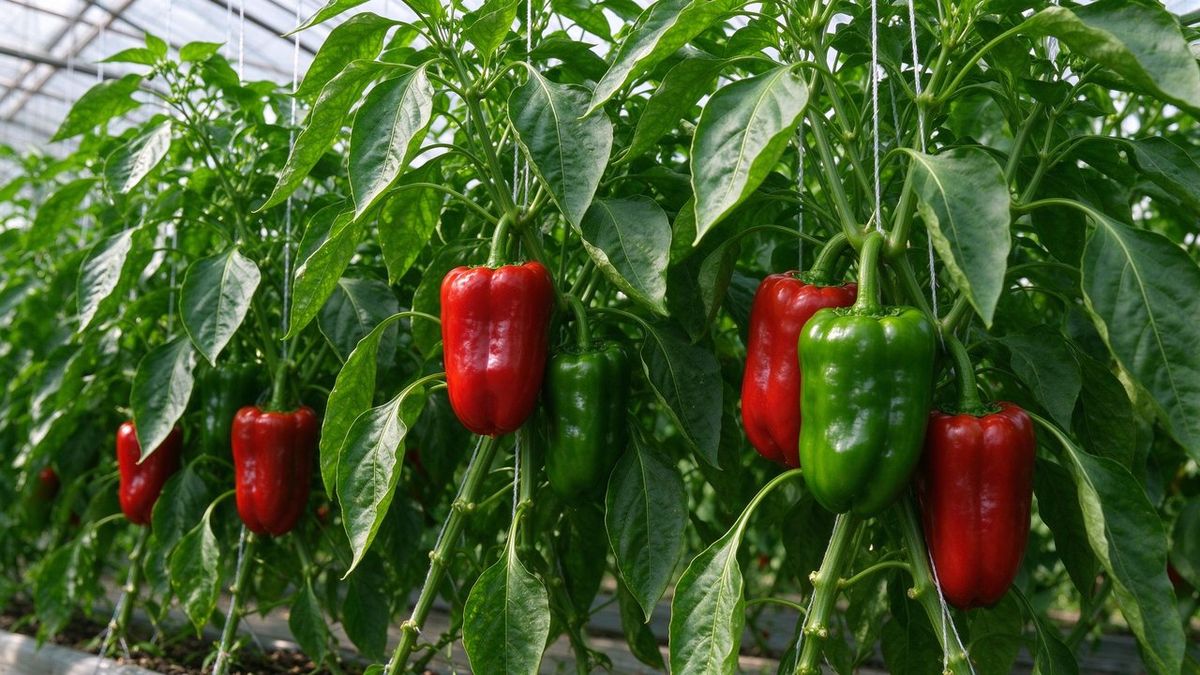
Red, yellow, and orange bell peppers reach their marketable color only when three variables align: daily light integral above 22 moles per square meter, fruit-zone temperature between 20 and 26 degrees Celsius, and a leaf-to-fruit ratio of 12 to 15 leaves per fruit. When any of these falls out of range, color break is delayed, mottled, or pale. This article explains the physiology behind ripening and the cultural levers that commercial growers at Zhongtian Agricultural Technology pull to get uniform, high-gloss fruit in 28 to 32 days from breaker stage.
Physiology of Pepper Ripening
Bell peppers are non-climacteric: they do not continue to ripen or accumulate sugar after harvest, and ethylene has only a minor effect on color. Color development is driven by chlorophyll breakdown and carotenoid accumulation — capsanthin and capsorubin in red fruit, violaxanthin in yellow, beta-carotene in orange. The enzymes that synthesize these carotenoids have a temperature optimum of 22 to 25 degrees Celsius; above 30 degrees Celsius they are denatured, and below 15 degrees Celsius their activity drops by 70 percent.
Assimilate supply from the leaf canopy is the substrate for pigment synthesis. Each green fruit needs 12 to 15 healthy, fully illuminated leaves within 30 centimeters to supply the 1.2 grams of dry matter that accumulates during the 28-day color-break window. If leaves are stripped too aggressively, fruit turns pale and soft; if leaves are left dense, light reaching the fruit is insufficient and color breaks slowly.
Light Management
Daily light integral above 22 moles per square meter is required for full color; below 18 moles, red peppers take 40 days or more to reach 80 percent surface color. In winter, supplement with high-pressure sodium lamps at 60 micromoles per square meter per second for 6 hours per day over the canopy. Reflective mulch on the floor raises light at the fruit zone by 15 to 20 percent and speeds color break by 3 to 5 days.
Shade screens are deployed when external radiation exceeds 650 watts per square meter to keep fruit temperature below 30 degrees Celsius; direct sun on a red fruit above 35 degrees Celsius causes sunscald bleaching. Remove leaves selectively so that fruit receives filtered, not direct, light: the canopy should cast dappled shadow on the fruit, not full shade. Lower-leaf stripping stops once fruit begins to color, because the remaining leaves are feeding ripening fruit.
Temperature and Humidity Control
Day temperature during color break should be 23 to 26 degrees Celsius; night temperature 18 to 20 degrees Celsius. A day-night difference of 5 to 7 degrees Celsius maximizes carotenoid accumulation. If daytime temperature exceeds 30 degrees Celsius for more than four hours, open vents fully, run wet-pad cooling at 60 percent efficiency, and raise shading to 40 percent.
Relative humidity of 65 to 75 percent keeps calyx fresh and reduces water loss; above 85 percent, Botrytis attacks the ripening fruit within days. Do not irrigate heavily in the last 5 days before harvest, because excess water dilutes pigment and causes fruit splitting. Cut daily irrigation volume by 30 percent once the first cluster reaches 50 percent red.
Nutrition for Color
Potassium drives fruit color: tissue potassium at mid-fruit should be 4.5 to 5.5 percent dry weight. If potassium is below 3.5 percent, foliar feed with potassium nitrate at 3 grams per liter every 7 days. Avoid excess nitrogen during color break, because it promotes leaf growth at the expense of fruit pigment; drop nitrogen by 30 percent from the vegetative recipe once fruit starts turning.
Magnesium is required for chlorophyll breakdown; if interveinal chlorosis appears on older leaves, foliar spray magnesium sulfate at 2 grams per liter. Calcium holds firmness, and a final calcium chloride spray at 0.5 grams per liter 10 days before harvest reduces blossom-end rot on the ripening fruit. Run-off EC during color break should be 2.5 to 2.8 mS per centimeter; below 2.0, color is pale and soft.
Harvest Timing for Color Uniformity
Pick fruit when 80 to 90 percent of the surface is target color; at this stage the fruit has reached 90 percent of final dry weight and will hold its color for 18 days at 8 degrees Celsius. Do not wait for 100 percent color on the plant, because over-mature fruit softens rapidly and bruises in pack-out. Each plant is picked twice a week at peak load; fruit left more than 4 days past 80 percent color will drop firmness below 15 newtons.
Record color uniformity per block: if more than 15 percent of fruit is 50 percent or less colored at the expected harvest date, the light or temperature window is wrong. At Zhongtian Agricultural Technology, weekly color charts guide harvest timing, and the harvest crew is trained to leave pale fruit on the plant for the next pass.
Color development in bell peppers is a light- and temperature-driven process, not a time-based one. Daily light integral above 22 moles per square meter, fruit-zone temperature held at 23 to 26 degrees Celsius, 12 to 15 leaves per fruit, and a potassium-rich but nitrogen-light nutrition program will deliver uniform 80-percent-red fruit in 28 to 32 days. Disciplined harvest at 80 percent color keeps firmness high and shelf life at 18 to 21 days.


