
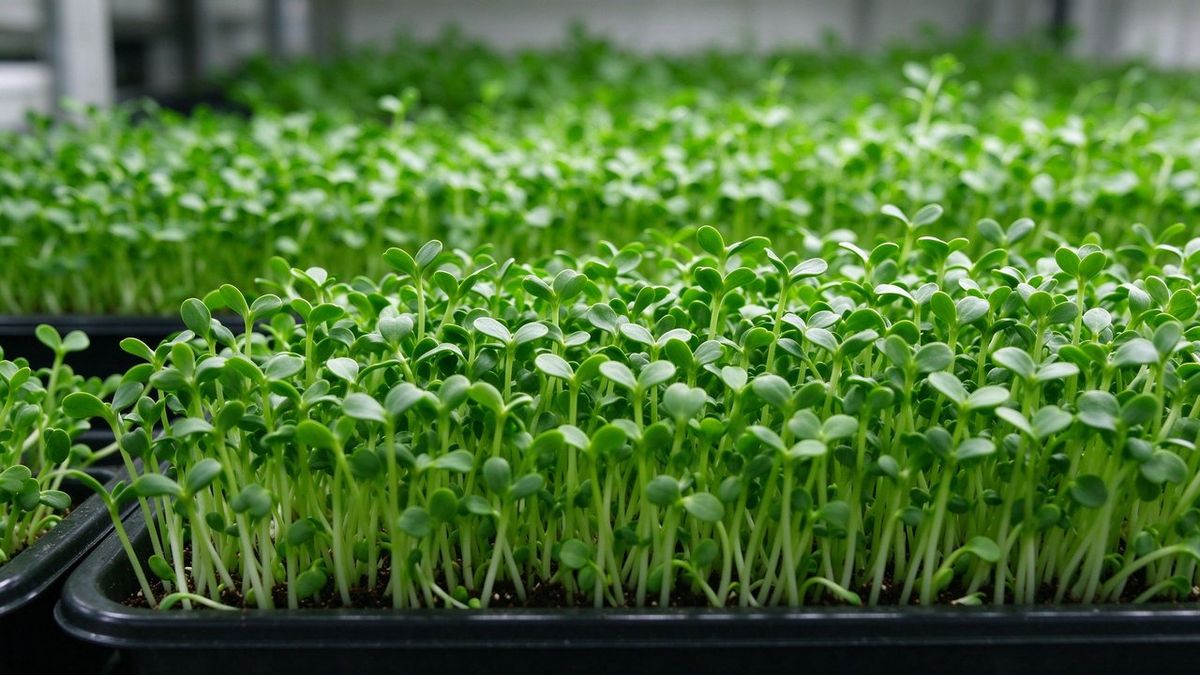
Arugula (Eruca sativa) and mizuna (Brassica rapa nipposinica) are fast-maturing salad greens that deliver sharp, peppery or mustard-like flavor on 20 to 30 day cycles. Both are brassicas, so they share the same cultural demands as other protected greens: cool temperatures, steady calcium, and careful ventilation to prevent tipburn and downy mildew. Arugula bolts quickly once day temperatures exceed 24 degrees, while mizuna tolerates heat and cold more gracefully, which makes them complementary in a mixed baby-leaf program. Dense broadcast sowing at 4 to 6 grams per square meter on peat or coco mats, followed by a single cut, yields 2.5 to 4.0 kilograms per square meter per cycle on a compact tabletop footprint.
Crop Type and Sowing Density
Standard arugula has deeply lobed leaves and a strong peppery bite; ‘astro’ and ‘runway’ are slow-bolting hybrids favored for greenhouse production. Mizuna forms a rosette of finely serrated, mild-tasting leaves; ‘kyona’ and ‘midnight’ are widely grown. Mix the two 60:40 for a balanced salad cut that stays tender even in cool weather. Sow by hand or by seed drill onto 2 centimeter thick coco or peat mats, 4 to 5 grams per square meter for arugula and 3 to 4 grams for mizuna.
Germination takes two to three days at 18 to 20 degrees. Cover seed with a thin 5 millimeter layer of vermiculite to retain moisture. Thin if broadcast density exceeds 800 plants per square meter; overcrowding produces long, weak stems that lodge and rot at the base. Target 500 to 600 plants per square meter at the four-leaf stage, which gives an even, upright canopy and a single clean cut at harvest.
Climate Controls
Arugula and mizuna grow best at 16 to 20 degrees Celsius by day and 10 to 12 degrees at night. Above 22 degrees, arugula develops a harsh, bitter flavor and bolts in 25 days; below 8 degrees, growth slows to a near halt. Vent when the canopy reaches 20 degrees, and use 30 to 40 percent shade cloth in summer to keep the leaves tender. Mizuna tolerates 28 degrees for short periods without bolting, which makes it the reliable anchor of a summer mix.
Relative humidity between 60 and 70 percent keeps leaves crisp and reduces downy mildew. Run horizontal air flow fans at 0.3 to 0.4 m/s continuously; stagnant humid air creates botrytis pockets on the inner rosette in 48 hours. On winter nights, keep the minimum above 8 degrees to prevent leaf yellowing. In solar greenhouses, close the quilt 30 minutes before sunset to capture residual heat.
Fertigation on Mats
Drip irrigation tape laid every 15 centimeters across the mat delivers nutrient solution at an electrical conductivity of 1.6 to 2.0 mS/cm, pH 5.8 to 6.2. Arugula is a light feeder; above 2.2 mS/cm the leaves accumulate excess nitrate and become bitter. Feed two to three times per day, 200 to 300 mL per square meter per event, starting at the two-leaf stage. Stop irrigation two hours before harvest so leaves are dry.
Calcium is critical for tipburn control. Apply calcium nitrate at 0.5 g/L through the drip at day 10 and day 17, and keep total calcium in the feed at 140 to 180 mg/L. Magnesium should be 40 to 50 mg/L to avoid interveinal chlorosis. Track mat moisture by lifting a corner; if the surface is dry but the underside is wet, reduce frequency rather than duration. Mats are usually replaced every two cycles to prevent root-borne disease buildup.
Pest and Disease Pressure
Flea beetles (Phyllotreta) chew small round holes in arugula leaves, and they enter through open vents in spring. Cover the crop with a 40 mesh insect net during the flight window, and place yellow sticky cards at one per 15 square meter just above the canopy. Aphids cluster on mizuna rosettes; release Aphidius colemani at 0.5 per square meter weekly once scouting shows two aphids per 10 plants.
Downy mildew appears as yellow angular spots with purple-gray sporulation on leaf undersides during cool, wet nights. Reduce leaf wetness by avoiding late-afternoon irrigation and by venting for 15 minutes after sunrise to purge condensation. Apply a copper hydroxide program at 1.5 g/L at the first sign of lesions. White rust (Albugo) on arugula is rare in protected culture but requires removal of infected plants immediately; do not compost them.
Harvest and Post-Harvest
Cut at 10 to 15 centimeters tall, 20 to 28 days after sowing, with a sanitized knife held just above the mat. Do not cut into the growing point; arugula will not regrow and mizuna gives only one weak second cut. Immediately plunge cut leaves into iced water at 2 degrees for five minutes, spin dry, and pack in vented clamshells or perforated film. Shelf life is 7 to 10 days at 1 to 3 degrees.
Yield is typically 2.5 to 4.0 kilograms per square meter per cycle, with water use of 4 to 6 liters per square meter per day. Schedule weekly sowings so a 200 square meter table delivers 50 to 80 kilograms of cut salad each week. Track average piece weight and stem length; buyers reject stems longer than 8 millimeters, which usually signals too high density or too warm a night. Zhongtian Agricultural Technology supplies mat benches, drip lines, and climate controllers tuned to hold the 16 to 20 degree daytime band and the 1.8 mS/cm feed recipe automatically.
Arugula and mizuna are high-value, short-cycle specialty greens that fail from heat and wet foliage, not from nutrition. A tight 16 to 20 degree band, light 1.8 mS/cm feeding, insect-net exclusion, and immediate cooling turn a 25 day sowing into a steady premium salad line.


