
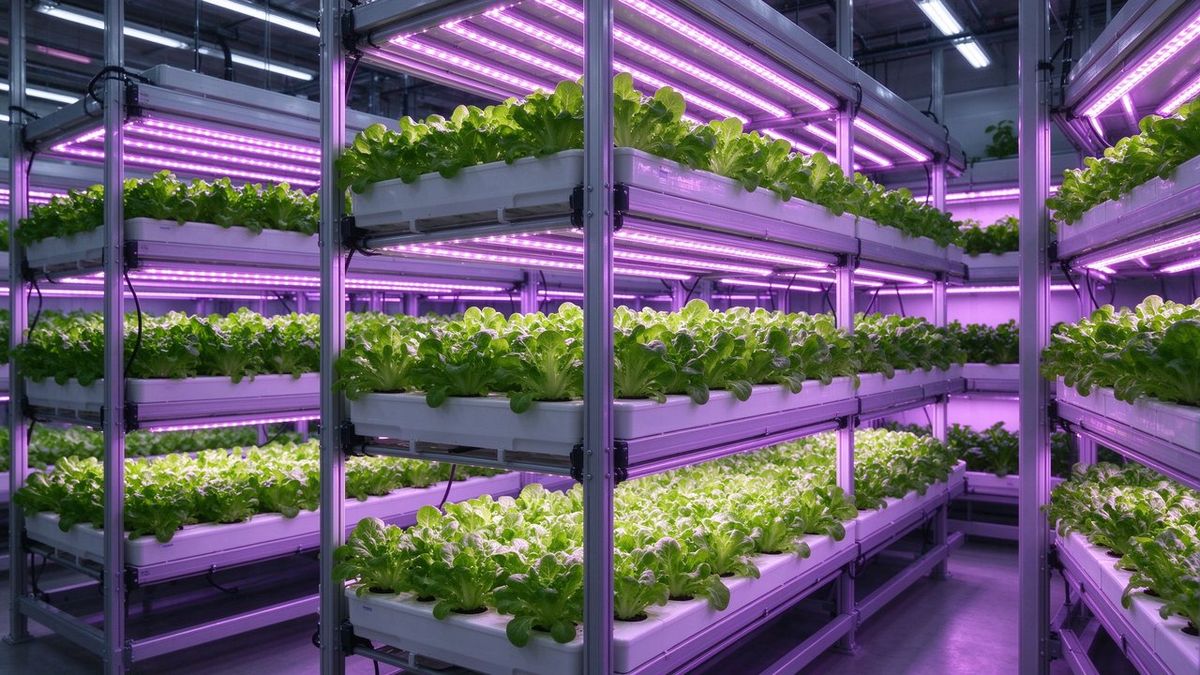
Vertical gutter hydroponics grows strawberry plants in long, narrow channels stacked in tiers or hanging A-frames, multiplying the usable growing area by 2 to 4 times compared with horizontal bag culture. Each gutter holds a thin layer of coco coir or rockwool, irrigated by drip or by a shallow recirculating nutrient film. The system saves floor space, improves air flow around the plants, and makes harvesting ergonomic. Yields of 12 to 18 kilograms per square meter of floor per year are achievable, but the system demands precise nutrition, even light, and strict disease control because the canopy is denser and harder to inspect.
Gutter Design and Layout
Vertical gutters are 15 to 20 centimeter wide food-grade PVC or food-contact plastic channels, mounted on A-frame racks or hanging wires in 2 to 4 tiers. Each tier is 40 to 50 centimeters apart vertically so the canopy does not shade the row below. Channels run on a 1.5 percent slope, with a drain at the low end feeding back to a central sump. Plant spacing is 20 to 25 centimeters along the gutter, one plant per planting hole.
Layout: a double A-frame carries 4 rows (2 per side) over a 1.2 meter floor footprint, giving 4 linear meters of crop per floor meter. A 1000 square meter floor then yields 4000 linear meters of row, planting 16,000 to 20,000 plants. Keep central aisles 80 centimeters wide for harvest carts. Hang gutters at 0.8 to 1.0 meter height on the lower tier and 1.6 meters on the upper tier for ergonomic picking.
Growing Medium and Irrigation
Fill gutters with a thin 5 to 8 centimeter layer of coco coir or a coco-perlite mix; do not use deep medium because the root mat must stay oxygenated. Install two drippers per plant at 1 liter per hour, or use a shallow NFT film of 3 to 5 millimeters. Run 10 to 15 irrigations per day, 80 to 120 mL per event, starting at 08:00 and stopping 2 hours before sunset. Drainage must be 20 to 30 percent; collect runoff in a sump.
Recirculating water needs a 200 micrometre filter and a UV sterilizer at 40 mJ/cm2 to control Pythium. Hold the nutrient solution at an electrical conductivity of 1.8 to 2.2 mS/cm, pH 5.8 to 6.2, and temperature 18 to 22 degrees. Dissolved oxygen must stay above 6 mg/L; if it drops below 5 mg/L, root slime and disease appear within a week. Test sump EC and pH daily; rebuild the sump every 2 to 3 weeks.
Light and Climate
Vertical stacking creates light gradients: the top tier receives 100 percent of available light, the middle 70 percent, the bottom 50 percent. Mitigate by rotating tiers every 4 weeks, or by installing inter-tier LED bars at 150 to 200 micromoles per square meter between rows. Target a daily light integral of 15 to 20 mol per square meter on every tier; without supplementation, bottom-tier yield drops by 30 to 40 percent.
Climate should be 18 to 22 degrees Celsius by day and 12 to 15 degrees at night. Relative humidity between 60 and 70 percent; vertical canopies trap humid air, so run horizontal fans at 0.4 m/s between tiers. Vent when canopy reaches 22 degrees; use 30 percent shade in summer. In winter, supplement all tiers with 200 micromole LEDs for 8 to 10 hours.
Pollination and Fruit
Bumblebee colonies must be placed within the vertical array; bumblebees fly 2 to 3 meters horizontally but avoid stacked tiers. Release one hive per 500 square meter of floor, positioned at the middle tier. If tiers are more than 2 meters tall, vibrate flower trusses by hand or with an electric wand twice a week. Check fruit set weekly; nubbin fruit signals poor pollination.
Fruit on vertical gutters hangs downward, which reduces contact with wet medium and cuts botrytis by 40 to 50 percent compared with horizontal bags. But fruit on the bottom tier can be smaller due to lower light; rotate blocks. Thin trusses to 6 to 8 fruit per truss so remaining berries fill to 25 to 30 grams. Harvest every 2 to 3 days when fruit is fully red.
Disease and Yield
The dense vertical canopy is a powdery mildew risk. Prevent by running inter-tier fans, keeping RH below 70 percent, and applying sulfur at 2 g/L as a protectant. Botrytis on ripe fruit thrives on wet flowers; remove dead petals and apply fludioxonil at first bloom. Spider mites build fast in warm, dry vertical air; release Phytoseiulus persimilis at 10 per square meter weekly.
Yield is 12 to 18 kilograms per square meter of floor per year, roughly 2 to 3 times horizontal bag culture. Water use is 4 to 6 liters per square meter per day. Track energy per kilogram; vertical systems use more lighting per kilogram than horizontal ones, usually 150 to 200 kWh per kilogram. Zhongtian Agricultural Technology supplies A-frame gutter systems, inter-tier LED bars, and UV-sterilized recirculating sump stations that hold the 2.0 mS/cm feed and 18 to 22 degree water automatically.
Vertical gutter strawberry multiplies floor yield but demands even light, recirculating water discipline, and inter-tier air movement. Tier rotation, inter-row LEDs, UV-sterilized sump, and strict RH control turn a 4-tier A-frame into 12 to 18 kilograms per square meter of floor per year.


