
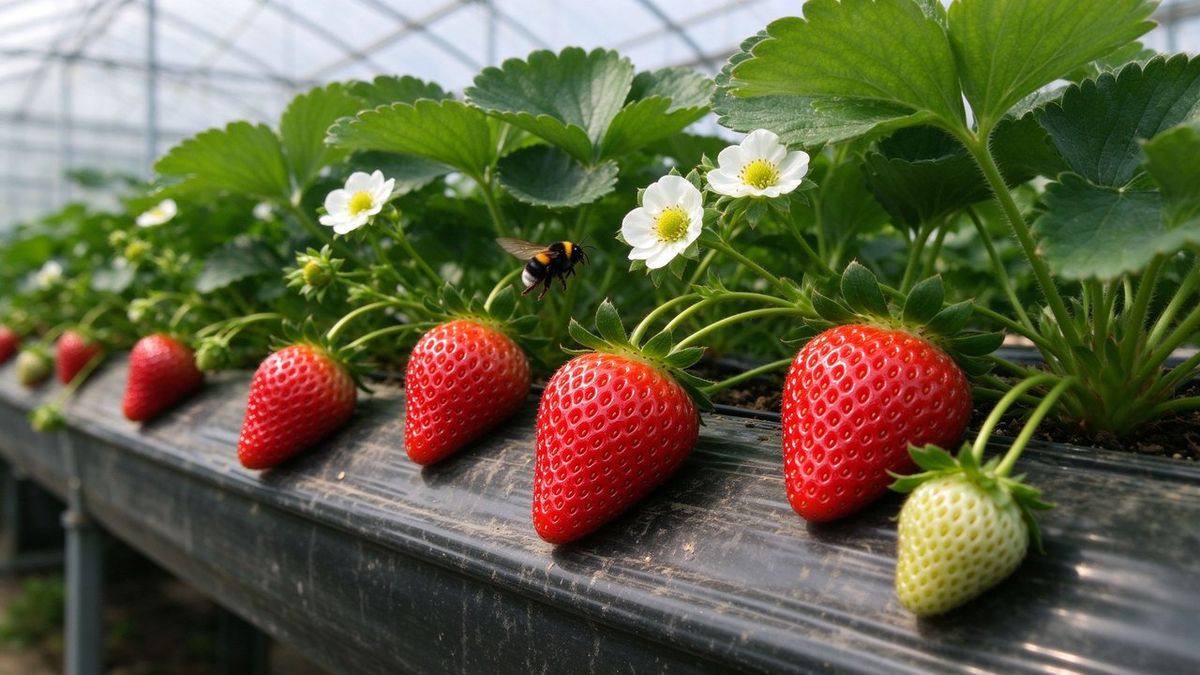
Day-neutral strawberry varieties flower and fruit continuously as long as temperature stays between 15 and 25 degrees, regardless of day length. This makes them the backbone of protected greenhouse production, because they can be planted in spring and cropped through autumn without the strict short-day window of June-bearing types. Variety selection drives 30 to 50 percent of yield and fruit quality, and the wrong choice shows up as small fruit, poor flavor, or early disease collapse. The best varieties balance yield, fruit size, flavor, disease resistance, and shelf life.
Top Day-Neutral Varieties
‘Albion’ is the most widely grown day-neutral: large, firm, deep-red fruit with good flavor, high yield, and resistance to Verticillium and Phytophthora crown rot. It performs well under protected culture and stores 5 to 7 days. ‘San Andreas’ is a sibling with slightly softer fruit and earlier season, best for local direct markets. ‘Evie 2’ crops heavily in spring and early summer, with medium-large bright red fruit.
‘Monterey’ and ‘Camarosa’ derivatives offer good flavor but softer shelf life, suited to farm-gate sales. ‘Seascape’ is reliable in cooler coastal climates. ‘Mara des Bois’ is a gourmet variety with strong aroma and white-pink fruit, commanding a premium price. Trial 3 to 4 varieties per season on 10 plant rows; keep records of yield, fruit weight, and rejection rate by block.
Matching Variety to Season
No single variety performs equally in all months. Spring blocks (March to May) favor ‘Albion’ and ‘Evie 2’, which fruit heavily under rising light. Summer blocks (June to August) need heat tolerance; ‘San Andreas’ and ‘Albion’ hold up best above 25 degrees. Autumn blocks (September to November) favor ‘Monterey’ and ‘Mara des Bois’, which produce flavorful fruit under lower light.
Winter production under supplemental light uses ‘Albion’ and ‘Seascape’, which tolerate low light and still set fruit. Avoid short-day varieties such as ‘Camino Real’ and ‘Honeoye’ in a day-neutral program; they crop only under short days and will stall in summer. Match the variety’s chilling requirement to your plant source; frigo plants need explicit cold storage.
Yield and Fruit Size Targets
A mature day-neutral plant produces 300 to 600 grams of fruit over a 4 to 5 month season. At 9 plants per square meter, that is 2.7 to 5.4 kilograms per square meter per season. First harvest is lighter at 0.5 to 1.0 kilograms; the second and third months peak at 1.0 to 1.5 kilograms per month. Average fruit weight should hold 25 to 35 grams; below 18 grams, buyers reject the tray.
Track fruit size weekly by weighing 20 random berries. If average weight drops below 20 grams, suspect insufficient light, excess plant density, or powdery mildew. Adjust density to 8 to 9 plants per square meter; overcrowding reduces fruit size faster than it raises total yield. Thin flower trusses to 6 to 8 flowers per truss so the remaining fruit fills out.
Disease Resistance Profiles
Check the disease resistance profile of each variety. ‘Albion’ carries resistance to Verticillium dahliae and Phytophthora cactorum. ‘San Andreas’ is moderately resistant to powdery mildew but susceptible to botrytis in wet seasons. ‘Evie 2’ is susceptible to spider mites. ‘Mara des Bois’ has soft fruit that bruises easily and needs careful handling.
Rotate varieties by block to avoid building host-specific pathogens. Do not plant the same variety in the same block two cycles in a row. Keep mother plants off-site; bring in certified virus-tested runner plants each season. Test the coco or peat medium for Phytophthora before planting; a 1 gram per liter drench of fosetyl-Al at transplant protects crowns.
Trial Record and Decision
Run a formal variety trial each season: 10 plants per variety, randomized in 3 blocks, with the same fertigation and climate. Record weekly yield, average fruit weight, rejection rate (misshapen, rotten, small), and brix. Brix above 8 degrees signals good flavor; below 6 degrees fruit is watery. After 2 seasons you will have a local performance table.
Choose varieties on three criteria: 50 percent yield and fruit size, 30 percent disease resistance, 20 percent shelf life and flavor. Price premium for gourmet varieties such as ‘Mara des Bois’ can justify lower yields. Zhongtian Agricultural Technology supplies certified frigo plants, elevated bag systems, and climate controls that let you run variety trials under identical conditions across blocks.
Day-neutral variety selection is the highest-leverage decision in greenhouse strawberry. Trial 3 to 4 varieties per season, match them to the season, thin trusses for fruit size, and rotate by block; the right mix lifts yield 30 percent and rejection rate below 5 percent.


