
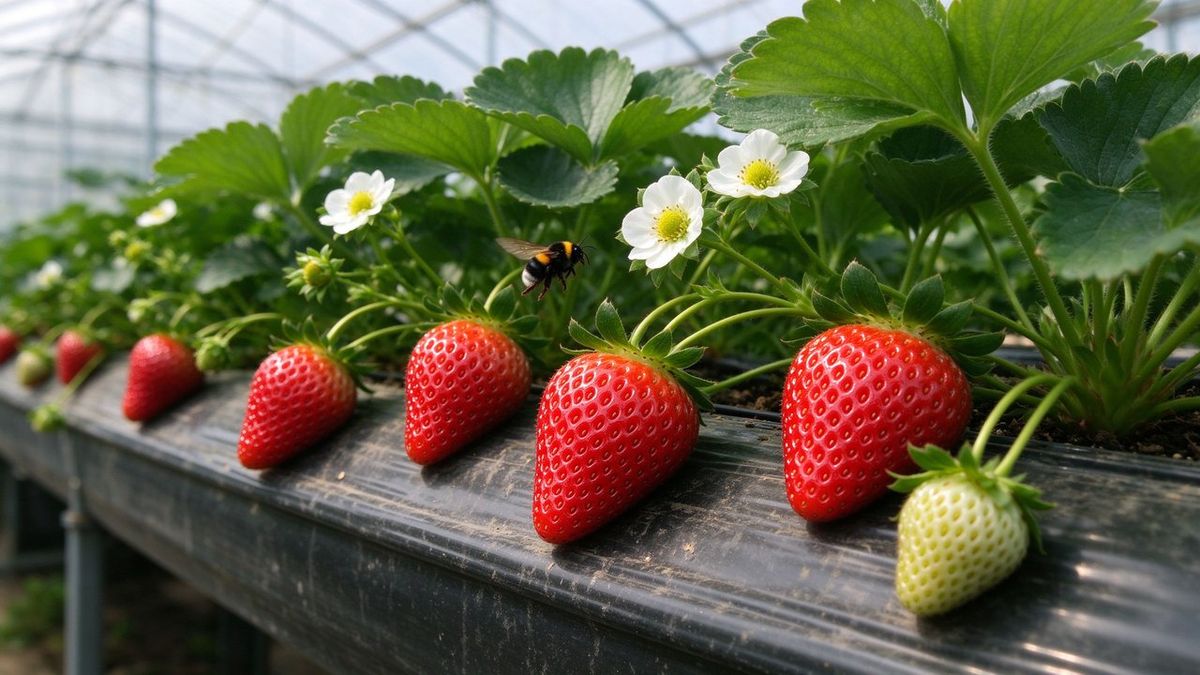
Year-round greenhouse strawberry production uses a combination of cold-stored frigo plants, day-neutral varieties, and climate-controlled cultivation to deliver fruit every month of the year. The crop is grown on elevated coco or peat bags, usually two rows per bed, at a density of 8 to 10 plants per square meter. A well-run house yields 4.0 to 6.0 kilograms per square meter per year of fruit graded at 20 to 35 grams per berry. The main challenges are balancing temperature and light for flowering, managing powdery mildew and botrytis, and scheduling planting blocks so one harvest cycle follows another without gap.
Planting Material and Scheduling
Use cold-stored frigo plants (A+ grade) for spring and summer planting, and fresh dug plants for autumn planting. Frigo plants give a first harvest 5 to 7 weeks after planting, while fresh plants go through a winter rest and crop in spring. Day-neutral varieties such as ‘Albion’, ‘San Andreas’, and ‘Evie 2’ flower continuously under 12 to 14 hour days, while short-day varieties such as ‘Camino Real’ crop only under short days.
Plan a continuous schedule: plant a new block every 4 to 6 weeks so one block is at flowering, one at green fruit, and one at harvest at all times. Each productive block lasts 3 to 5 months. Divide a 1000 square meter house into 5 equal blocks; rotate varieties by block to spread disease risk. Keep mother plants off-site to avoid virus buildup.
Climate for Flowering and Fruit
Day temperature should be 18 to 22 degrees Celsius, night 12 to 15 degrees. Above 25 degrees, pollen viability drops and fruit becomes misshapen; below 8 degrees, growth stops. Relative humidity between 60 and 75 percent is ideal; above 80 percent, powdery mildew and botrytis explode. Vent when canopy reaches 22 degrees; use 30 percent shade in summer.
Light drives flowering and fruit weight. Target a daily light integral of 15 to 20 mol per square meter. In winter, supplement with 200 to 250 micromole LEDs over the rows for 8 to 10 hours; without supplemental light, winter fruit is small and yields drop by 40 percent. Run high-pressure sodium or LED inter-canopy lights at 100 to 150 micromoles just above the flower trusses.
Fertigation on Bags
Grow on 10 to 12 liter coco or peat bags, two plants per bag, spaced 25 centimeters apart in rows on 1.2 meter beds. Use a complete strawberry nutrient solution at an electrical conductivity of 1.6 to 2.0 mS/cm during vegetative growth, rising to 2.0 to 2.4 during fruiting. pH should be 5.8 to 6.2. Potassium must be generous, at 200 to 250 mg/L, to support fruit sugar.
Irrigate through two drippers per bag at 2 liters per hour. Run 8 to 12 irrigations per day, 100 to 150 mL per event, starting at 08:00 and stopping 2 hours before sunset. Target 20 to 30 percent drainage; leachate should measure within plus or minus 0.3 mS/cm of the feed. Track bag weight daily; bags should lose 10 to 15 percent of their weight between irrigations.
Pollination and Fruit Set
Strawberry flowers need mechanical vibration or insect pollination for full fruit set. Release bumblebee hives at one colony per 500 to 1000 square meter at 10 percent open flowers. Bumblebees work 12 to 18 degree days and cloudy conditions, which honeybees avoid. If bumblebees are not available, vibrate flower trusses with an electric wand for 5 minutes per row twice a week.
Poor pollination produces small, misshapen nubbin fruit. Check pollen viability by dabbing a flower on black paper; viable pollen is yellow and abundant. If pollen is sparse, suspect night temperature above 18 degrees or nutrient imbalance. Remove misshapen fruit at harvest to divert energy to good fruit.
Disease and Harvest
Powdery mildew (Podosphaera aphanis) appears as white fungal growth on leaf undersides and fruit calyxes. Prevent by keeping RH below 75 percent, running fans at 0.4 m/s, and applying sulfur at 2 g/L as a protectant. Botrytis gray mold on ripe fruit thrives in wet flowers; remove dead petals and apply fludioxonil at 0.5 mL/L at first bloom. Spider mites build in warm, dry air; release Phytoseiulus persimilis at 10 per square meter weekly.
Harvest ripe fruit every 2 to 3 days, early in the morning when fruit is cool. Pick with the cap attached, twist gently, and place in 250 gram clamshells. Cool to 4 degrees Celsius within 2 hours; shelf life at 2 to 4 degrees is 5 to 7 days. Yield is 4.0 to 6.0 kilograms per square meter per year; average fruit weight 20 to 35 grams. Zhongtian Agricultural Technology supplies elevated bag benches, bumblebee-compatible LED lighting, and climate controls that hold the 18 to 22 degree band and 60 to 75 percent RH automatically.
Year-round strawberry production is a scheduling and climate exercise. Frigo and day-neutral blocks on a 4 to 6 week rotation, disciplined 18 to 22 degree climate, generous potassium feeding, bumblebee pollination, and a strict botrytis program turn a 1000 square meter house into a continuous premium fruit line.


