
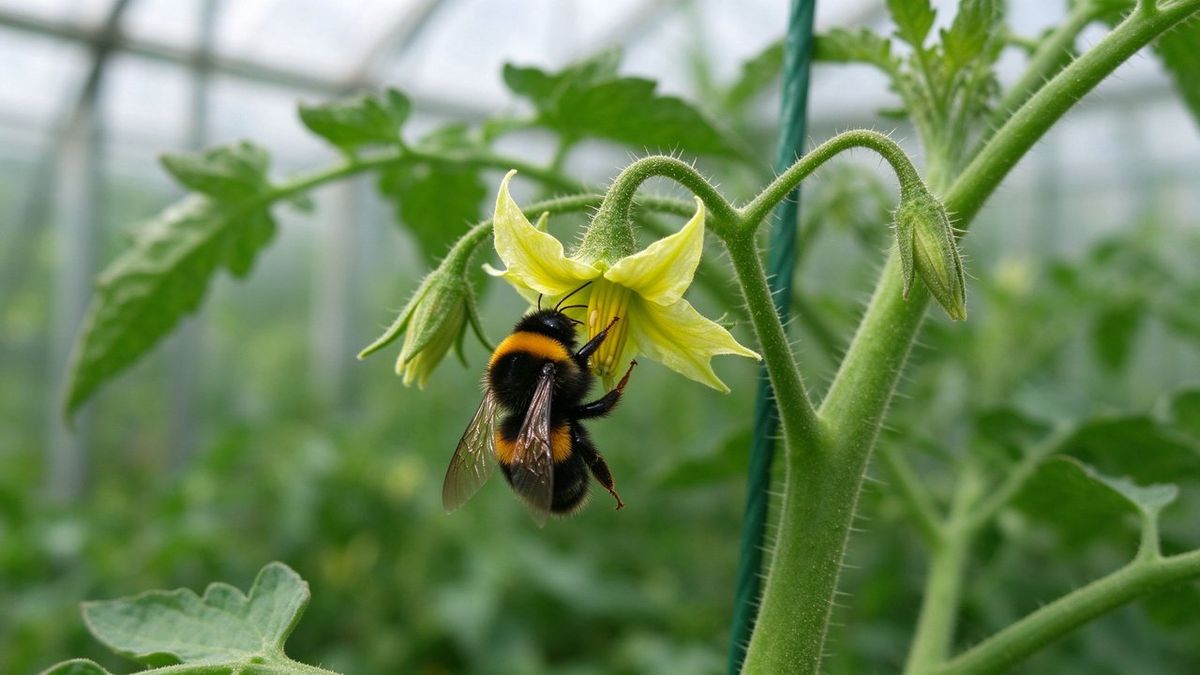
Bumblebee colonies (Bombus terrestris) are the standard pollination tool in greenhouse strawberry because they forage at 12 to 18 degrees Celsius, work in cloudy and humid conditions, and sonicate flower trusses far more effectively than honeybees. A single colony of 60 to 80 worker bumblebees can pollinate 500 to 1000 square meters of strawberry, improving fruit set by 20 to 40 percent and cutting the rate of misshapen fruit from 15 percent to under 5 percent. Success depends on colony placement, temperature management, compatible chemistries, and routine hive health checks.
Colony Introduction and Density
Introduce one bumblebee colony per 500 to 1000 square meter at 10 percent open flowers. Hives should be placed at 1.0 to 1.5 meter height, facing the central aisle, with the entrance pointing east so morning sun activates foraging. In multi-tier vertical systems, place hives at the middle tier; bumblebees fly horizontally rather than climbing. Keep hives shaded from direct sun; internal hive temperature must stay below 30 degrees.
Inspect colony strength on day 3 and day 10 after introduction. A healthy hive shows 30 to 40 visible workers on or near the entrance and a growing brood. If fewer than 10 workers forage, suspect pesticide drift from a neighboring block, low temperature below 10 degrees, or a weak colony. Replace weak hives within 48 hours; a single missed flowering week costs 10 to 15 percent of yield.
Climate for Bumblebee Foraging
Bumblebees forage at 12 to 28 degrees, with peak activity at 18 to 25 degrees. Below 10 degrees they stay in the hive; above 32 degrees they stop foraging and cool the nest. Vent and shade the greenhouse to keep canopy between 18 and 25 degrees. Relative humidity between 50 and 70 percent is ideal; above 85 percent, pollen clumps and bees struggle to carry it.
Light level matters: bumblebees work poorly on dark, overcast days and in greenhouses with heavy shade. In winter, supplement with 100 to 150 micromole LEDs to extend foraging hours. Hives should not be exposed to direct misting; wet entrances reduce foraging. Keep hive entrances clear of leaves and debris; a blocked entrance doubles return time.
Pollination Quality and Fruit Shape
Good bumblebee pollination produces round, fully filled fruit with uniform color. Poor pollination produces nubbins, lopsided fruit, and small berries. Check 20 random flowers per block: well-pollinated flowers have 80 percent of the stamens with visible yellow pollen. After 24 hours, petals should begin to drop; if petals stay attached for more than 48 hours, pollination is incomplete.
Track fruit shape weekly. If misshapen fruit exceeds 8 percent, inspect hive strength first. Common causes: hive placed too far from the block, temperature below 12 degrees, or recent pesticide application. If two hives are in the house, rotate which block they service. Bumblebees have a 100 to 200 meter foraging range but prefer flowers within 30 meters of the hive.
Chemistry Compatibility
Bumblebees are highly sensitive to neonicotinoids, pyrethroids, and many fungicides. Stop all spray programs 48 hours before introducing hives, and do not apply any product during the flowering period unless it is explicitly labeled bumblebee-safe. Check the label’s bee-toxicity rating; products classified as ‘dangerous to bees’ must not be used. Sulfur, kaolin, and some copper products are low-toxicity but should be applied in the evening when bees are back in the hive.
If a pesticide application is unavoidable, close the hive entrance in the evening and move the hive to a dark, cool room for 48 to 72 hours after spraying. Ventilate the house fully before reopening. Track all spray applications in a logbook with date, product, rate, and hive location. Repeated accidental kills cost 200 to 400 RMB per replacement hive plus lost pollination.
Colony Nutrition and Replacement
Commercial hives come with a sugar solution feeder that sustains the colony when pollen is scarce. Do not let the feeder run dry; check weekly and top up. A strawberry crop provides enough pollen for a moderate colony, but in low-light winter blocks, supplement with a 1:1 sugar-water feeder. Hive life is typically 6 to 10 weeks in a greenhouse; replace when worker counts drop below 20 or when the queen slows laying.
Track cost per square meter: a colony costs 300 to 500 RMB and lasts 8 to 10 weeks, which is about 0.05 RMB per square meter per day. Compare this to the 20 to 40 percent yield gain and the reduction in misshapen fruit; bumblebee pollination pays back 10 to 20 times its cost. Zhongtian Agricultural Technology supplies certified Bombus terrestris colonies, hive stands, and climate controls that hold the 18 to 25 degree foraging band and the 50 to 70 percent RH automatically.
Bumblebee pollination is a precision input, not a set-and-forget installation. Correct hive density, 18 to 25 degree foraging climate, strict pesticide discipline, and weekly hive checks cut misshapen fruit to under 5 percent and lift yield by 20 to 40 percent.


