
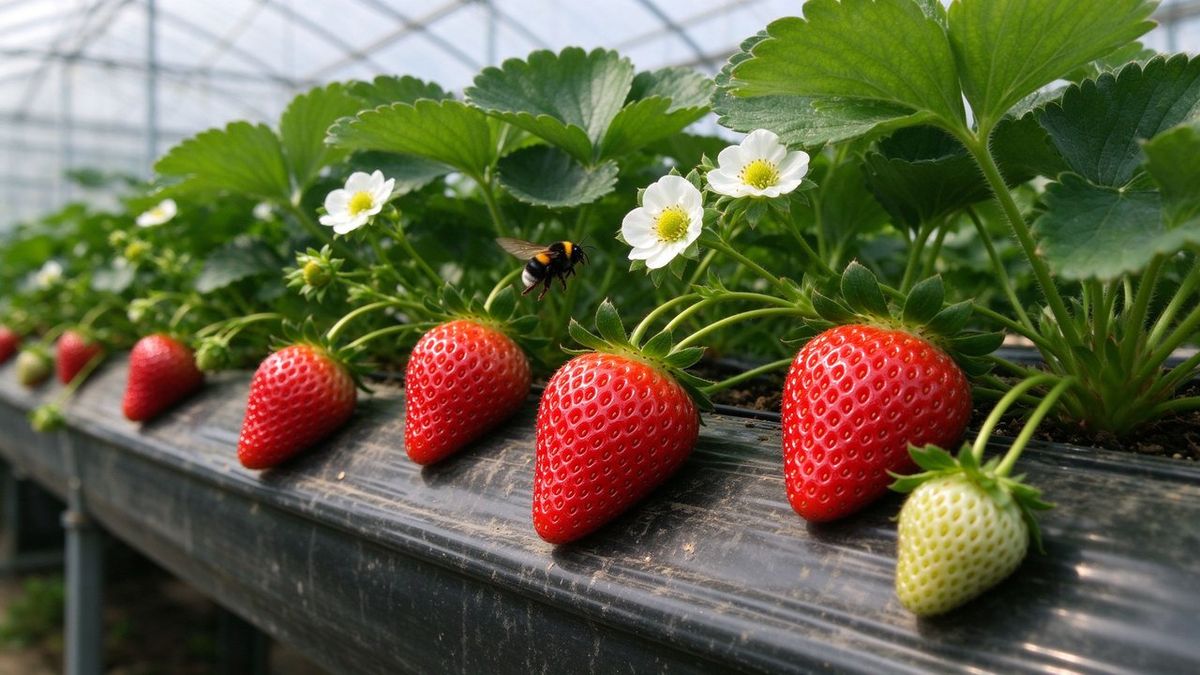
The black vine weevil Otiorhynchus sulcatus and the strawberry root weevil Otiorhynchus ovatus are silent killers in substrate-grown strawberry. Adults notch leaf margins at night, but the real economic loss is inflicted by legless C-shaped larvae feeding on fine roots and crowns from August through April. A density of three larvae per litre of coco substrate is enough to stunt a plant and trigger wilting that is easily mistaken for drought. Because adults are flightless and spread by walking and on contaminated tray plants, scouting and biological suppression are the backbone of protected-culture programmes.
Damage Thresholds and Scouting
Scouting combines visual leaf-notching counts with substrate flotation. Ten gullies per bay are sampled at random: a 200 mL core of substrate is washed through a 2 mm sieve and larvae counted. The action threshold is one larva per litre of substrate; at this density a rescue treatment is justified. Adult notching above 10 per cent of leaves per crown signals a migrating population and prompts a barrier application even if larval counts are still low.
Nocturnal adults are monitored with folded corrugated-card traps placed on gully rails; traps are inspected every 14 days. Peak adult emergence occurs at soil temperatures above 15 degrees Celsius, usually four to six weeks after strawberry planting. Because larvae overwinter in coco slabs, slabs from a previously infested crop are never reused; they are removed to waste and the trough surface is flame-sterilised between cycles.
Entomopathogenic Nematode Programmes
Heterorhabditis bacteriophora and Steinernema kraussei are the standard biocontrol agents. S. kraussei remains active at substrate temperatures as low as 5 degrees Celsius, making it the preferred species for autumn and winter applications, while H. bacteriophora performs best at 18 to 22 degrees Celsius. The recommended rate is 250 infective juveniles per square metre, delivered through the drip line after screens are removed and filters bypassed to prevent trapping.
Application timing matters more than rate. A first drench is applied at planting as a preventive, then two follow-up drenches at four-week intervals during peak larval activity. Substrate must be saturated immediately before and after nematode application; drip cycles are run for 15 minutes on either side, and vents remain closed for four hours to keep humidity high. Nematode viability is checked before application by placing a drop on a slide and observing active movement at 40x magnification; dead, straight nematodes indicate a poor batch and the order should be rejected.
Beauveria bassiana and Cultural Controls
The entomopathogenic fungus Beauveria bassiana strain ATCC 74040 is applied as a foliar spray targeting nocturnal adults at a rate of 2.0 litres per hectare of formulated product, diluted in 800 to 1,000 litres of water. Sprays are applied at dusk when adults are active, and the greenhouse is kept above 90 per cent RH overnight to support spore germination. Three sprays at 10-day intervals coincide with adult emergence peaks; this reduced egg laying by 60 to 70 per cent in university trials.
Cultural suppression starts at the nursery: plug plants are inspected on arrival, and any tray showing leaf notching is rejected. Goldenrod or ornamental beetle trap crops are not recommended inside a closed greenhouse because they attract adults into the crop. Instead, gully-side weeds are eliminated and a 30 cm strip of bare concrete is kept clean between crop bays and greenhouse walls, breaking the walking route adults use to disperse between troughs.
Rescue Chemistry and Resistance Management
When nematode and fungus programmes fail, a soil-directed drench of chlorantraniliprole is registered against root weevil larvae in most strawberry-growing regions. The active ingredient is delivered through the drip at 0.4 kg per hectare, followed immediately by a 10-minute irrigation cycle to move the chemical into the root zone. A single application per crop cycle is the maximum label rate; repeated use invites resistance in weevil populations.
Adult knockdown with a foliar pyrethroid is permitted only during the pre-flower window, because bumblebee hives are active once flowering begins. When a flowering rescue is unavoidable, acetamiprid is applied at dusk after hives are closed, and hives remain sealed for 12 hours. Resistance is managed by rotating modes of action between crops: a chlorantraniliprole year is followed by a nematode-and-Beauveria year so that no single chemistry dominates the rotation.
Root weevil is a population-management problem, not a single-spray problem. Combine nursery inspection, threshold-based substrate sampling, nematode drenches timed to substrate temperature, and a restricted rescue chemistry used once per cycle. That sequence keeps larval density below one per litre and avoids the crown rot secondary infections that follow severe root pruning.


