
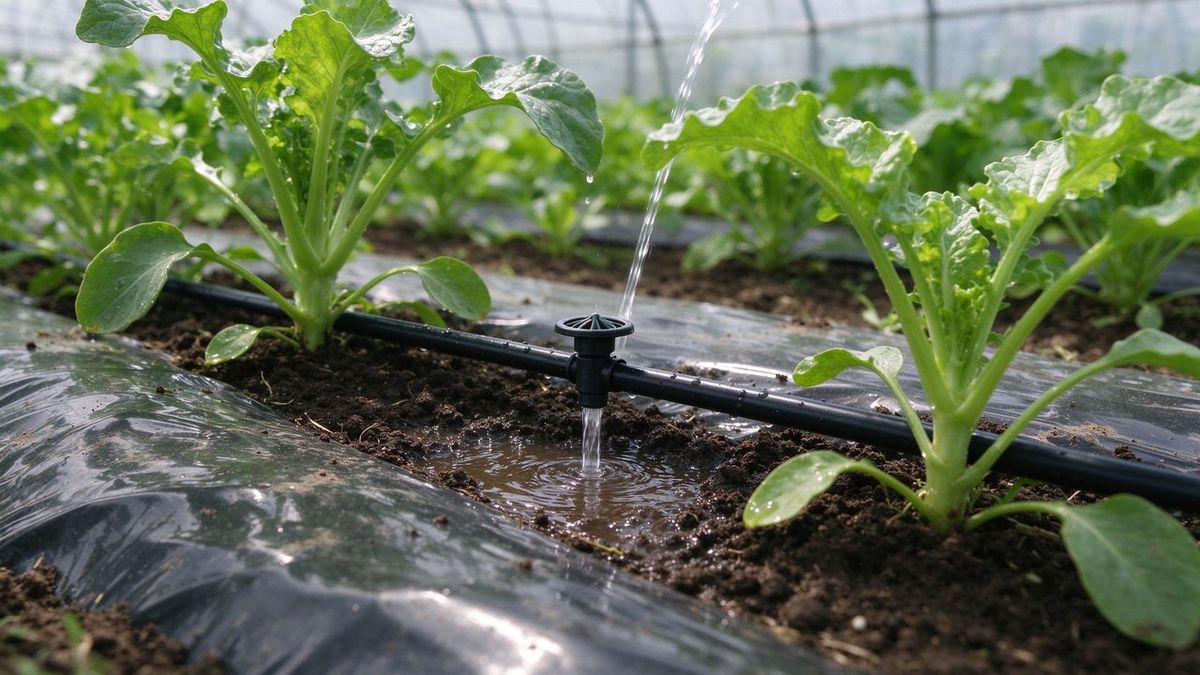
Fertigation in greenhouse strawberry is the single largest lever on fruit size, shelf life, and disease pressure. Too little nitrogen produces small pale fruit; too much produces soft, watery berries that rot in the punnet. A modern schedule splits the crop into four feeding phases, each with its own EC, nitrate-to-potassium ratio, and calcium allocation. The schedule is delivered through pressure-compensating drip lines at 2.0 L/h per emitter, one emitter per plant, and is adjusted daily based on drainage analysis.
Water Source and Base Nutrient Solution
Greenhouse strawberry requires irrigation water with a sodium absorption ratio below 2.0 and chloride below 60 mg/L. If bore water exceeds these limits, reverse osmosis or dilution with rainwater is required before mixing. The base tank is prepared as two separate stock solutions to prevent precipitation: A-tank holds calcium nitrate at 150 g/L, and B-tank holds potassium nitrate, mono-potassium phosphate, magnesium sulphate, and all trace elements. Acid (nitric or phosphoric) is injected at the mixing head to bring final pH to 5.4 to 5.8.
A standard starter recipe per 1,000 litres of feed contains 120 mg/L nitrogen as nitrate, 30 mg/L ammonium nitrogen, 45 mg/L phosphorus, 180 mg/L potassium, 140 mg/L calcium, and 45 mg/L magnesium. Trace elements are held at 1.0 mg/L iron, 0.5 mg/L manganese, 0.3 mg/L zinc, 0.15 mg/L copper, 0.05 mg/L molybdenum, and 0.5 mg/L boron. Electrodes measuring feed EC and pH are calibrated weekly with pH 4.0 and 7.0 buffers and 1.413 mS/cm standard solution.
Phase Feeding by Crop Stage
Phase 1, planting to first flower, runs for 14 to 21 days at EC 1.0 to 1.2 mS/cm with a nitrogen-to-potassium ratio of 1:0.8. The goal is root establishment, not canopy. Phase 2, first flower to first harvest, raises EC to 1.4 to 1.6 mS/cm and shifts the N:K ratio to 1:1.4 to support truss development. Phase 3, peak harvest weeks 4 through 12, holds EC at 1.6 to 1.8 mS/cm with N:K at 1:1.8; calcium is increased to 160 mg/L to reduce fruit softening.
Phase 4, late harvest after week 12, drops EC back to 1.4 mS/cm and raises magnesium to 60 mg/L to push crown carbohydrate reserves for a second flush if the crop is everbearing. Throughout all phases, daily drainage EC is kept within 0.3 mS/cm of feed EC; if drainage climbs above 2.2 mS/cm, the schedule is flushed with clear water for two cycles before resuming. A drainage pH above 6.2 indicates sodium or bicarbonate accumulation and triggers an acid flush at pH 4.5.
Irrigation Volume and Timing
Irrigation is scheduled by solar radiation integral rather than by clock. The controller opens the first cycle when cumulative light reaches 150 J/cm² after sunrise, then repeats every 100 J/cm². Each cycle delivers 80 to 100 mL per square metre, which is 60 to 90 seconds on a 2.0 L/h emitter. Total daily volume in summer reaches 2.5 to 3.5 L per square metre; in winter it drops to 0.8 to 1.2 L.
Last irrigation cycle is scheduled so that slabs are near field capacity at sunset but not saturated: a final run at two hours before dusk on short days, four hours before dusk on long days. Slab weight sensors on representative troughs are calibrated weekly; the target slab weight rises by 10 to 15 per cent during a cycle and falls by 8 to 10 per cent between cycles. A slab that never dries out by 15 per cent is overwatered and loses root oxygen.
Foliar Nutrition and Calcium Timing
Calcium deficiency shows as green-tip fruit and botrytis-prone berries. Even with adequate root calcium, a foliar supplement of 0.4 per cent calcium nitrate (4 g/L) is sprayed at 7 to 10 day intervals during fruit swell, applied in the morning so leaves dry by noon. Foliar calcium is never mixed with sulphate salts because calcium sulphate precipitates and clogs spray nozzles.
Magnesium deficiency appears as interveinal reddening on older leaves and is corrected with a 0.3 per cent magnesium sulphate foliar spray at two consecutive weeks. Iron deficiency in alkaline substrate is corrected by chelated iron (Fe-EDDHA) at 0.2 g/L through the drip, not by foliar feeding, because strawberry leaves absorb iron poorly. Tissue sampling every four weeks confirms: target leaf nitrogen 2.6 to 3.0 per cent dry weight, potassium 2.0 to 2.5 per cent, calcium 1.0 to 1.4 per cent.
A strawberry fertigation schedule is a living plan, not a printed recipe. Daily drainage checks, weekly electrode calibration, and tissue sampling every four weeks keep EC, pH, and element ratios inside the narrow bands that produce firm, well-coloured fruit. When drainage runs clean and tissue values land in range, the rest of the greenhouse climate work is far more forgiving.


