
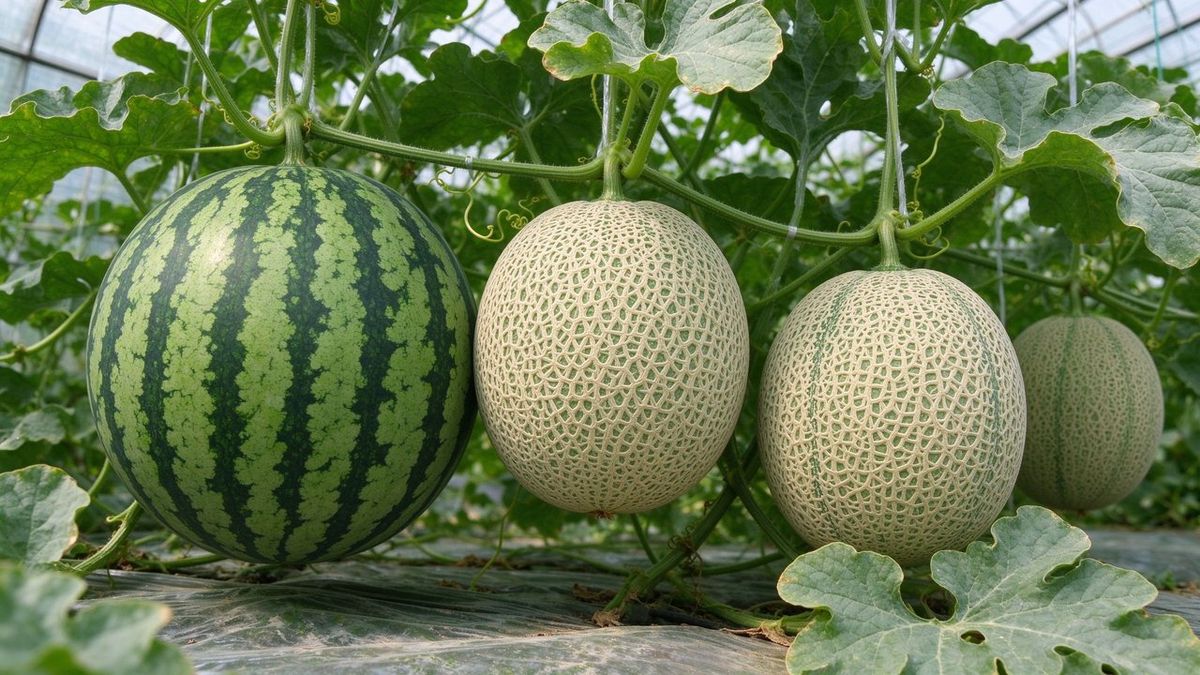
Sugar content, measured as degrees Brix, is the single number that defines melon premium price. A field cantaloupe averages 9 to 10 degrees Brix; a premium greenhouse fruit reaches 13 to 15. The difference is earned in the final 20 days before harvest, through light capture, controlled water stress, temperature differential, and leaf-to-fruit ratio. Growers who treat sugar accumulation as a discrete phase of the crop cycle consistently deliver retail-grade fruit; those who irrigate freely to the very end sell at discount.
Physiology of Sugar Loading
Melon leaves photosynthesise sucrose, which is transported to the fruit phloem and stored in the flesh as sucrose, glucose, and fructose. Until 20 days after pollination, the fruit accumulates mostly water and structural tissue; in the final 20 days, sucrose loading accelerates 5-fold. A single cantaloupe requires 15 to 20 functional leaves to fill one fruit with sugar. Removing leaves below the fruit sinks the source-sink ratio and drops Brix by 1.5 to 2.0 degrees.
Temperature drives enzyme activity. Sucrose phosphate synthase, the key enzyme that loads sucrose into phloem, peaks at 25 to 30 degrees. Night temperature below 15 degrees slows the conversion of starch to sugar; night above 22 degrees causes respiratory loss of 10 to 15 per cent of fixed carbon. The sweet spot is 28 day / 17 night, which is why autumn greenhouse melons often taste better than summer ones — the diurnal differential is naturally wider.
Water Stress Timing
Controlled water stress is the most powerful lever on Brix. After the fruit reaches full size (around 30 days after pollination), irrigation volume is cut by 30 to 40 per cent. The plant responds by closing stomata slightly, which slows vegetative growth and pushes assimilates toward the fruit. Over-irrigated melons stay at 9 to 10 degrees Brix; moderately stressed fruit reaches 12 to 13.
The stress must be carefully calibrated. Too little water causes leaf wilting by midday and stops photosynthesis entirely, which reduces fruit size and produces sunscald. The target is slab weight that drops 25 per cent between irrigations, never more than 30 per cent. A moisture tensiometer at 15 cm depth reads 20 to 30 kPa before irrigation; above 40 kPa, the plant is too stressed. Three days before harvest, water is restored to normal to avoid fruit splitting on the way to the packing shed.
Light, Leaf Area, and Source-Sink Balance
Light integral in the final 20 days directly determines Brix. A daily light integral of 25 to 30 mol/m²/day produces 13-degree-Brix fruit; 15 mol drops to 10 degrees. In winter bays, supplemental LED at 150 micromoles per square metre per second extends the day to 14 hours and closes this gap. Shade screens are kept fully open on sunny days during the sugar phase; leaf temperature may reach 35 degrees but photosynthesis is still positive.
Leaf-to-fruit ratio is managed by pruning. Each fruit requires 15 to 20 leaves; if three fruit are left on a plant, only two reach premium Brix. Standard practice allows one fruit per plant on vertical systems, or two on strong grafted plants. Laterals below the fruit node are retained as the sugar source; leaves above are thinned to keep the canopy open. Yellowing older leaves are removed weekly so photosynthate is not wasted on declining tissue.
Post-Harvest Sugar Retention
Melon sugar is set at harvest; it does not continue to accumulate after picking because the fruit is a climacteric that respires its own sugars. Cantaloupe harvested at half-slip holds 12 to 13 degrees Brix for 10 days at 7 degrees; Honeydew holds 11 to 12 for 21 days. Storage temperature is critical: below 5 degrees, chill injury disrupts cell membranes and causes off-flavours; above 12 degrees, softening accelerates.
Controlled atmosphere storage at 5 per cent oxygen and 10 per cent carbon dioxide extends shelf life by 30 per cent and preserves Brix. Ethylene is kept below 0.1 ppm because it accelerates softening. Samples from each harvest lot are tested with a refractometer; a fruit below 10 degrees Brix is packed into the economy channel, never into premium cartons. This grading discipline protects the grower’s brand and prevents the worst fruit from souring the customer’s impression of the whole pack.
Sugar in melon is earned in the final 20 days: by keeping 15 to 20 healthy leaves per fruit, by running a 10-degree diurnal temperature differential, by cutting water by 30 per cent without wilting, and by never shading the crop when light integral is the limiting factor. A premium Brix of 13 degrees is not luck — it is a phase-managed outcome, measured refractometer lot by lot.


