
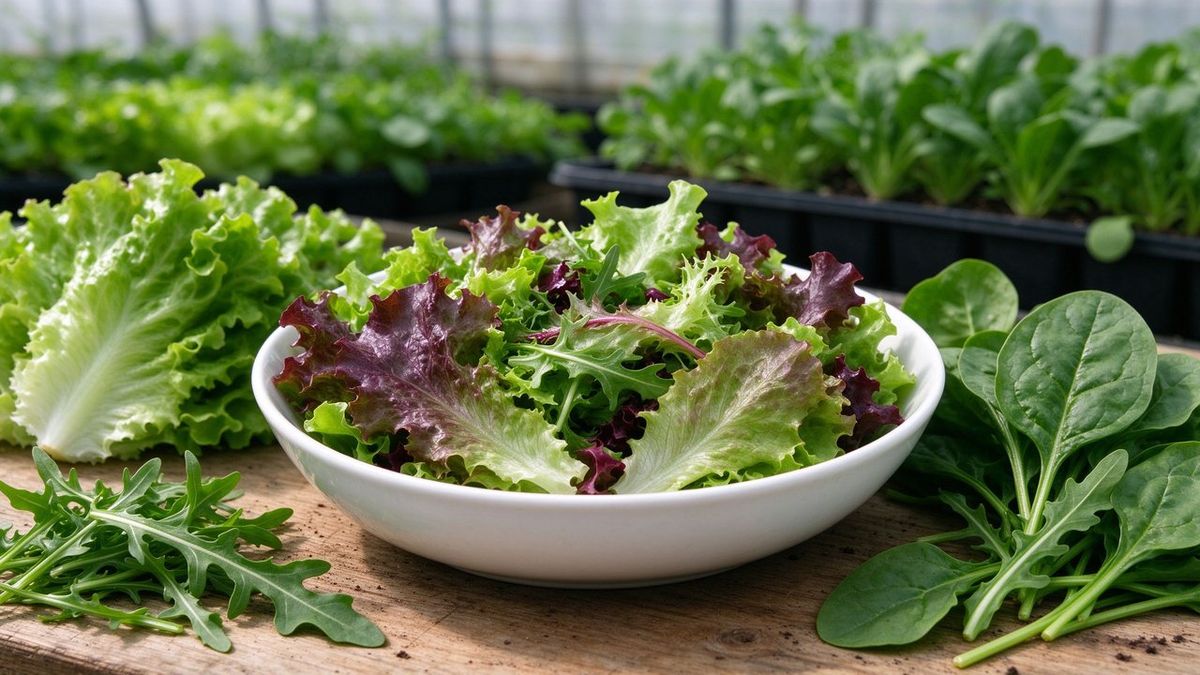
Baby leaf salad is harvested at the 5 to 8 true-leaf stage, 20 to 30 days after sowing, and sold as washed, mixed, ready-to-eat packs. The commercial value is in consistency: leaf size, color, stem length, and mix ratio must be identical pack to pack. Most greenhouse baby leaf is grown on peat or coco benches at 8 to 12 centimeters bed height, using a blend of 6 to 12 species. Yields of 3.0 to 4.5 kilograms per square meter per cycle are standard, with 18 to 22 cycles per year. The main risks are tipburn, bolting, and post-harvest rot from slow cooling.
Mix Design and Variety Blend
A standard baby leaf mix combines 60 percent lettuce (green oak, red oak, Lollo rossa, romaine), 20 percent brassicas (arugula, mizuna, tatsoi, mustard), 10 percent chicories (radicchio, escarole), and 10 percent specialty (basil, parsley, beet, Swiss chard). The blend must mature together; slow or fast varieties within the mix ruin uniformity. Test new blends on a 5 tray pilot for two cycles before committing a full block.
Sow by species on a precision seed drill at 4 to 5 grams per square meter, with rows 7 to 10 centimeters apart. Denser than 6 grams produces thin stems that lodge; thinner than 3 grams gives bare patches. Sow in blocks on a fixed weekly schedule so a 200 square meter bench delivers a fresh cut every Monday. Record mix ratio on the tray label; buyers reject off-ratio packs.
Climate for Baby Leaf
Target air temperature of 16 to 20 degrees Celsius by day and 10 to 12 degrees at night. Above 22 degrees, stems elongate and tipburn rises; below 8 degrees, growth stalls and leaves yellow. Vent when canopy reaches 20 degrees; in summer use 30 to 40 percent shade cloth and evaporative cooling to hold canopy below 24. Run horizontal air flow fans at 0.3 m/s continuously to keep leaves dry.
Relative humidity should stay between 60 and 70 percent. Above 80 percent for more than 10 hours, downy mildew and botrytis appear within 48 hours. Vent for 15 minutes after sunrise to purge condensation. In winter, close vents completely at night and keep minimum above 8 degrees; supplement with 100 to 150 micromole LEDs for 8 hours if daily light integral falls below 10 mol.
Fertigation and Water
Use a dilute nutrient solution at an electrical conductivity of 1.6 to 2.0 mS/cm, pH 5.8 to 6.2. Baby leaf is a light feeder; higher EC produces bitter leaves and excess nitrate. Drip tape every 10 to 15 centimeters delivers 1.5 to 2.0 liters per hour per emitter. Irrigate 2 to 3 times per day, 150 to 200 mL per square meter per event, starting at the two-leaf stage. Stop irrigation 12 hours before harvest so foliage is dry.
Calcium at 140 to 180 mg/L in the feed prevents tipburn on the inner leaves. Magnesium at 40 to 50 mg/L avoids interveinal chlorosis. Test leachate weekly; bed EC should stay within plus or minus 0.3 mS/cm of the feed. If the bed surface crusts, reduce frequency and let the top 1 centimeter dry between irrigations. Replace peat beds every 6 to 8 cycles to avoid pathogen buildup.
Pest and Disease Management
Aphids and whiteflies are the main pests on baby leaf. Release Aphidius colemani at 0.5 per square meter weekly once scouting shows 2 aphids per tray. Cover vents with 40 mesh netting to exclude whitefly. Leafminer flies leave serpentine trails; place yellow sticky cards at one per 15 square meter and release Diglyphus isaea at 0.3 per square meter weekly. Avoid broad-spectrum insecticides within 14 days of harvest.
Downy mildew on lettuce and brassicas is the main disease. Prevent by keeping leaf surfaces dry and by venting after sunrise. Apply a protective copper hydroxide program at 1.5 g/L in the wettest months. Botrytis on red-tinged leaves appears as gray mold; remove infected trays immediately. Do not harvest trays with any visible mold; even a small spot ruins the whole pack.
Harvest, Washing, and Cooling
Cut at 8 to 12 centimeters tall, 20 to 28 days after sowing, with a sanitized knife held just above the bed. Move trays directly to a 4 degree packing room within 30 minutes of cutting. Wash in a flume with 50 to 100 ppm chlorine or peracetic acid at 2 degrees for 60 seconds, then rinse in clean iced water. Spin-dry gently to remove free water; wet packs rot within 48 hours.
Pack into vented bags or clamshells at 100 to 200 grams; mix to the recipe ratio on the label. Shelf life at 1 to 3 degrees is 7 to 10 days. Yield is 3.0 to 4.5 kilograms per square meter per cycle; weekly production on a 200 square meter bench is 600 to 900 kilograms per cycle. Track post-harvest loss; well-run operations keep it below 5 percent. Zhongtian Agricultural Technology supplies climate stations, drip rigs, and evaporative cooling that hold the 16 to 20 degree band and the 1.8 mS/cm feed automatically.
Baby leaf is a consistency business: the same mix ratio, the same leaf size, the same color pack after pack. A tight 16 to 20 degree band, dilute 1.8 mS/cm feed, strict dry pre-harvest, and a 4 degree packing room turn a 25 day sowing into a reliable premium weekly line.


