
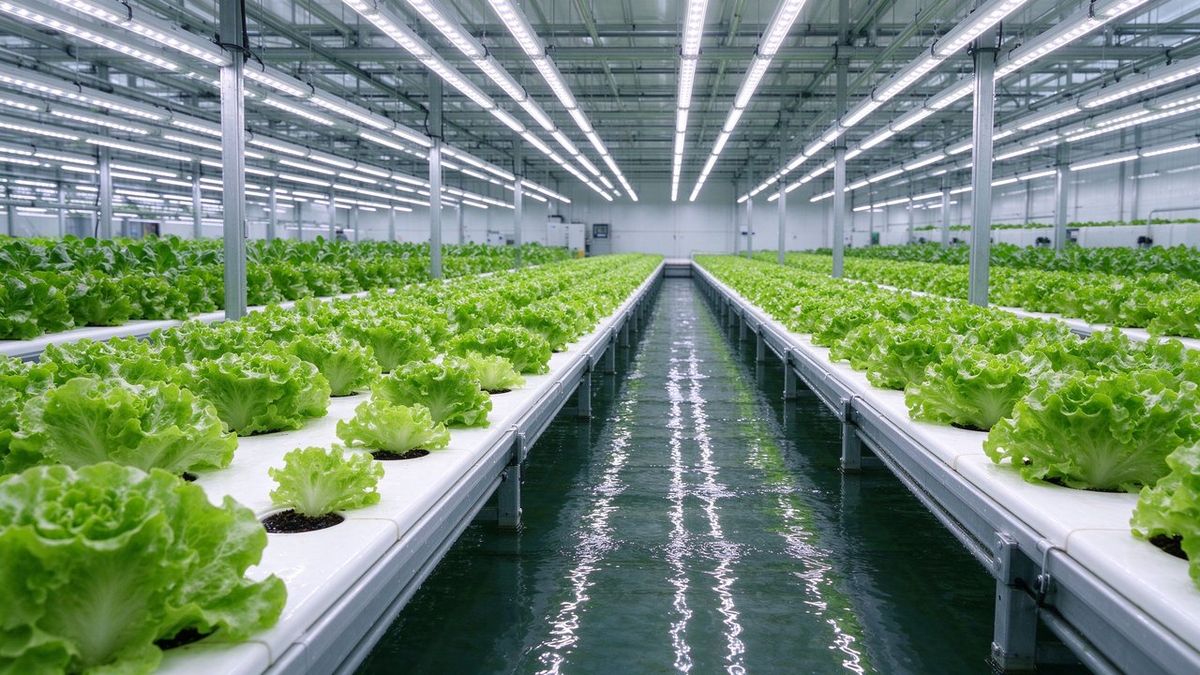
Swiss chard (Beta vulgaris cicla) and beet greens (Beta vulgaris flavescens) are multi-cut leafy vegetables grown for their broad, colorful petioles and tender blades. They tolerate cool and mild heat, recover well from repeated cuts, and produce 8 to 12 kilograms per square meter over a 90 to 120 day planting. Chard is most often sold as a rainbow mix of white, yellow, orange, and red petioles, while beet greens are cut young for salad. The main production risks are leaf miner flies, Cercospora leaf spot, and bolting under long warm days.
Varieties and Planting
Rainbow chard mixes ‘Bright Lights’, ‘Rhubarb Red’, and ‘Fordhook Giant’ are standard for greenhouse production. Beet greens are usually harvested from baby-beet plantings at 25 to 30 days, or from dedicated leaf-beet varieties. Sow seed in cell trays at 2 seeds per cell, thin to one, and transplant at 4 true leaves, 25 by 30 centimeters apart on raised beds or coco slabs. Direct sowing at 3 grams per meter row works for beet greens.
Crop duration to first cut is 35 to 45 days. After the first cut, allow 20 to 30 days between subsequent cuts, depending on temperature. Plan 4 to 6 cuts per planting before the crown becomes woody and yield drops. Stagger plantings by two weeks to keep one block at each stage. Rainbow chard does not require vernalization, so it can be sown year-round in a protected house.
Climate and Light
Chard grows best at 15 to 22 degrees Celsius by day and 8 to 12 degrees at night. It tolerates light frosts and short periods at 30 degrees without bolting, but petioles become fibrous above 28 degrees. Vent when canopy reaches 22 degrees; use 30 percent shade cloth in summer. In winter, close vents at night and keep minimum above 5 degrees; supplement with 100 micromole LEDs for 8 hours if daily light integral drops below 10 mol.
Relative humidity between 60 and 75 percent keeps leaves tender and reduces Cercospora. Run horizontal fans at 0.3 m/s to dry petiole bases after irrigation. Bolting is rare in chard but appears when day length exceeds 14 hours combined with night temperatures above 18 degrees; if a stalk emerges, cut it out at the crown and the plant will continue to produce leaves.
Fertility and Irrigation
Chard is a moderate to heavy feeder. Incorporate 2 kilograms per square meter of decomposed manure before planting and apply a balanced 15-15-15 at 30 grams per square meter. On coco slabs, feed at an electrical conductivity of 2.0 to 2.4 mS/cm, pH 6.0 to 6.5. Beet family prefers slightly alkaline conditions; below pH 5.8, boron uptake fails and internal heart browning appears.
Apply boron at 0.5 to 0.8 mg/L in the feed; chard is one of the most boron-sensitive greenhouse crops. Irrigate drip at 2 liters per hour per emitter, 2 to 3 times per day, 200 to 300 mL per plant per event. Keep root-zone moisture steady; drought stress triggers bolting and fibrous stems. Side-dress with calcium nitrate at 1 g/L through the drip 10 days after each cut to speed regrowth.
Pest and Disease Control
Leaf miner flies (Pegomya betae) tunnel serpentine mines in the leaves. Cover beds with insect net at sowing; place yellow sticky cards at one per 15 square meter and release Diglyphus isaea at 0.3 per square meter weekly once adult flight begins. Aphids colonize the underside of leaves; release Aphidius colemani at 0.5 per square meter. Avoid pyrethroids, which kill the parasitoids.
Cercospora leaf spot appears as small brown spots with red halos in warm, wet weather. Prevent by avoiding overhead irrigation after 15:00 and by removing lower outer leaves at each cut. Apply mancozeb at 2 g/L at the first sign, rotating with azoxystrobin. Downy mildew on beet greens appears as pale patches with gray sporulation; vent aggressively after sunrise and apply copper hydroxide at 1.5 g/L.
Harvest and Yield
Harvest outer leaves by twisting them off at the base, taking 3 to 5 leaves per plant per week, leaving the central heart untouched. Do not shear the whole plant unless it is being grown for baby leaf. Bunches of 250 to 300 grams should be immediately hydro-cooled to 2 degrees Celsius; chard wilts within 4 hours at room temperature. Pack in perforated film at 95 percent RH; shelf life is 10 to 14 days.
Yield is 8 to 12 kilograms per square meter over a full multi-cut planting, with 1.5 to 2.5 kilograms per cut. Water use is 3 to 5 liters per square meter per day. Track average petiole width; buyers reject petioles narrower than 8 millimeters, which usually signals too high density. Zhongtian Agricultural Technology supplies raised-bed benches, drip rigs, and climate controls tuned to hold the 15 to 22 degree band and the 2.2 mS/cm feed with boron supplementation automatically.
Swiss chard and beet greens are forgiving multi-cut crops that reward steady irrigation and careful boron supply. Weekly outer-leaf harvesting, aggressive venting, and disciplined leaf-miner exclusion turn a single 100 day planting into a continuous colorful revenue line.


