
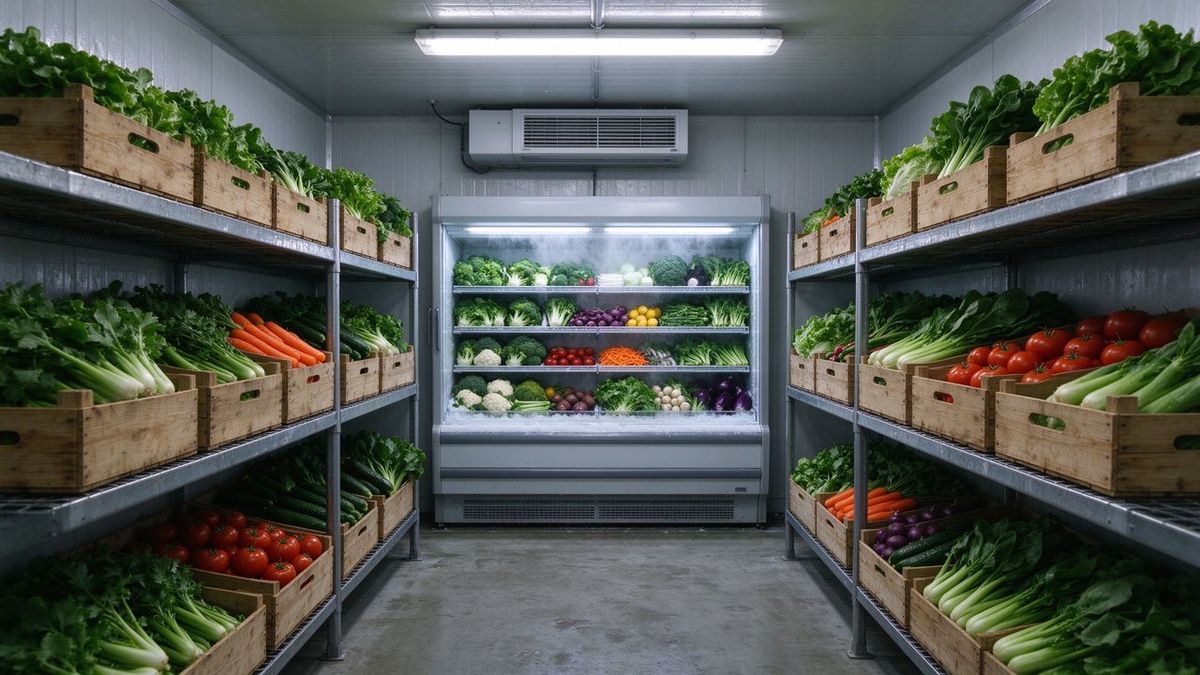
Frigo strawberry plants are field-grown for one season, lifted at dormancy, trimmed, and held in cold storage for up to nine months before planting. The entire protected-culture calendar depends on a chain that never deviates from minus 0.5 to plus 0.5 degrees Celsius. A warm spike of three hours at 5 degrees Celsius breaks dormancy prematurely and causes blind plants; a freeze below minus 2 degrees kills crown tissue. Temperature, humidity, and atmosphere control in storage are therefore as critical as the field production itself.
Lifting, Grading, and Pre-Cooling
Plants are lifted when 80 per cent of leaves have died back and crowns have accumulated 300 hours below 7 degrees Celsius, typically mid-November in northern growing regions. Crowns are graded by diameter: A1 grade 22 mm and above, A grade 18 to 22 mm, and B grade 12 to 18 mm. Greenhouse production demands A or A1; B grade is reserved for garden packs. Leaves are trimmed to 12 cm and roots to 10 cm before packing.
Pre-cooling happens within four hours of lifting: trays of bare-root plants are placed in a forced-air cooler at 0 degrees Celsius with 0.5 m/s airflow until core crown temperature reaches 1 degree Celsius. This takes 8 to 12 hours. Any delay between lifting and pre-cooling allows root metabolism to build heat and deplete stored carbohydrates, reducing field survival by 15 to 20 per cent. Crowns are then packed into 5 kg perforated polyethylene bags in ventilated cartons.
Storage Temperature, Humidity, and Atmosphere
Storage rooms hold minus 0.5 to plus 0.5 degrees Celsius with 90 to 95 per cent relative humidity. Humidity this high demands careful sanitation: walls are lined with food-grade epoxy and floor drains are flooded every 14 days with 1 per cent hydrogen peroxide to suppress Botrytis and Rhizopus. Temperature is logged every 10 minutes by independent sensors; any reading outside band triggers an alarm to the manager’s phone.
Controlled atmosphere storage reduces oxygen to 5 per cent and raises carbon dioxide to 10 per cent, slowing respiration by 40 per cent and extending usable storage from 5 to 7 months up to 9 months. CA rooms are cycled twice daily with fresh air exchanges to prevent ethylene buildup above 0.1 ppm, which causes crown browning. Plants stored longer than 9 months show reduced first-truss yield regardless of CA; calendar planning should avoid stockpiling beyond that horizon.
Dormancy Breaking and Thaw Protocol
Frigo plugs are planted straight from cold without thawing, but bare-root A-grade crowns require a controlled thaw. Cartons are moved from 0 degrees into a 5 degrees Celsius room for 24 hours, then into 10 degrees for another 24 hours, before planting. Rapid thawing at 20 degrees causes condensation on crowns and invites grey mould during establishment. Root-dip in a 0.1 per cent thiophanate-methyl suspension for two minutes immediately before planting suppresses crown rot.
The forcing date is engineered backwards from the target harvest window. Day-neutral frigo plants produce first open flower 35 to 45 days after planting; June-bearers take 50 to 60 days. Planting should occur when root-zone temperature reaches 12 degrees Celsius; planting into colder soil delays establishment by two weeks and produces uneven first flush. Zhongtian Agricultural Technology schedules lifting, storage, and planting as a single chain so that a batch’s planting date is fixed before it enters the cooler.
Crop Quality Checks After Storage
On arrival at the greenhouse, every carton is opened and inspected: crowns should be pale cream, firm, and free of mould. A brown, soft crown indicates chilling injury and the entire carton is rejected. Root tips should be white; black tips indicate desiccation in storage. A quick viability test cuts one crown longitudinally: the vascular ring must be uniformly greenish-white, with no brown streaks.
Establishment monitoring continues for 21 days after planting. Survival above 95 per cent indicates good storage; below 90 per cent points to a storage chain break. Weekly stand counts flag weak bays early so that replugs can be slotted in before the calendar slips. Crowns that show delayed budding more than 10 days after neighbours are removed and replaced, because a late plant in an everbearing bay becomes a disease reservoir rather than a yield contributor.
Cold storage is the calendar spine of protected strawberry. A chain that holds minus 0.5 to plus 0.5 degrees Celsius, 90 to 95 per cent humidity, and controlled atmosphere from lift to planting delivers uniform, high-yielding stands. Every degree-hour deviation shows up later as blind crowns, slow first flush, or disease pressure, which is why temperature logging and carton-level inspection are non-negotiable disciplines.


