
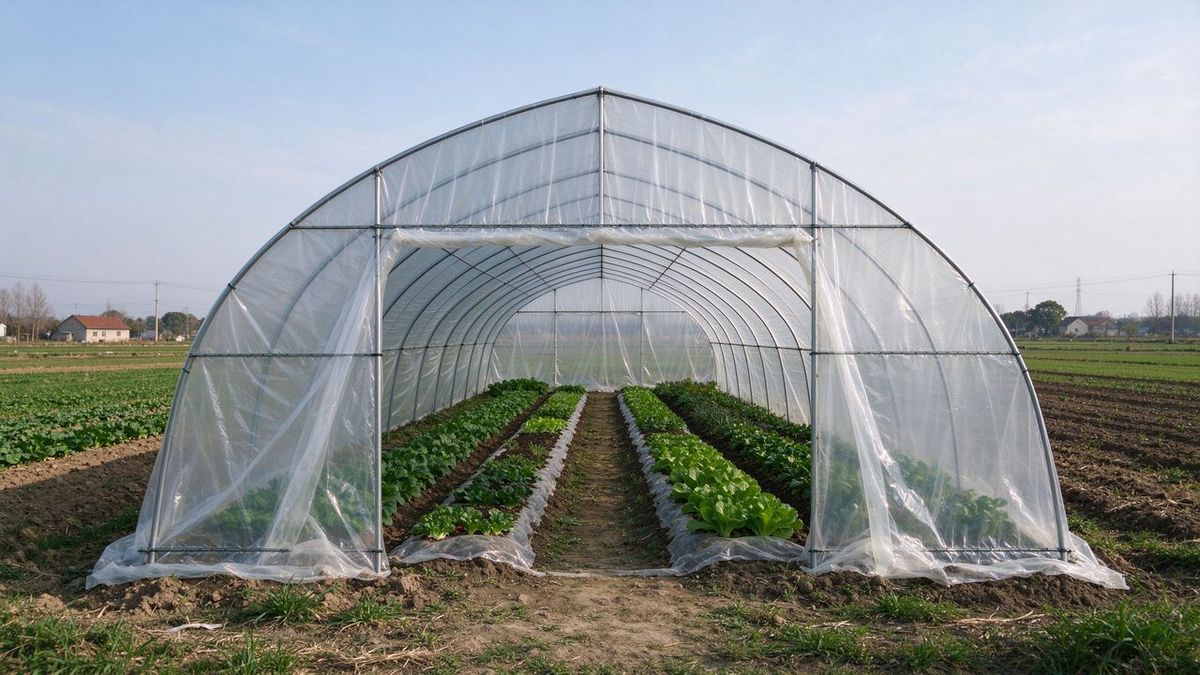
Strawberry high tunnels are poly-covered, quonset-style structures with no active heating, used in mild winter climates to force short-day cultivars into harvest from December through March. Compared with heated glasshouses, tunnels cut capital cost by 60 to 70 per cent and running cost by 80 per cent, but they demand a different climate strategy because temperature can swing from minus 5 outside to plus 25 inside on a sunny day. The crop relies on row covers, ventilated sidewalls, and soil or raised-bed heating cables to hold the narrow temperature band that produces winter fruit.
Tunnel Geometry and Microclimate
A commercial tunnel is 8 m wide and 4.2 m ridge height, covered with 200 micrometre infrared-diffusive polyethylene with a 4-year additive life. Sidewalls roll up to 1.5 m for ventilation, and a 60 cm vent strip runs along the ridge. Internal air temperature on a sunny winter day climbs 15 to 20 degrees above outside, so side ventilation opens automatically at 18 degrees Celsius to prevent leaf scorch. Night temperature inside hovers 3 to 5 degrees above outside under a single layer.
A second-layer inflated poly cover is installed from December through February, raising night temperature by an additional 2 to 3 degrees. Low tunnels of 30 g/m² non-woven fleece are floated over beds on hoops during severe cold snaps below minus 5 degrees outside; this triples the effective insulation over the crop. The combination of tunnel plus low tunnel keeps root zone above 8 degrees even when outside falls to minus 10, which is the survival threshold for strawberry roots.
Bed Preparation and Planting
Beds are formed 30 cm high and 80 cm wide, covered with black or white-on-black mulch depending on season. For winter production, white-on-black mulch reflects light onto lower leaves and keeps soil 2 to 3 degrees cooler in autumn, then warms in winter because the black layer faces soil. Drip tape at 1.0 L/h emitters every 20 cm is laid on the bed centre before mulch. Two rows are planted on 30 cm in-row spacing, offset to 40 cm between rows.
Short-day cultivars ‘Chandler’, ‘Camarosa’, and ‘Jewell’ are preferred for tunnels; they initiate flowers under the autumn short days and respond to tunnel warmth by ripening fruit in December. Tray plants are set in late August to early September, allowing 8 to 10 weeks of runnering and crown thickening before short days trigger flowering. Planting density is 85,000 to 90,000 plants per hectare; higher density suppresses fruit size but spreads harvest across more trusses.
Winter Climate and Irrigation
Winter days require vent management: sidewalls open at 18 degrees, close at 12 degrees. On nights forecast below minus 2 degrees inside, row covers are deployed. Overhead nozzles for frost protection are installed as backup; they activate when air temperature falls to 0.5 degrees and continue until ice glazes clear. Irrigation is short and infrequent: one 10-minute cycle every other morning on sunny days, never on cold wet days. Overwatering in winter drives root disease and slows fruit ripening.
Fertigation is reduced to 1.0 mS/cm EC in winter, with nitrate at 90 mg/L and potassium at 150 mg/L. Leaf tissue sampling in January shows if nitrogen is adequate: target 2.4 per cent dry weight. Pollination in winter is the weakest link: bumblebee hives are less active below 12 degrees, so honeybee hives are added on calm warm days. Misshapen fruit in tunnel strawberry is almost always a pollination problem, not a nutrition problem.
Harvest Timing and Economics
Winter tunnel harvest begins in early December and runs through March, picking every 3 to 4 days. Yields average 1.5 to 2.5 kg per square metre over the season, but average fruit weight is lower than summer because slower ripening concentrates sugars rather than size. Prices in winter are two to four times summer prices, so even moderate yields are profitable. The economic sweet spot is harvest between Christmas and Chinese New Year, when retail prices peak.
The principal risk is a late freeze that kills open flowers. A single minus 4 degree night inside the tunnel can wipe out two weeks of harvest. Growers mitigate with backup heaters (diesel, vented outside) and by keeping row covers ready. After March, sidewalls stay fully open and the tunnel behaves as a shaded nursery; plants are cleared in April to prepare the next summer crop. Tunnel rotation with leafy greens in the off-season improves soil health and spreads fixed costs.
High tunnels make winter strawberry possible without the capital of a heated glasshouse, but they shift risk to weather management. Side ventilation that opens at 18 degrees, row covers for nights below minus 2, and reduced winter EC keep the crop alive and productive. The premium for December fruit justifies the discipline, provided the grower has a frost-backup plan that works when the forecast is wrong.


