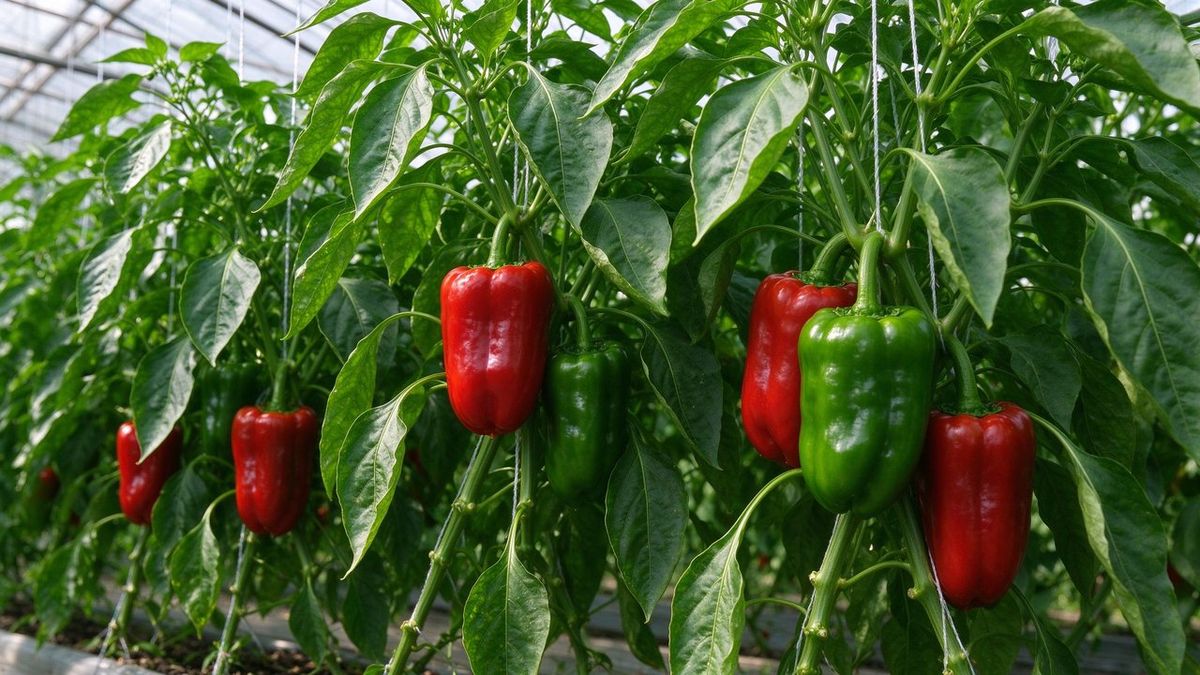
Bell pepper (Capsicum annuum) is the second most important fruiting vegetable in modern greenhouse horticulture, yielding 18 to 25 kg per square metre per year under controlled climate. It is slower than tomato to establish but more tolerant of lower light, and it rewards disciplined pruning, balanced nutrition, and bumblebee pollination with thick-walled, blocky fruit. The essentials span climate, planting density, training, and harvest timing.
Climate Setpoints for Bell Pepper
Day temperature 22 to 26 degrees Celsius, night 18 to 20. Bell pepper sets fruit best at 23 to 25; above 30 degrees fruit aborts and flowers drop, below 15 growth nearly stops. Relative humidity 65 to 75 percent; keep RH below 80 at night to limit Botrytis. Vapour-pressure deficit 0.5 to 0.9 kPa.
Light: bell pepper needs 12 to 15 mol per square metre daily light integral for good fruit colour. In winter, supplemental LED at 180 micromoles per square metre per second for 14 hours lifts yield 20 percent. Shade 25 percent when PAR exceeds 1200 micromoles to prevent sunscald on exposed fruit.
Planting Density and Training
Plant at 2.5 to 3.0 plants per square metre, on rockwool or coco slabs. Train to two to four stems per plant: pinch the growing tip above the 6th true leaf to force two strong branches, then select four stems total. Tie each stem to a vertical twine. Remove all lateral shoots below the first fruit for the first 8 weeks.
Prune lower leaves weekly once the canopy closes. Keep a 30 cm clean stem at the base. Bell pepper does not need as aggressive pruning as tomato; over-pruning reduces leaf area and fruit size. Maintain 3.5 to 4.5 square metres of leaf area per square metre of floor.
Nutrition and Irrigation
Feed EC 2.2 to 2.6 mS per cm, pH 5.5 to 5.8. Nitrate 140 to 170 mg per litre, potassium 200 to 240, calcium 200 to 240, magnesium 40 to 60. Calcium is critical for thick walls; low calcium causes blossom-end rot. Irrigate 1.2 to 1.8 litres per plant per day, pulsed every 45 to 60 minutes during daylight.
Drainage 25 to 30 percent. Check drainage EC daily; if it rises above 3.0, increase leaching. Magnesium deficiency (interveinal yellowing on older leaves) appears quickly; feed magnesium at 50 mg per litre or foliar spray at 0.5 percent magnesium sulphate.
Pollination and Fruit Set
Bell pepper flowers are self-fertile but need vibration for good fruit set. Release one bumblebee hive per 2000 m2 at first open flower. A hive visits 100 to 150 flowers per hour at 22 to 26 degrees. Activity drops below 14 or above 30 degrees, so supplement with electric vibration at midday on cold days.
Fruit set succeeds when the ovary swells within 5 days of anthesis. Expect 15 to 20 percent natural abortion; above 30 percent the climate is too hot or too dry. Remove first two fruit below node 8 to allow the plant to build a strong frame before carrying load.
Harvest Timing and Yield Targets
Harvest bell pepper at the green mature stage for shipping, or leave on the plant to turn red, yellow, or orange for premium price. Fruit takes 45 to 55 days from anthesis to green mature, and another 15 to 20 days to full colour. Cut the fruit with a knife; never twist.
Expected yield: 18 to 22 kg per square metre per year in green stage, or 12 to 15 kg in coloured stage at premium price. Harvest twice per week, 3 to 4 fruit per plant per week at peak. Zhongtian Agricultural Technology targets a 90 percent grade-A rate: blocky, 180 to 220 g, no blossom-end rot, no sunscald.
Bell pepper rewards slow, disciplined management: 24 degrees day temperature, balanced calcium-rich feed, four-stem training, and bumblebee pollination. The 18 to 22 kg per square metre annual yield is predictable once the climate and nutrition bands are held steady across the year.