Perlite slabs and rockwool blocks are the two dominant soilless substrates for greenhouse cucumber, chosen for their inert chemistry, air-filled porosity, and drainage. Rockwool is the long-standing standard for long English cucumbers; perlite slabs and coco coir are close competitors that win on cost, weight, and reuse. Both need precise fertigation to compensate for the substrate’s zero buffering capacity.
Rockwool: Air Porosity and Water Retention
A standard 100 x 20 x 8 cm rockwool slab holds about 5 litres of water at field capacity, with 75 percent of its volume as air pores. Fibres are bonded with a phenolic resin that is naturally alkaline; soak new slabs in nutrient solution at pH 5.5 to 6.0 for 24 hours before planting. Without conditioning the pH drifts to 7.0 and locks out iron and manganese.
Rockwool has zero cation exchange capacity, so every nutrient must come from the drip. Feed EC runs 2.4 to 2.8 mS per cm and pH 5.5 to 5.8. Drainage should be 25 to 30 percent of applied volume. Slabs are single-use: reuse across more than one crop cycle risks root disease carry-over unless steam-treated.
Perlite Slabs and Grow Bags
Perlite is expanded volcanic glass, 3 to 5 mm granule size, packed into 15 litre slabs at a bulk density of 80 to 100 kg per cubic metre. It drains faster than rockwool, holding only 40 percent water at saturation, so irrigation pulses must be more frequent: 8 to 12 pulses per day versus 6 to 8 on rockwool. Perlite is lighter and cheaper, but it compresses over a season and loses air porosity.
Perlite pH is neutral and requires no conditioning, but it has a small cation exchange capacity that binds potassium; raise K in the feed by 10 percent versus a rockwool recipe. Perlite slabs are typically single-use but can be disinfected with hydrogen peroxide at 3 percent for 24 hours between crops.
Coco Coir as a Third Option
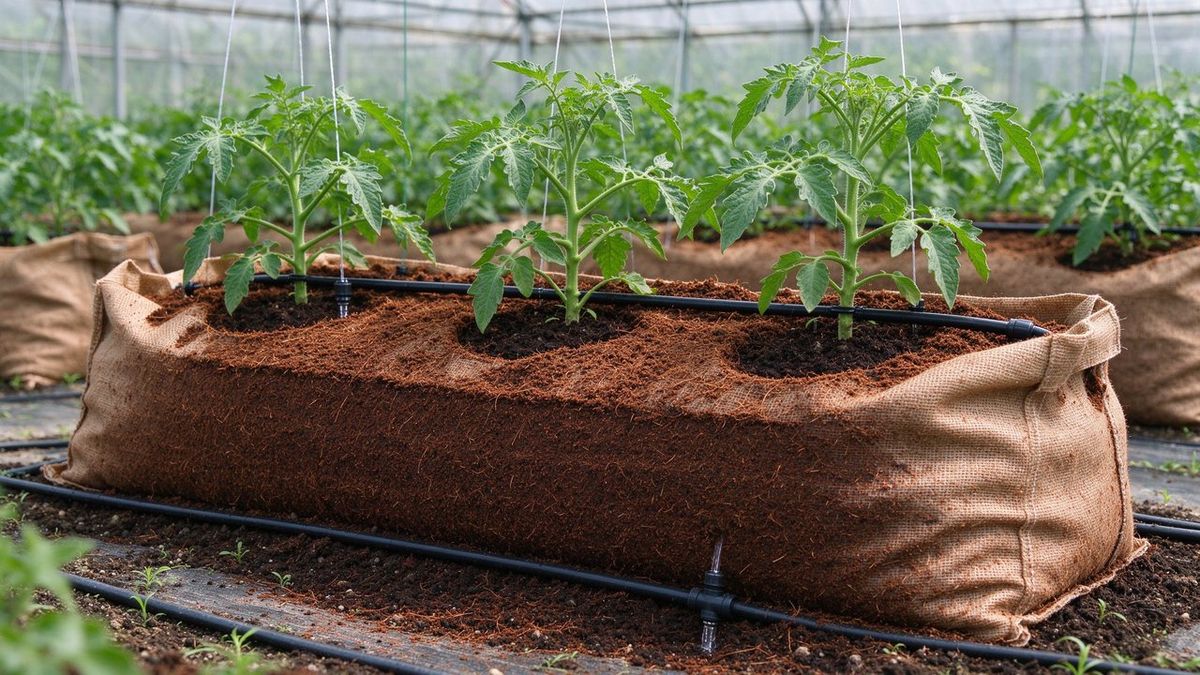
Coco coir slabs have 65 percent air-filled porosity and hold 60 percent water, a middle ground between rockwool and perlite. Buffered coco (washed to remove sodium and potassium) needs extra calcium in the feed because coco naturally binds Ca. Keep calcium at 220 mg per litre, about 15 percent above rockwool rates. Coco also retains iron well, so Fe can be dropped from 20 to 15 micromoles per litre.
Coco is the most forgiving substrate for a new grower: its buffer capacity prevents the sudden EC swings that shock rockwool crops. It is also heavier to handle at installation and takes longer to dry out between crops, so ensure floor drainage underneath.
Emitters and Slab Hydration
Use one 2-litres-per-hour pressure-compensating emitter per plant on slabs; on larger 2.4 plants per square metre blocks use two emitters per slab. Insert the emitter 5 cm into the slab and check the wet pattern by lifting the slab edge after the first week. The wet zone should reach 70 percent of the slab length; a dry core means the emitter is blocked.
Irrigation scheduling: start 1 hour after sunrise, pulse every 45 minutes, stop 2 hours before sunset. Pulse volume 200 to 300 ml per plant. Drainage should reach 25 percent by 14:00; if drainage is below 15 percent at midday, increase pulse size. Use a drainage EC sensor per bay to catch substrate salt buildup.
Disinfection and End-of-Crop Protocol
At crop end, pull all slabs and bag them. Do not leave old slabs on the floor; they harbour Pythium and Fusarium spores for months. Rockwool slabs are sent for recycling or landfill; perlite can be steam-treated at 95 degrees for 30 minutes and reused once. Coco coir can be composted on site after heat treatment.
Between crops, clean the floor with 1 percent bleach and run a 48-hour empty period at 40 degrees Celsius to drop pest populations. Zhongtian Agricultural Technology prefers rockwool for long English cucumbers in high-value blocks and uses buffered coco for mini cucumber blocks, balancing cost, weight, and the forgiving buffer that reduces nutritional mistakes.
Rockwool remains the standard for long cucumbers, but perlite and buffered coco are valid alternatives that trade cost against management precision. Whichever substrate is chosen, conditioning, drainage monitoring, and single-use discipline are non-negotiable.