
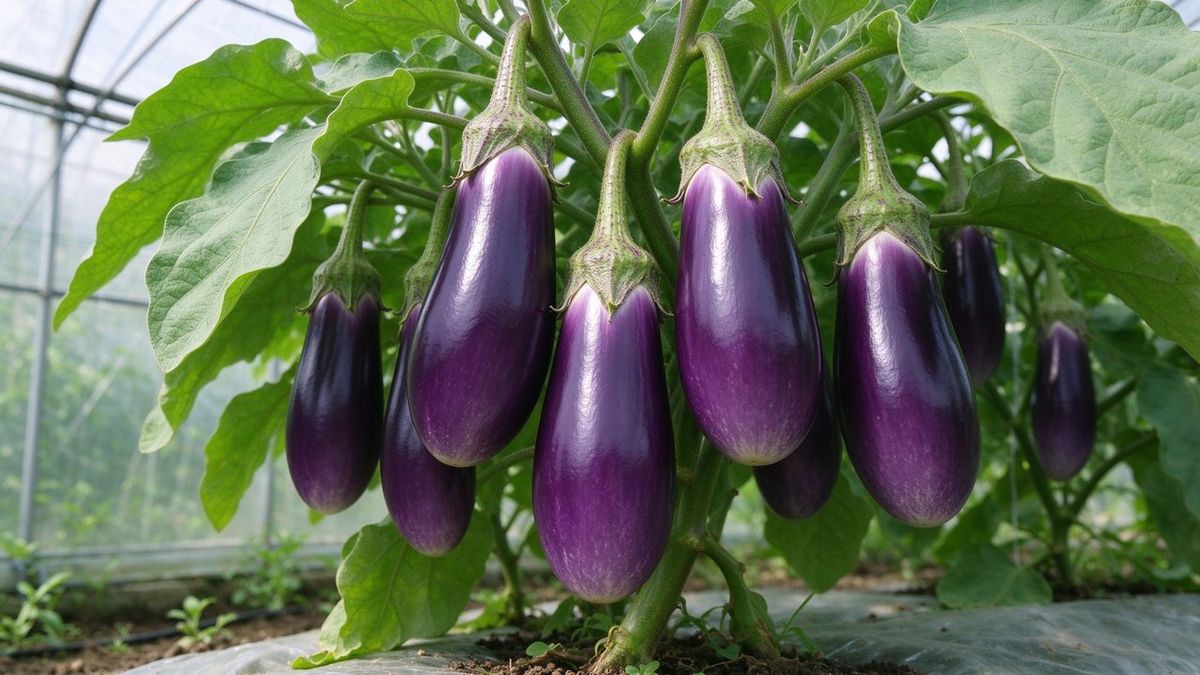
Eggplant, Solanum melongena, is a warm-season protected crop that rewards a long, stable cycle: 120 to 150 days from seed to first harvest, with production continuing for 6 to 9 months. Unlike peppers, eggplant is a heavy feeder and a vigorous grower, reaching 1.8 meters on a high-wire trellis. The commercial program at Zhongtian Agricultural Technology averages 6 to 8 kg of fruit per square meter over an eight-month cycle, with fruit weight of 350 to 450 grams. This article walks through propagation, transplanting, training, and the harvest rhythm.
Propagation and Seedling Stage
Eggplant seed has a 5 to 7 year viability but germinates slowly: 10 to 14 days at 28 to 30 degrees Celsius, dropping to 20 days below 25. Sow into 128-cell trays filled with a 1:1 peat and perlite mix, one seed per cell, covered with 5 millimeters of vermiculite. Keep the medium at 25 to 28 degrees Celsius by day and 22 degrees Celsius by night, and maintain 90 percent relative humidity until emergence. Once the first true leaf expands, drop night temperature to 18 degrees Celsius to avoid leggy transplants.
Transplant-ready seedlings are 35 to 45 days old, with 4 to 5 true leaves, a 3-millimeter-thick stem, and a root ball that holds together when pulled from the cell. Do not hold seedlings in trays beyond 50 days, because they become root-bound and stunted after transplant. Fertilize trays weekly with calcium nitrate at 0.5 grams per liter plus a complete trace-element mix; EC of the tray leachate should be 1.2 to 1.5 mS per centimeter.
Transplanting and Establishment
Transplant into coco-coir bags or sterilized soil beds at a density of 1.6 to 2.0 plants per square meter, on 1.2-meter row centers and 0.45 meters within the row. Plant at the same depth as in the tray; burying the stem can cause stem rot. Irrigate immediately with a starter solution of 0.5 grams per liter calcium nitrate plus 0.1 milliliters per liter of rooting vitamin mix, 200 milliliters per plant.
Root-zone temperature must stay at 20 to 22 degrees Celsius for the first two weeks. Below 16 degrees Celsius, transplant shock lasts 10 to 14 days and the early fruit set is lost. Air temperature should be 25 to 28 degrees Celsius by day and 20 degrees Celsius by night for the first week, then drop to 23 to 26 by day and 18 by night. Relative humidity at 70 to 80 percent reduces transplant stress.
Training and Canopy
Eggplant is trained to a single or double stem on a vertical string at 2 meters height. With the single-stem system, all laterals are pinched at the first leaf above the flower, giving 1.8 to 2.0 plants per square meter. With the double-stem system, two strong branches are retained above the first bifurcation and the density drops to 1.4 plants per square meter. The single-stem system gives earlier, more uniform fruit and is preferred for greenhouse production.
Remove the first flower and the two adjacent suckers so the plant builds vegetative mass before fruiting. From the second flower onward, retain one fruit per leaf axil; pinch the lateral above the fruit to one leaf. Lower leaves are stripped two per week once the first fruit reaches 15 centimeters length. Rewrap the stem on the string every 10 days to prevent girdling as the stem thickens to 15 millimeters.
Nutrition and Irrigation
The base nutrient recipe for eggplant targets EC 2.6 to 3.0 mS per centimeter and pH 5.5 to 5.8. Macronutrients in millimoles per liter: 13 nitrate-N, 1.0 ammonium-N, 1.3 phosphorus, 7.0 potassium, 4.5 calcium, and 2.2 magnesium. Eggplant is a heavy potassium user; tissue potassium at mid-fruit should read 4.5 to 5.5 percent dry weight. During the first four weeks after transplant, run EC at 2.0, then ramp up by 0.2 per week to 2.8.
Irrigation pulses are 300 milliliters per emitter at 2 liters per hour, triggered by a light integral of 2.0 megajoules per square meter, with run-off stabilized at 25 to 30 percent. Irrigation stops 2 hours before sunset. In winter, pre-heat nutrient solution to 20 degrees Celsius. Monitor run-off EC daily; if it rises above 3.5 mS per centimeter, leach with clear water for 30 minutes.
Climate and Pollination
Optimal air temperature is 25 to 28 degrees Celsius by day and 18 to 20 by night. Above 32 degrees Celsius, pollen viability drops and fruit becomes seedless and puffy; below 15 degrees Celsius, pollen does not release and fruit sets poorly. Ventilation opens at 28 degrees Celsius; shade screens deploy at 650 watts per square meter. Vapor-pressure deficit should be 0.8 to 1.2 kilopascals.
Eggplant flowers are self-fertile but need vibration to release pollen. Introduce bumblebee hives at 10 percent open flowers, at a density of one hive per 2,000 square meters; bumblebees work eggplant well because their buzz-pollination matches the flower’s pollen-release mechanism. Alternatively, vibrate flower trusses with an electric pollinator wand at 90 hertz every other morning between 09:00 and 11:00.
Harvest Rhythm
Fruit is harvested 20 to 25 days after pollination, when the skin is glossy and the fruit gives slightly to thumb pressure. Cut the fruit with a knife, leaving a 2-centimeter calyx; never twist, because that tears the stem. Harvest twice a week at peak load, picking 3 to 5 fruit per plant per week. Average fruit weight should be 350 to 450 grams; oversize fruit above 600 grams is woody and culled.
After the eighth week of harvest, productivity per node declines. Lower the plant by unwinding it from the string, and start a new upward growth from a retained lateral. This lowering cycle extends the productive life to 8 to 9 months. At end of cycle, strip the plants, solarize the substrate, and disinfect the gutters.
Greenhouse eggplant is a long-cycle, high-yield crop that rewards disciplined propagation, single-stem training, and a potassium-heavy nutrition program. From seed to first harvest in 120 days, with EC ramping from 2.0 to 2.8, bumblebee pollination, and twice-weekly harvest, commercial blocks deliver 6 to 8 kg per square meter over eight months. The combination of root-zone warmth at transplant and a balanced 25-to-28-degree-Celsius climate is what separates profitable blocks from marginal ones.


