
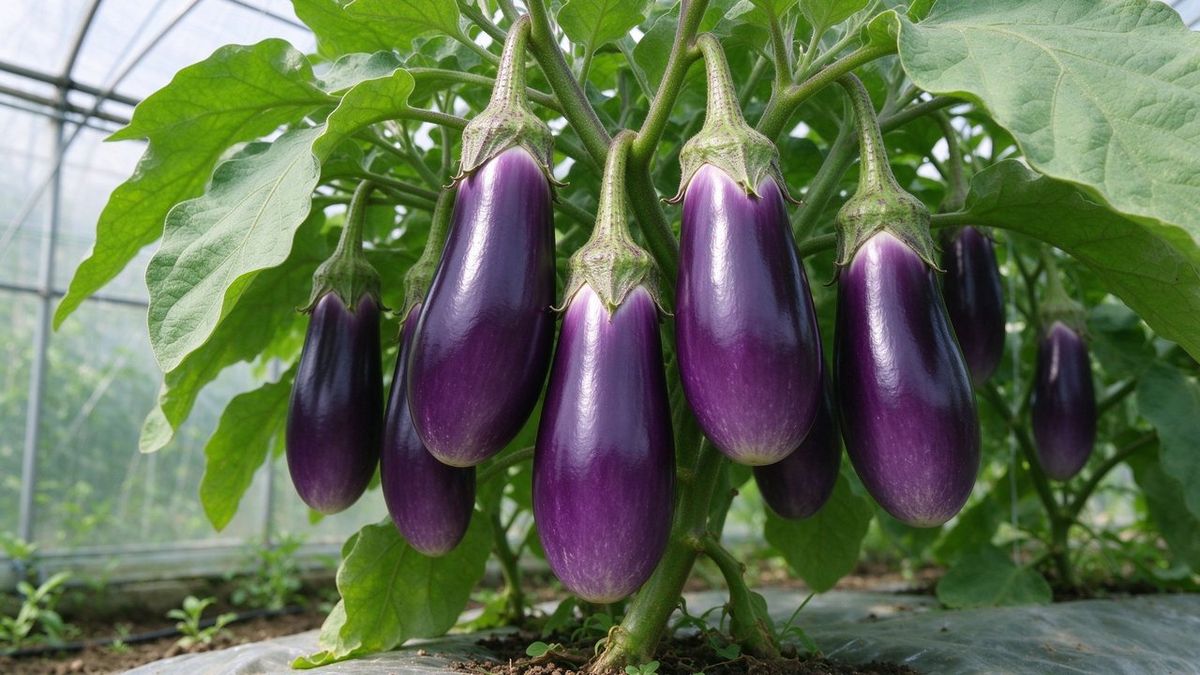
Variety choice determines 40 percent of the final yield and quality of a greenhouse eggplant crop. Protected cultivation demands cultivars with short internodes for high-wire training, parthenocarpic tendency for cool or hot spells when pollinators are inactive, resistance to Verticillium and Fusarium, and fruit that holds gloss and firmness for 14 to 18 days. This article compares the four commercial classes of eggplant, the key traits to screen, and the regional recommendations used at Zhongtian Agricultural Technology for spring, autumn, and year-round protected cycles.
The Four Commercial Fruit Types
Globe-shaped purple eggplants, the classic Western type, weigh 350 to 500 grams with a round to oval fruit 15 centimeters long. They are preferred for European and North American markets and have a glossy, deep purple skin. Long Asian-type eggplants are 25 to 35 centimeters long, weigh 200 to 300 grams, and are thinner-skinned; they command premium prices in Asian retail and require gentler handling because the skin scratches easily.
Semi-long oriental types, intermediate between globe and long, weigh 250 to 350 grams and have a calyx that stays green and attractive. Small white or oval eggplants are specialty items for chefs and are grown on a smaller scale. Choose fruit type by the target market before considering other traits; all other selection criteria follow from that decision.
Key Traits to Screen
Disease resistance is non-negotiable in long-cycle protected production: look for resistance to Verticillium dahliae (Ve gene), Fusarium oxysporum f. sp. melongenae, and root-knot nematode Meloidogyne incognita. A cultivar without Verticillium resistance will decline sharply after month four. Leaf and calyx color should be dark purple, which signals anthocyanin production and correlates with fruit skin depth.
Fruit set under stress is the second most important trait. Parthenocarpic or semi-parthenocarpic cultivars set fruit without pollination when temperature exceeds 32 degrees Celsius or drops below 16, avoiding the misshapen, seedless puffy fruit that otherwise appears. Fruit calyx should be small and green, not large and spiny, because a spiny calyx scratches neighboring fruit in the carton. Fruit shelf life should exceed 14 days at 10 degrees Celsius.
Spring, Autumn, and Year-Round Cycles
For a spring cycle transplanted in February and harvested May through September, choose cultivars with strong early vigor and tolerance to low light: long-cycle Italian types that set fruit at 18 degrees Celsius night. For an autumn cycle transplanted in July and harvested September through December, choose heat-tolerant cultivars that set fruit above 32 degrees Celsius; summer-sown eggplant often fails on cultivars bred for cool spring production.
Year-round production in northern glasshouses needs cultivars that tolerate both low winter light and high summer heat. Semi-long oriental hybrids with intermediate resistance to both temperature extremes are preferred. In southern China, where winter is mild, a single long cycle from September to June works best, using cultivars that hold fruit quality at 25 degrees Celsius winter nights. At Zhongtian Agricultural Technology, each block is trial-planted with two cultivars side by side for one cycle before full commitment.
Yield and Quality Benchmarks
A good protected-crop hybrid should deliver 6 to 8 kg per square meter over an eight-month cycle, with 80 percent of fruit in the 350 to 450 gram Class A range. Average fruit weight should not drop below 280 grams by month six, which signals the cultivar is losing vigor. Skin gloss should hold for 14 days after harvest at 10 degrees Celsius; cultivars that dull within 7 days are not suitable for long-distance retail.
Internal quality matters: cut fruit cross-section should show a compact seed cavity with less than 20 hollow space, and seed count should be below 300 per fruit. High seed count correlates with rapid flesh toughening. Taste panels rate eggplant by bitterness from solanine; cultivars with high-nitrogen uptake produce fruit that tastes bitter when picked over-ripe.
Source and Seed Quality
Buy seed from reputable breeders and keep germination records; eggplant seed loses 10 percent viability per year in cool dry storage. Treat seed with hot water at 52 degrees Celsius for 20 minutes to eliminate bacterial canker and Phomopsis before sowing. Do not save seed from hybrid cultivars, because second-generation segregation destroys fruit uniformity and disease resistance.
Before committing a full block, order a trial packet of 100 to 200 seed, grow 20 plants alongside the current cultivar for one cycle, and record fruit count, weight, disease pressure, and shelf life. A 10 percent yield advantage justifies switching; a 5 percent advantage plus a quality improvement justifies it. At Zhongtian Agricultural Technology, variety trials are repeated every three years as new hybrids enter the market.
Variety selection in protected eggplant is a balance of market type, disease resistance, stress tolerance, and shelf life. Match the fruit shape to the retail channel, require Verticillium and Fusarium resistance, and choose cultivars that set fruit under the temperature extremes of your specific cycle. A one-cycle side-by-side trial before full commitment, followed by a three-year refresh, keeps the variety mix productive and matched to the market. The 40 percent yield and quality contribution from variety choice is the highest-return decision in the whole crop plan.


