
Eggplant fruit set collapses when greenhouse temperatures exceed 32 degrees Celsius during flowering: pollen becomes non-viable, the style fails to fertilize ovules, and the few fruit that do set are puffy, seedless, and misshapen. In hot-summer protected culture across central and southern China, fruit set in July and August can drop by 60 to 70 percent without intervention. This article covers the climate levers, cultivar choices, and pollination practices that growers at Zhongtian Agricultural Technology use to hold fruit set above 80 percent even when peak daytime temperature reaches 35 degrees Celsius.
Why Heat Breaks Fruit Set
Eggplant pollen is viable between 20 and 30 degrees Celsius. Above 32 degrees Celsius, pollen grains burst and lose 90 percent of fertility within two hours; even if pollination occurs, high night temperature above 22 degrees Celsius causes ovule abortion. The result is a hollow, puffy fruit with a small seed cavity and thin flesh — commercially culled.
High heat also desiccates the stigma: relative humidity below 55 percent dries the stigmatic surface, so even viable pollen fails to germinate. Vapor-pressure deficit above 1.5 kilopascals causes stomatal closure and reduces the sugar supply to the developing fruit. The combination of heat and dry air is far more damaging than heat alone.
Cooling the Greenhouse
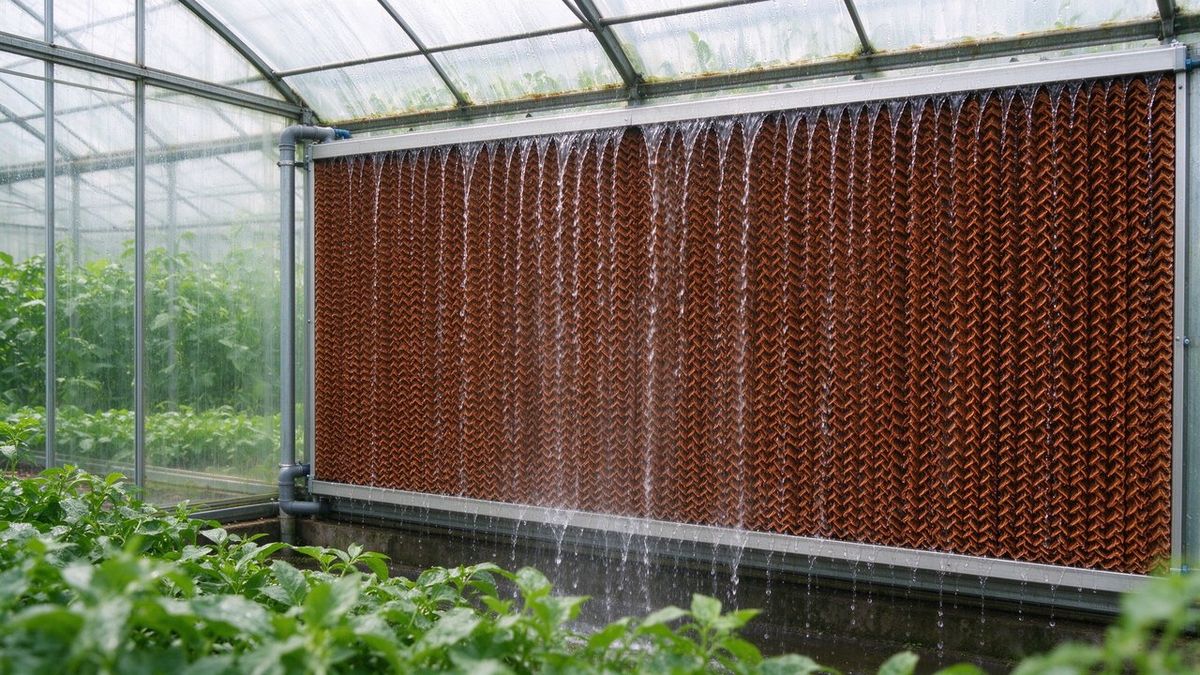
Wet-pad and fan cooling is the workhorse: a 10-centimeter cellulose pad on one gable and exhaust fans on the opposite gable, sized at one air change per minute, drops air temperature by 6 to 8 degrees Celsius below ambient when relative humidity is below 70 percent. Pad water is recirculated at 4 liters per minute per meter of pad length; clean the pad monthly with 1 percent vinegar to remove mineral scale.
External shade cloth of 30 to 40 percent density, deployed when external radiation exceeds 600 watts per square meter, reduces fruit-zone temperature by another 3 to 4 degrees Celsius. Paint the roof with a 5 percent whitewash in July; wash it off in September. Run cooling pads only when outside temperature exceeds 28 degrees Celsius, because running them too early in the season over-cools the crop and delays growth.
Irrigation and Canopy for Cooling
Keep root-zone temperature below 24 degrees Celsius by shading substrate, running nutrient solution through a chiller, and irrigating more frequently with smaller pulses. A hot root zone above 26 degrees Celsius suppresses water uptake even when soil is wet, triggering internal water deficit that mimics drought. Irrigate at 25 percent run-off and maintain dissolved oxygen above 6 mg per liter.
A dense leaf canopy shades the fruit and lowers fruit temperature by 4 to 5 degrees Celsius, but must not be so dense that air circulation drops below 0.2 meters per second. Leave 25 to 30 leaves per plant; strip lower leaves only once fruit is harvested. Avoid heavy pruning in July, because the remaining leaves are the crop’s natural cooling system.
Pollination Under Heat
Bumblebees stop foraging above 30 degrees Celsius, so in hot greenhouses they are unreliable. Switch to mechanical vibration: use an electric pollinator wand at 90 hertz on the flower truss every other morning between 08:00 and 10:00, when pollen is most receptive. Vibrate for 2 seconds per truss; more than that damages the style.
Parthenocarpic cultivars set fruit without pollination and are the most reliable option for hot summer cycles. Choose hybrid lines bred for high-temperature fruit set; these produce marketable fruit even when no pollen is viable. Alternatively, spray open flowers with 10 parts per million of 4-chlorophenoxyacetic acid within 24 hours of flower opening; this triggers parthenocarpic fruit set but must be applied at 08:00 when the plant is turgid, to avoid leaf epinasty.
Nutrition and Fruit Quality
High heat raises transpiration and nutrient demand. During July and August, raise potassium by 15 percent from the base recipe and add extra calcium at 5.0 millimoles per liter to prevent blossom-end rot on the new fruit. Run EC at 2.4 to 2.6 rather than 2.8, because high EC under heat stress causes salt burn on young leaves.
Foliar feeding with 0.2 parts per million of brassinolide at 7-day intervals during heat waves helps the plant maintain cell membrane integrity. Do not over-apply nitrogen in summer, because lush growth under heat becomes soft and disease-prone. Monitor fruit for puffiness weekly: if more than 5 percent of new fruit is hollow when cut, raise night ventilation to drop night temperature below 22 degrees Celsius.
End-of-Heat Transition
As outside temperature drops below 30 degrees Celsius in September, back off the cooling pads and shade, return to bumblebee pollination, and raise EC back to 2.8. The transition week is critical: do it gradually over 5 to 7 days, because a sudden warm-up after weeks of cooling causes flower drop on the next two clusters.
Record weekly fruit set rate per block: the number of fruit reaching 5 centimeters per 10 open flowers. A target above 70 percent means the cooling program is working. At Zhongtian Agricultural Technology, blocks that drop below 50 percent fruit set in July are flagged for cultivar switch the following year.
Fruit set in hot greenhouses is held above 80 percent by combining wet-pad cooling, 30 percent external shade, chiller-controlled root temperature, and either parthenocarpic cultivars or mechanical vibration. Do not rely on bumblebees above 30 degrees Celsius, and keep potassium and calcium elevated while EC drops to 2.4 to 2.6. Weekly fruit-set tracking identifies blocks that need cultivar change before the next summer cycle.


